Pages

Tuesday, September 9, 2008

Kyoto - Restaurant Reviews

I always handpick our restaurant visits before every trip to Japan, always doing my share of homework on peoples' recommendations beforehand. At Kyoto we visited a number of restaurants, and as usual a few were excellent while some were frankly forgettable. This article will review only those I can truly recommend -- no need to waste everyone's time.


Food Review: IDZUJU (Higashiyama District, Kyoto)
Address: Kyoto-shi Higashiyama-ku Gion-cho Kitagawa 292-1
Hours: Daily 11:30-20:00 except Wednesdays
Website/Map: From Yahoo Japan (in Japanese only)
Directions: Easy. It's across the street from the Yasaka Jinja shrine, at the northwest street corner.

This is a hundred-year-old Kyoto-style Sushi restaurant at the heart of the tourist district of Gion, and one of the most anticipated restaurant visits on our trip.

Like most Sushi lovers around the world, my concept of Sushi had been largely influenced by Edomae-zushi (Tokyo-style) -- the Nigiri-zushi with a piece of irregularly cut Neta (topping) on top of a hand-shaped ball of rice. But prior to our trip I've known that the Kansai region still serves an archaic, completely different style of Sushi, and so we made very sure to visit a traditional and reputable Kyo-zushi restaurant at Kyoto's historic Higashiyama District.

With this criteria we narrowed the list down to three choices:
1) IDZU - the grand-daddy of Kyo-zushi restaurants established in 1781. Most expensive of the three.
2) IDZUJU - the offshoot of Idzu at "only" 100-years-old, but reputes to uphold the original recipe passed down from Idzu. Naturally it's cheaper than Idzu.
3) YAGURA-ZUSHI - A 250-year-old Sushi-ya situated right beside Minamiza Theatre. Seems to be less famous than the other two, and priced about the same as Idzuju.
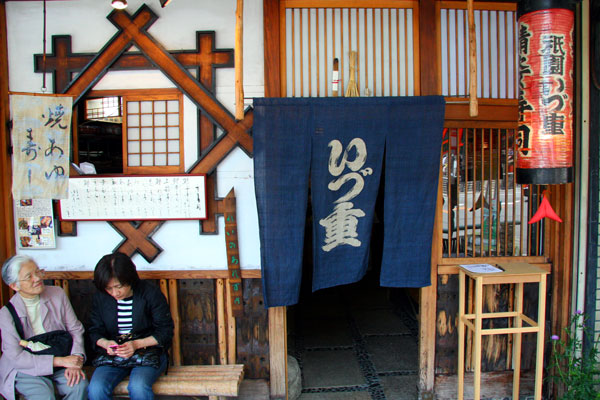


We picked Idzuju mainly because of the promise of the "original recipe" at a cheaper price, and also due to its convenient location right across from Yasaka Jinja shrine. At a glance it looked just like any neighborhood Sushi-ya, but looking closely one could see the red lantern advertising traditional "Saba Sugata-zushi", and the white cloth screen advertising the seasonal specialty of "Yaki Ayu-zushi". At this point I reasoned that if they're bold enough to advertise it outside their shop, that's what we should have.


No language barriers for 99% of tourists as far as ordering food is concerned -- the menu was written in at least four languages that I could see -- Japanese, English, French, Chinese, and occasionally even German, Spanish and Turkish! For instance Sawara was translated to "Spanish Mackerel", "Thazard Oriental", and "Carite Oriental".

As we wanted to sample the most traditional of Kyo-zuzhi, we ordered the prominently advertised Saba Sugata-zushi and Yaki Ayu-zushi, along with another Kansai specialty, the Hako-zushi (box-pressed sushi).


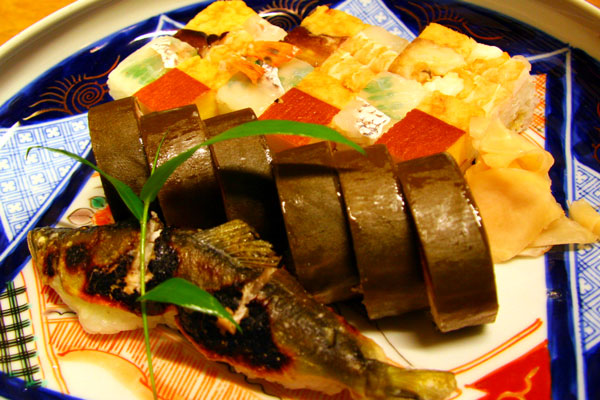
After a short 10 minutes arrived their most famous dish, the "original recipe" passed down from Idzu -- the Saba Sugata-zushi. In simple terms it was six pieces of cylindrical sushi, consisting of soft vinegared rice stuffed inside half a mackerel, then wrapped in Konbu seaweed and bamboo skin, and cured overnight.

I don't want to understate the risk I was taking -- my wife NEVER eats Saba at Sushi restaurants outside of Japan. Period. As any fan of Japanese cooking knows, Saba is an oily fish with a fairly strong taste, and goes bad very quickly -- in fact in Japan it's joked that Saba starts to go bad when it's still alive. Naturally I was worried about the effect of leaving Saba overnight for the curing, but I also reasoned that this has been one of Kyoto's famous dishes for centuries and therefore a must for a self-declared food junkie like myself. If my wife stopped after one bite, well ... I was prepared to finish the other five-and-a-half pieces.


Compared to modern Nigiri-zushi and its reliance on the freshness of ingredients, Sugata-zushi is a much older method of fish-preservation from an age without refrigeration and preservatives. The meticulous procedure requires taking a whole fish to clean, debone, and then stuff with vinegared rice, such that the original shape of the fish is presented in front the the client's eyes. This is what "Sugata" (appearance) means.

My wife took the first bite.

"Ummm you should try this it's really good!" I heard almost in disbelief, for I have never seen my wife enjoying ANY form of Saba sushi before or ever since. The fermentation process had miraculously mellowed out the strong fishy taste of the Saba, producing a mild, tender, slightly oily flesh. And the rice was no less amazing, having transformed into a buttery soft cake of semi-glutinous starch. In other words, perfection.

So there IS something special about the time-honoured recipe. According to their pamphlet they're still using "resident Saba" off the waters of Tsushima, top quality Hanabishi vinegar, and bamboo skins from Takefu -- I have no idea what these ingredients are, but it just shows the kind of committed obstinacy towards the upkeeping of traditional excellence.


After that it was time to move onto another classic Kansai specialty -- a colorful mosaic of rectangular-shaped, box-pressed Deluxe Hako-zushi. Here I counted six ingredients -- broiled Hamo (pike eel), Ebi, Tamago, Torigai, Tai and Kinome (the young leaves of Sansho pepper).

The emphasis of the dish seems to be the subtle combination of ingredients -- from the delicate Torigai and Ebi, to the refreshing Tai / Kinome, and finally to the sweet-flavored broiled Hamo and Tamago omelette.

My favorite was the Tai / Kinome combination, and of course it's just as delightful to look at. Nevertheless I think I still prefer Edo-mae (Tokyo-style) sushi's focus on absolute freshness. I'm not saying this wasn't fresh -- it's still very good in fact, just not spectacular.


Available from May to September only, this Yaki Ayu-zushi was a whole Ayu (sweetfish) lightly salted and char-broiled, then placed on top of two Nigiri style sushi rice balls. I just can't resist whatever is considered "in season" for traditional Japanese cuisine whenever we travel to Japan, but frankly this wasn't as special as I had hoped for.
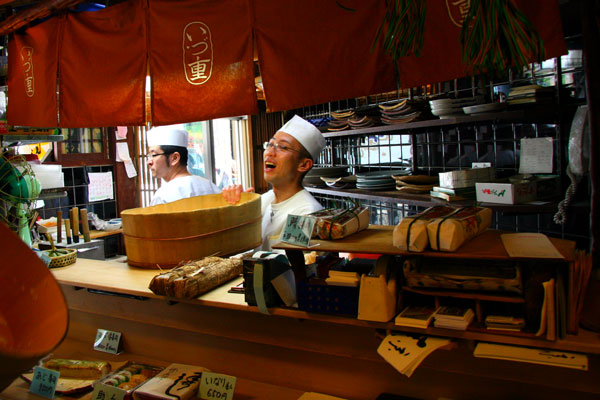


Overall it was the most traditional experience for Kansai-style Sushi, and if we were to go back to our townhouse right away I would have bought a pack of Inari Sushi (650 yen) for take-out. And largely due to the absolutely incredible Saba Sugata-zushi, it was quite a memorable meal.

Bill for Two Persons
Saba Sugata-zushi1900 yen
Deluxe Hako-zushi1500 yen
Yaki Ayu-zushi850 yen
TOTAL4250 yen (CAD$43)


Food Review: KATSUKURA (Kyoto Station Branch)
Address: Kyoto-shi Kyoto-Eki-Biru The Cube 11F
Hours: Daily 11:00-22:00
Website/Map: Official Site (in Japanese only)
Directions: You can't miss it -- it's right on top of the Kyoto Station, inside the shopping centre complex on the 11th Floor. Just go to the Isetan Department Store, then take the elevator there up to 11th Floor.


No prestigious historic restaurant this time -- actually it's arguably one of the most popular Tonkatsu chains in Japan. You must be wondering why I'm writing review for a chain outlet, but the reason is, I think this really was an excellent value for my money. Still in doubt? Just look at the huge line-up of Kyoto-ites waiting to get in.

Although Kyoto's cuisine is mostly known for refined traditional fare such as Tofu and local vegetables in elaborate Kaiseki presentation, the ancient capital has also produced this excellent chain for Yoshoku (Japanese-Western fusion). The word "Tonkatsu" itself is an amalgamated term from Ton (pork) and Katsu-retsu (Japanized pronunciation for "Cutlet"), and as the name suggests, it's the popular Japanese version of Schwein-schnitzel.

There are currently five branches of Katsukura in Kyoto alone, even more in Tokyo, and close to 30 nationwide. The flagship branch is located on the bustling Sanjo street, but we decided to visit the Kyoto-Station-Building branch for convenience. As we arrived around 18:45 on a busy Saturday evening, the lineup was already at 20-plus clients -- not bad for a restaurant chain.


It's not difficult to understand its popularity once we were handed the menu while still standing in line outside -- the cheapest 70-gram Tonkatsu Meal started at only 890 yen (CAD$9), while the high-end house special Katsukura Meal would set you back a reasonable 1740 yen (CAD$17). Every set meal included unlimited barley rice, shredded cabbages, pickles and dressing, guaranteeing the most filling meal at even the cheapest price.

But don't let the pricing give you the false impression of a greasy fast-food joint, as you simply can't underestimate the Japanese quality control at even the cheapest of cheap chain restaurants (the excellent MOS Burger comes to mind). Upon sitting down we're given a mortar and pestle to grind our own fresh toasted sesame -- the quality is really in the details.


There's little English on the menu, but it shouldn't matter -- there were enough pictures to point you finger at. We had a really hard time deciding between several really attractive options:
- Tofu Skin Croquette and Pork Fillet - 1440 yen
- Tofu Skin Croquette and Deep Fried Prawn - 1440 yen
- Yonezawa Pork Fillet - 1220 yen
- Zuwai Crab Cream Croquette and Pork Fillet - 1720 yen
- House Special Katsukura Meal - 1740 yen

At the end we settled on two of the more expensive set dinners. We could afford to splurge at a place like this.


My House Special arrived in a wonderfully golden Panko crust, thunderously crunchy and yet light on oil, enclosing a perfectly tender, juicy fillet of pork. And topping with the apple-and-date-infused Tonkatsu sauce and the aromatic smell of freshly-ground sesame, it was simply the best Tonkatsu / pork chop / schnitzel I've ever had in any country. And the 25cm-long gigantic prawn was even better, so succulent and crispy that I even chewed down the tail shell. It's so easy to forget that we're sitting in a family restaurant chain -- I wish my neighborhood Denny's is this good.


You can see the pink, perfectly cooked flesh of the pork cutlet in this picture of my wife's Zuwai Crab Croquette and Pork Fillet Meal -- I just can't imagine how much closer to perfection Tonkatsu can ever get. The cream croquette is another Japanese family favorite, but compared to the amazing pork fillet and prawn it turned out to be somewhat ordinary. I could hardly taste any Zuwai Kani (long-legged crab) in the croquette.


Another one my wife's favorite family dishes -- the Chawan-mushi steamed custard. Huge in size, and pretty decent in taste. Not spectacular compared to the rest of the meal, and I would recommend it only for true Chawan-mushi lovers.

Did I mention the unlimited rice and cabbage salad? Turned out we didn't need the extra portion after all. Given such wonderful taste and generous portions, why should I hesitate to recommend this chain outlet?

Bill for Two Persons
Zuwai Crab Croquette and Pork Fillet Meal1720 yen
Katsukura Meal1740 yen
Large Chawan-mushi450 yen
TOTAL3910 yen (CAD$39)


Food Review: HISAGO (Higashiyama, Kyoto)
Address: Kyoto-shi Higashiyama-ku Yasaka-Torii-mae-kudaru Shita-Kawaramachi 484
Hours: Daily 11:30-19:30
Website/Map: from Kansai.com (in Japanese only)
Directions: Go to the centre of Yasaka Jinja shrine, and exit the shrine on the South side. The street running North-South in front of you is called Kawaramachi-Dori, and Hisago is about 5 minute's walk straight ahead, on the left side. Use the picture below as a reference since there's no English signage.


This is another inexpensive restaurant serving quality, family favorites at a convenient location at the heart of a tourist district. See our pattern?

At Hisago, the specialty is the ordinary Oyako-Don, served at neighborhood family restaurants at every street corner in Japan. They also serve a Kansai regional favorite of Konoha-Don (using sliced Kamaboko fish cake in place of chicken), but our sole reason for visit was their famous Oyako-Don, the subject of multiple TV and magazine interviews.

Housed inside a renovated Machiya (traditional townhouse) with wooden lattice doors and mullioned windows, Hisago started almost 80 years ago as a Soba noodle house that also served rice dishes. Today their store sign STILL writes their name in archaic Hentaikana script which is no longer in general usage. I wouldn't have even found this place if it wasn't for the little brown plaque on the left that at least presented the Hisago name in Hiragana script. And if you can't read Japanese, I suppose you'll just have to remember the photo above.


In most countries, the success of a restaurant would lead to an expansion of the flooring, followed by opening new branches, and eventually franchising. But Japan is still dotted with many historic, wildly famous restaurants still content to remain small, profitable family businesses passed down from father to son. In the case of Hisago, the seven tables inside hardly gave any hint of its popularity. There was a 45-minute lineup when we originally arrived for lunch, so we came back for an early dinner before the closing time of 19:30.
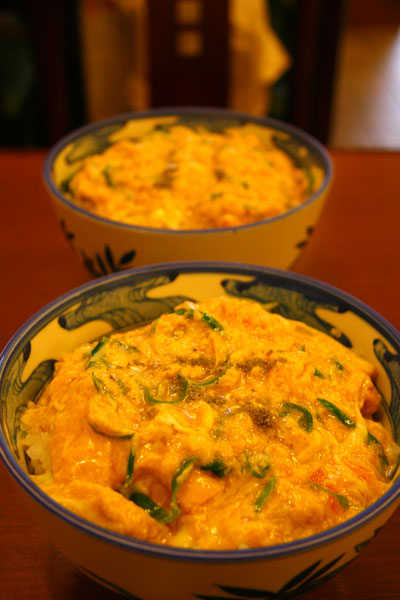


We both ordered the Oyako-Don, which understandably cost a little more than at typical neighborhood restaurants at 980 yen (CAD$10) each. It arrived in a slightly different appearance than the typical Oyako-Don, with a much softer, runnier egg mixture, Kujo green onions instead of Western onions, and a healthy dose of powdered Sansho pepper on top. And the taste was also quite different from the typical Mirin-sweetened family recipes, with the egg mixture taking on the delicately sweet, Umami flavor of Dashi broth, coupled with a slight "kick" from the Sansho pepper. Although not as spectacular as rumoured, it was still the best Oyako-Don I've ever had.

The only possible complaint was that the amount of chicken could have been a little more generous for the given price. Still it was a decent meal for less than 1000 yen in the middle of Kyoto's most popular tourist district -- perhaps it's just the wrong place to be looking for bargains.

Bill for Two Persons
Oyako Don980 yen
Oyako Don980 yen
TOTAL1960 yen (CAD$20)


Food Review: KICCHOMU (Nagakyo-ku, Kyoto)
Address: Kyoto-shi Nagakyo-ku Nishinokyo-Koboricho 1-8
Hours: 17:00-23:30
Website/Map: from Kyotozanmai.jp (in Japanese only)
Directions: Start from the JR Nijo Station and walk north along the Senbon-dori street. It's in the next block, on the left side of the street.

Of the four restaurants reviewed, this was the only non pre-planned visit -- it's an example of the most quintessential Izakaya establishments you'll run into anyday, anywhere in Japan. This one just happened to be several minutes' walk from the townhouse we rented, on an evening when my wife had a huge craving for Izakaya food like Tebasaki chicken wings.
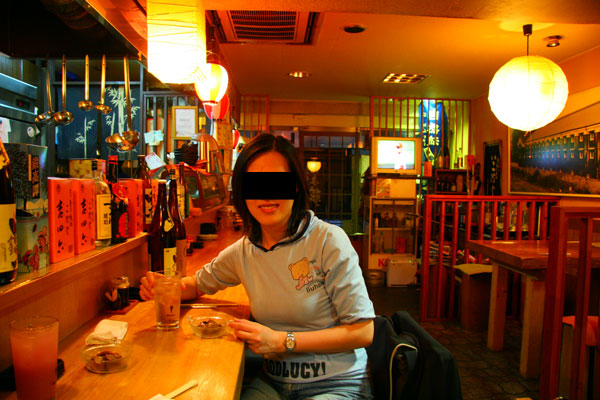


We had been standing the whole day watching the Aoi Matsuri festival, and as we saw the words "Tebasaki - 500 yen" on the menu outside, we immediately walked in without any hesitation.

But after sitting down and ordering a couple glasses of Chu-hai, we found out that Tebasaki was no long served here. Crap ... oh well, time to try something else.
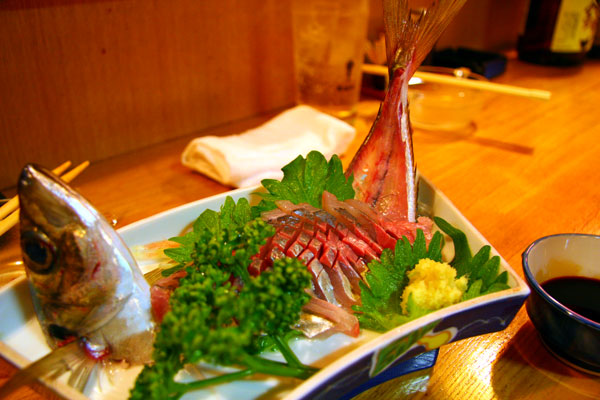


At least one of my favorites was still available -- an excellent Aji-zukuri with the level of freshness I never expected from a little Izakaya in the middle of landlocked Kyoto. Not Tsukiji-Market-fresh, but at least as good as any seafood-focused Izakaya in Tokyo or Osaka.


My wife ordered another one of her favorites in place of the unavailable Tebasaki. The Yaki-Ika was nice and tender, and I was pretty sure it was grilled over real charcoal. I would have preferred spicy mayo as a dipping sauce, but my wife is a purist when it comes to Yaki-Ika and chomped it down straight.
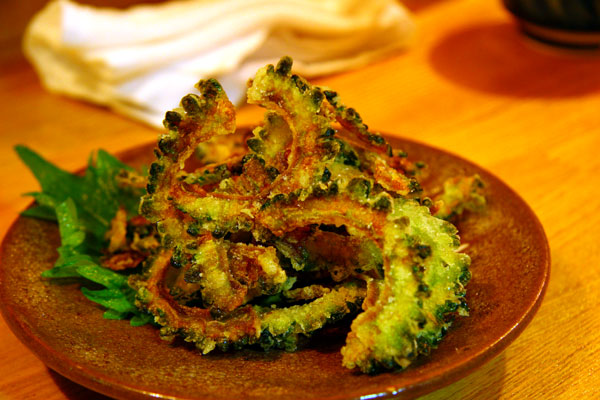


But I think the best dish of the meal was this strange little deep-fried dish that came as part of a 2200 yen (CAD$22) set meal. The thinly-sliced vegetable was crisp, sweet and slightly bitter at the same time, and I had no idea what it was. The Chef called it Goya, and it wasn't until returning to Vancouver that I found out it's the Japanese species of bitter melon.
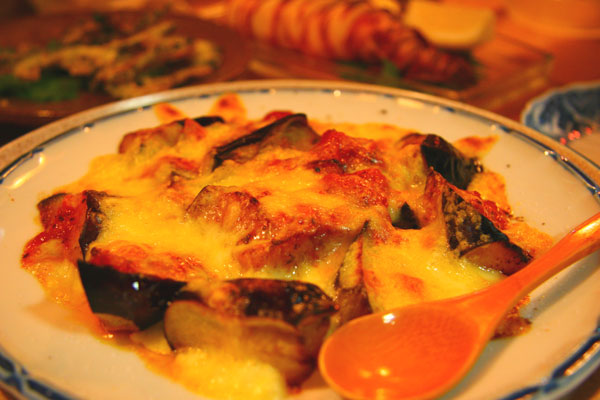


Eggplant Cheese-yaki ... I think. Again it was quite good. Not spectacular, but more than decent for a little one-man-show Izakaya.


We didn't chat much with the Chef and didn't even know his name, but we did find out that he was originally from Oita Prefecture from faraway Kyushu, as we should have guessed from the collection of sweet-potato-Shochu spirits available behind the counter. The food was surprisingly good overall, but then we were his only client that evening, and so perhaps that allowed him time to perfect our dishes between innings of a live Hanshin Tigers game on TV. Very authentically Kansai.

Bill for Two Persons
Aji-zukuri600 yen
Yaki Ika700 yen
"THE SET"2200 yen
Lychee Chu-Hai500 yen
Lemon Chu-Hai500 yen
TOTAL4500 yen (CAD$45)

Sunday, August 31, 2008

Kyoto - Practical Trip-Planning Mini-Guide


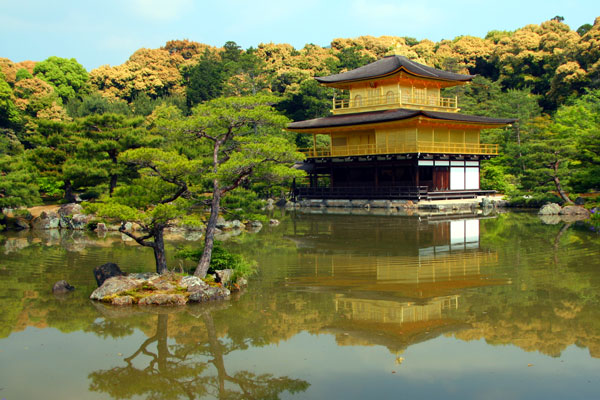
Golden phoenix at Kinkakuji


I won't write about Kyoto's major sights -- you can easily find thousands of sources online. Instead I'll write something more on the practical side -- a list of essential trip-planning considerations and solutions based on my own experience.


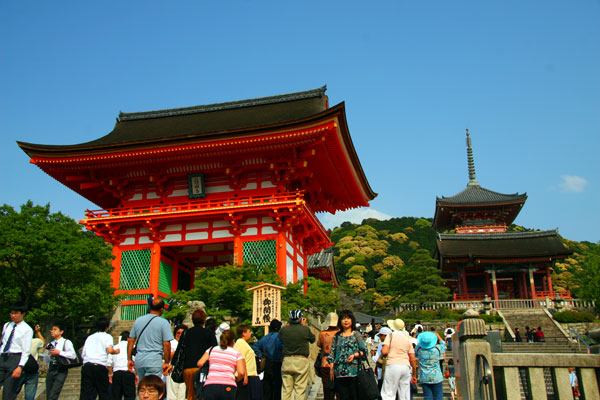
Entrance to Kiyomizudera


READY-TO-USE ITINERARIES

One Day Itinerary:
Kyoto Station - buy City Bus Day Pass (500 yen) - take Bus 205 to Kinkakuji - See Kinkakuji - Take Bus 12 to Higashiyama - have lunch at Gion District - walk to Yasaka Jinja - see Ninen-zaka and Sannen-zaka - walk to Kiyomizu Dera - take Bus 206 back to Kyoto Station - dinner and shopping at Kyoto Station.


Torii Tunnel at Fushimi Inari Shrine


Three Day Itinerary:
Day 1 - Same as One Day Itinerary
Day 2 - Kyoto Station - take JR train to Inari Station (190 yen) - walk to Fushimi Inari Shrine - take JR train to Umahori (400 yen) - take Sagano Scenic Railway to Arashiyama (600 yen) - see Tenryuji - walk towards Saga - see Otagi Nenbutsuji and/or Adashino Nenbutsuji - walk to Saga Torii-moto - take Kyoto Bus #72 back to Kyoto Station (270 yen)
Day 3 - Kyoto Station - buy City Bus Day Pass (500 yen) - take Bus 9 to Nijo Castle - see Nijo Castle - take bus 101 to Shijo-Karasuma - lunch and shopping along Shijo street - walk or take any bus along Shijo to Shijo-Kawaramachi - walk across and/or along the Kamo River - take Bus 207 to Sanjusangendo - see Sanjusangendo - take Bus 100 or 206 back to Kyoto Station


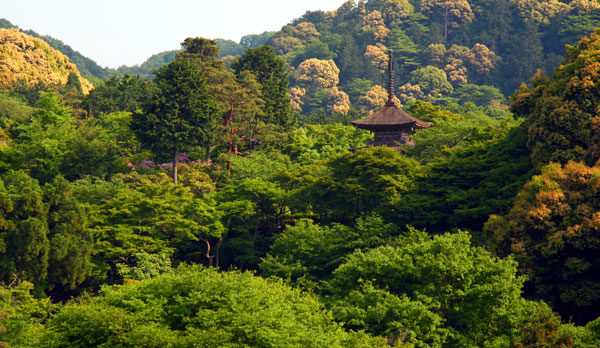
Old Scooter near the 5-Storey Pagoda


Five Day Itinerary:
Day 1 to 3 - same as Three Day Itinerary
Day 4 - spend the day in Uji (see separate article on Uji -- you'll thank me)
Day 5 - So many choices -- Pre-arrange for a tour of Kyoto Imperial Palace or any one of the other Palaces (Katsura Rikyu or Shugaku-en Rikyu), or go for a hike from Kurama to Kibune in northeast Kyoto, or take the Hieizan Railway to see Enryakuji.


Kinkakuji -- the Golden Pavilion


ARRIVAL

If you're coming from Tokyo on a grand tour of Japan, then you should already know about the JR Pass. It's less than two and a half hours taking the Shinkansen train.

If you're flying into the Kansai region, Kyoto has no international airport of its own so you'll mostly likely arrive at Kansai International Airport (IATA: KIX) just south of Osaka. There is a direct Limited Express train (nicknamed "Haruka") connecting to Kyoto. It takes 75 minutes and regularly costs 2980 yen (CAD$30).


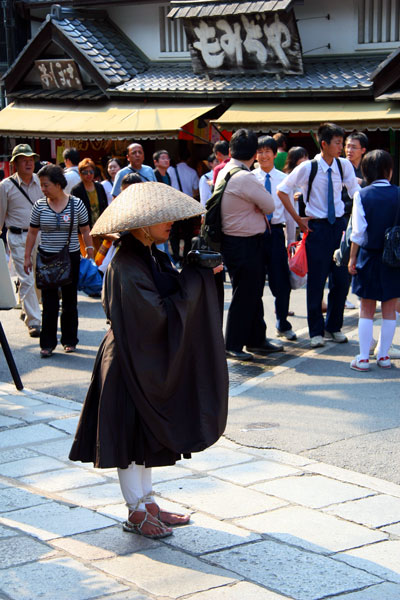
A Monk on the Path to Kiyomizudera


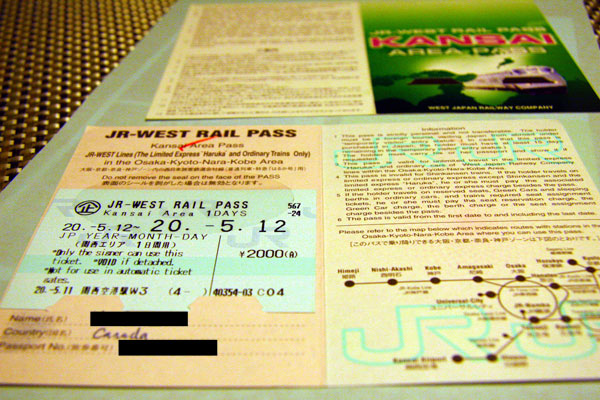
But you can get a substantial discount by buying a "JR West Kansai Area Pass" for 2000 yen, which covers the unlimited use of Haruka, Rapid, and Local trains within the Kansai area including Kansai Airport, Osaka, Kyoto, Nara, Kobe, and all the way to Himeji. You can buy this pass at any JR Ticket Office at the Kansai Airport or any other major JR stations in the Kansai Area.


JR West Kansai Area Pass


You can find out the official rules for the pass from the JR West Official Site.

[PRACTICAL TIP]: By the official rules you are supposed to buy only one JR Rail Pass of any type during one visit to Japan, so one staff will refuse to sell you more than one JR West Pass. But if you buy two JR West Pass from two different stations then they won't notice.


Maiko (apprentice Geisha) perhaps ... but intuition tells me they're
just dressed-up tourists


TRANSPORTATION

In Kyoto, the City Bus system rules. Enough said.

There IS a subway system, but it doesn't reach many of the major sights (eg.Golden Pavilion, Fushimi Inari Shrine ("fox shrine"), Arashiyama etc). IMHO the subway is best for connecting between JR's Kyoto Station and your hotel so you don't have to drag your luggage onto a crowded bus. But for general sightseeing purpose you can get almost anywhere once you familiarize with the City Bus system.


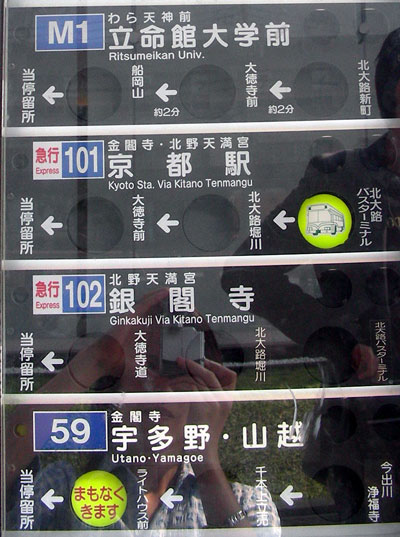
Information Panel at a City Bus stop


City Bus

There must be a hundred or so routes, so I will list only the one I found to be particularly useful:

- 4: Kyoto Station - Kawaramachi-Sanjo (shopping) - Shimogamo Jinja - Kamigamo Jinja
- South 5: Kyoto Station - Fushimi Inari shrine ("fox shrine")
- 12: Gion - Nijo Castle - Kinkakuji (Golden Pavilion)
- 59: Shijo-Keihan Station (near Gion) - Kinkakuji - Ryuanji
- 100: Kyoto Station - Sanjusangendo temple - Kiyomizu Dera temple - Gion District - Heian Jingu - Ginkakuji temple
- 205: Kyoto Station - Kawaramachi-Sanjo - Shimogamo Jinja - Kinkakuji
- 206: Kyoto Station - Sanjusangendo temple - Kiyomizu Dera temple - Gion District


Early Summer at Higashiyama (Eastern Hills) District


For a full list of routes, you can download the latest bus map from the City of Kyoto's official site.

It costs 220 yen everytime you get off a bus, so the relatively cheap Day Pass for 500 yen has become a favorite to tourists. Buy all the Day Passes you need for your entire stay in Kyoto when you arrive at Kyoto Station, or you risk boarding a bus with all its Day Passes sold out.


Inside Fushimi Inari Shrine Complex


Kyoto Bus

This is a private bus company, entire separate from the City Bus system. For casual tourists this is only useful for reaching the outskirt areas not served by City Bus. Useful routes include:

- 17: Kyoto Station - Sanjo-Keihan (near Gion) - Ohara
- 18: Kyoto Station - Higashiyama-Sanjo (near Gion) - Ohara
- 62: Sanjo-Keihan Station (near Gion) - Arashiyama - Saga
- 72: Kyoto Station - Arashiyama - Saga

Fares are generally within the 300 yen range. I took #62 from Nijo to Saga for 270 yen.


PRACTICAL TIP

Kyoto Bus #62 / #72 is my preferred way to get to the Arashiyama area -- if you stay on the bus after Arashiyama the bus takes you deep into an amazingly beautiful area known as Saga. From Saga you can take a scenic walk back to Arashiyama which should take about an hour if you don't stop. It took us four hours -- so you can imagine how nice it was. But MAKE SURE you get on KYOTO BUS #62/#72, not the City Bus!


Kiyomizudera -- a Candidate for the New 7 Wonders of the World


Subway

Great for connecting between these places:

- Kyoto Station (the city's major train station)
- Nijo Castle (Nijojo-mae Station)
- Shijo-Karasuma shopping district (Shijo Station)
- Gion District (Higashiyama Station)
- Daigoji Temple (Daigo Station)

And not much else...

Fares depend on the distance of travel, starting from 210 yen and goes up to 340 yen. Day Pass costs 600 yen and is valid only in the Subway.


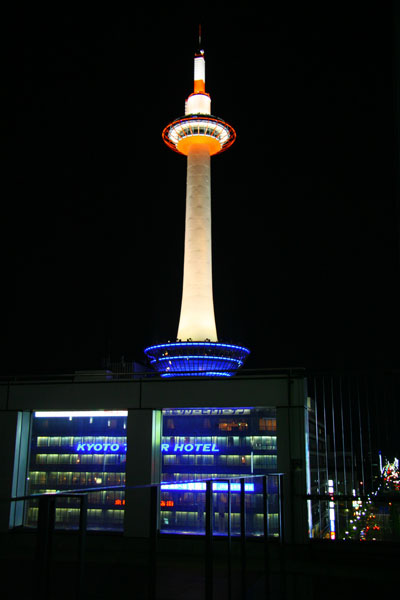
Kyoto Tower -- an Eyesore or a Landmark?


JR Trains

Though mostly used for inter-city connections, the JR is useful for getting between certain outlying areas of Kyoto. For instance it connects between Umahori, Arashiyama, Nijo Castle, Kyoto Station, Fushimi Inari Shrine, and all the way to Uji, Nara and beyond. A couple of real-life examples we encountered:

1) The end point of the Sagano Scenic Railway lies in Kameoka/Umahori, on the far western side of Kyoto beyond Arashiyama, and the JR is the cheapest (320 yen) and most convenient way to get back to Kyoto Station.

2) One day we took the JR from Nijo to Inari to see the fox shrine, and it took 190 yen and less than 20 minutes. By City Bus it would have taken two bus trips and at least 45 minutes.


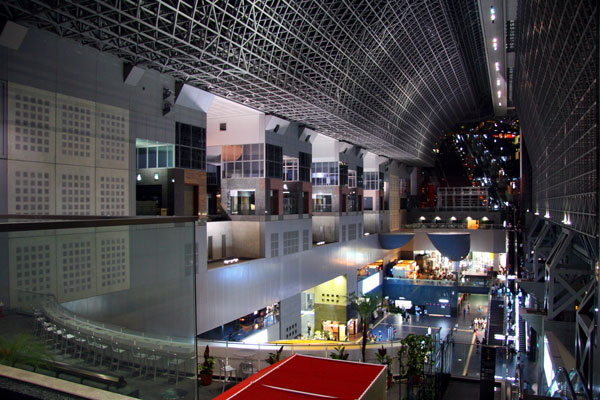
The Ultra-Modern Kyoto Station


Keihan Railway

These little private trains runs down the Eastern bank of the Kamo River. To most tourists the only usage is to get from the Gion area (Sanjo-Keihan Station) to Fushimi Inari Shrine (Fushimi Inari Station) and possibly all the way to Uji.

A trip between Sanjo-Keihan and Fushimi Inari costs just 200 yen, slightly cheaper than the bus and much more convenient.


"7 Falls and 8 Rises ... That's Life," says the little statue


Keifuku Railway

Another little private railway, this one mainly for getting to Arashiyama which isn't served by the City Bus. The problem is none of its stations connects you to subway stations or major JR stations, so its use is really quite limited unless you really plan on getting to one of its stations by City Bus.


Prayer Session at Kiyomizudera


ACCOMMODATION

As you've read from above, local transportation isn't as straight forward as Osaka or Tokyo (if you could call Tokyo's subway system "straight forward"). IMHO the best strategy is to stay within a few minutes walk from a subway station, a JR station, or a major bus route directly taking you to Kyoto Station. So all of my recommendations will fall within this category of convenience.

As in any other large Japanese city, there are hostels, business hotels, Ryokans (traditional inns), and then your typical three four five star Westernized hotels. Listed costs are as of Aug 2008.


Jishu Jinja -- the Famous Shrine for Romance-Seekers


Hostels / Guesthouses

Costa Del Sol - Dorms 2000 yen; Single w/Toilet+Shower 3500; Double 5500; Triple 7500. Walking distance to subway's Gojo Station.

Ichijo Ivy - Private suites with Toilet+Shower+Kitchen. The rate gets cheaper as you stay longer, and a three night stay for a double suite currently runs for about 7000 yen. Bus 101 takes you to Kyoto Station in about 25 minutes.


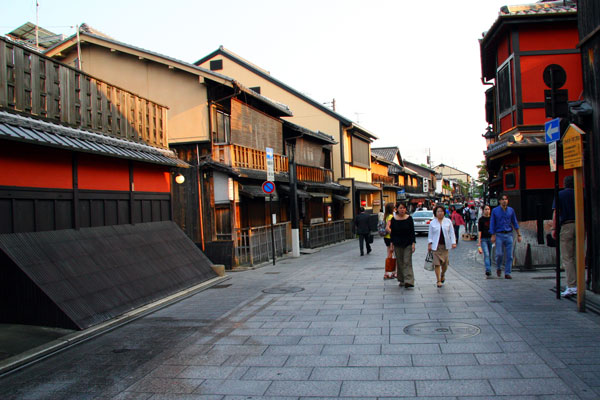
The Old Geisha Quarter of Hanami-Koji


Tour Club - Dorms 2450 yen; Double w/Toilet+Shower 6890; Triple 8880. 10 minutes walk (or a short bus ride) from Kyoto Station.

Guest Inn Kyoto - 3500 yen for a private single w/Toilet+Shower; 7000 for a double; 10500 for a triple. A few minutes to Kyoto Station via Bus 206.


Fox-faced Prayer Inscriptions at Fushimi Inari Shrine


Business Hotels

Toyoko Inn - There are 3 branches in Central Kyoto, all within walking distance of subway or bus stations, and costs around 6000 yen for a Single and 8000 for a Double/Twin. IMHO the best locations is the Shijo-Karasuma branch, which costs a little more.

Superhotel - Located right beside subway's Gojo station, and costs about 6000 yen for single, 8000 for double, and 9000 for triple.


Kodaiji Temple in Higashiyama District


Mid-Range Hotels and Beyond

If this is your preference then perhaps you shouldn't be reading this article. Sorry :)


Confectionist at Work


Minshuku / Ryokan - with Private Bathroom

If you want the full Japanese experience of staying at a traditional inn, Kyoto is a nice place to do it and the cost isn't much more than a business hotel:

Ohto Ryokan - Near Sanjusangendo temple, a short bus ride from Kyoto Station via Bus 100 or 206. All rooms with private toilet and shower. Single 4725 yen; Double 9450; Triple 12600.

Iroha Ryokan - At heart of the tourist district of Higashiyama, walking distance from Sanjo-Keihan subway station. Triple room with toilet for 12000 yen.


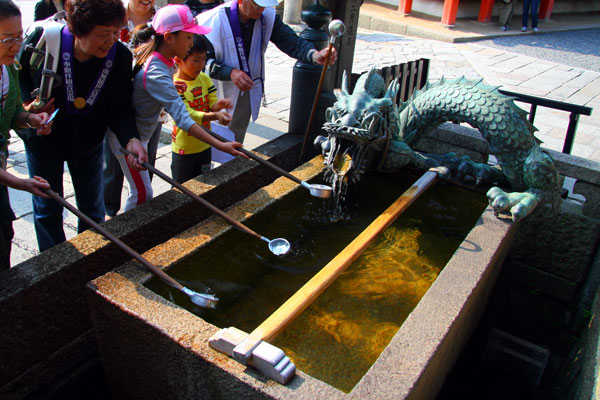
Cleanse Your Mouth at the Purifying Pool


Kinsuikan - Walking distance to subway's Karasume-Oike Station. Single Room with Toilet/Shower 6000 yen; Double 9000; Triple 12000.

Ikoi no Ie - Single Room with Toilet/Shower 7600 yen; Double 9600; Triple 12600. Also has ensuite rooms costing a bit more. Walking distance to Gojo subway station.


Most Paper Cranes I've Ever Seen in my Life


Station Ryokan Seiki - Walking distance from Kyoto Station. Single Room with Toilet/Bath 5500 yen; Double 8000; Triple 12000.

Ryokan Shimizu - Walking distance from Kyoto Station. All rooms with private toilet/bath. 5000 yen per person for low season; 6000 for mid season; 7000 for peak season.

Ryokan Kyoraku - Walking distance from Kyoto Station. Single Room with Toilet/Bath 6000 yen; Double 11000; Triple 16000.


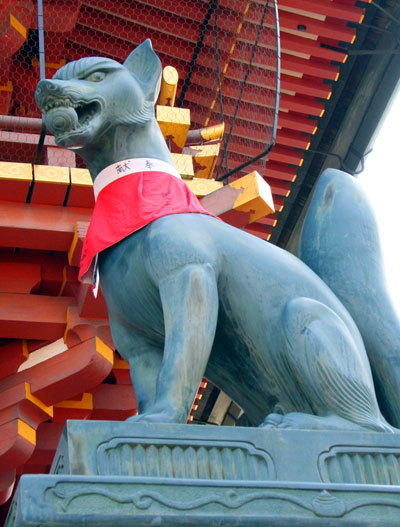
Object of Worship at Fushimi Inari Shrine -- the Fox


Minshuku / Ryokan - without Private Bathroom

I collected these links but never seriously considered them since my wife wanted a private bathroom. Also be sure to find out how to get to these Ryokans, as some of them may be quite a long bus ride from Kyoto Station.

Sanki - Single Room 4200 yen; Double 8000.

Fujiya Ryokan - Double 9000 yen.

Rokuroku - Double 8400; Triple 10200.

Matsubaya - Single Room 5460 yen; Double 9870; Triple 13860.

Hinomoto - Single Room 4200 yen; Double 8400.


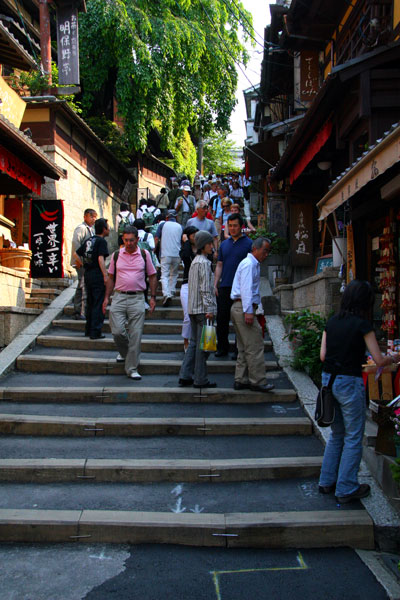
The Busy Sannen-zaka


Kyoka - Single Room 4200 yen; Double 8400.

Hiraiwa - Single Room 4200 yen; Double 8400.

Miwaya - Double 10500.

Nunoya - Single Room 6825 yen.

Kyonoen - Double Room 8000 yen.


Traditional Pottery Store outside Kodaiji Temple


Machiya Rental

If you really want the ultimate Kyoto experience, you can rent an entire Japanese-style Townhouse (Machiya) for your stay.

Though not business-hotel-cheap, if you compare it to renting a villa in Tuscany or Provence you'll realize this is still quite a bargain.

Kyoto Machiya - the first English-language-friendly Machiya rental site. Judging from the photos the townhouses look really posh and comfy. Expensive though.

Tenshi Tsukinuke - You need some minimal Japanese knowledge to make your reservation here. But it costs only 20000 yen for up to 4 occupants.

Shindo-shokuryo - You also need some minimal Japanese knowledge to make your reservation here. There are several Machiyas for rent, and the cheapest costs only 15800 yen for up to 3 occupants.


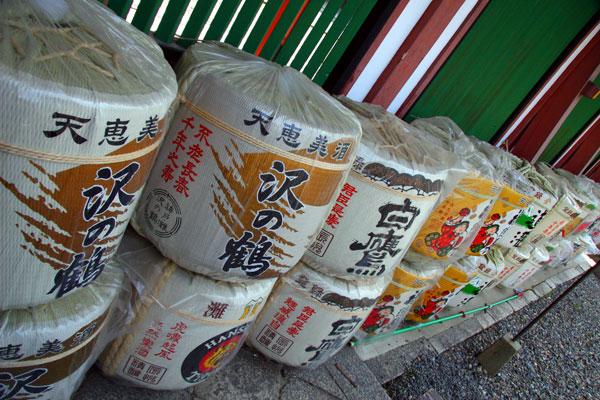
Sake Casks outside a Shrine


Kyoto Eco-House Machiya

This is the ultimate ultimate Kyoto experience - a Kyoto-Style Machiya maintained and rented out by a grassroot non-profit group working for the preservation of traditional Japanese townhouses. We stayed here for three nights in May 2008, and IMHO this is the ultimate immersion into the authentic Kyoto.


Eco-House Machiya -- Our Base for Exploring Kyoto


This is a 90-plus-year-old Machiya built in the traditional style with a raised floor, wooden lattice windows, and sliding wooden panels dividing two small Tatami-mat rooms. For three days this became our own, and we became regular Kyoto residents, buying necessities from the neighborhood 100-yen shop, cooking breakfast over the gas burner, hand-washing our clothes and drying them on the backyard clothesline. And the real kicker is --- it costs less than 5000 yen (CAD$50) per night, with your own kitchen, fridge, a clean bath/shower and all.

For now I'll provide a quick link for anyone interested in making a reservation very soon. But I promise I'll write a proper article on this wonderful and unique alternative accommodation in central Kyoto. Soon.


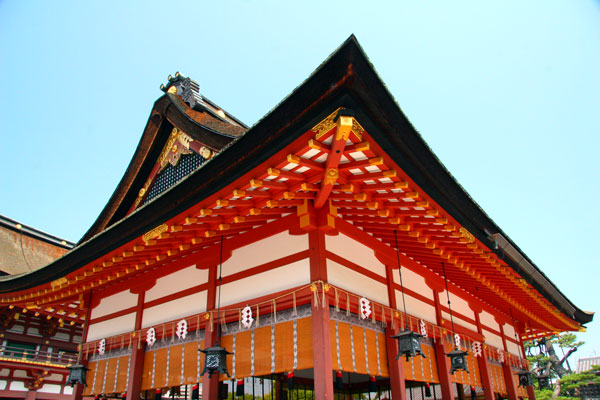
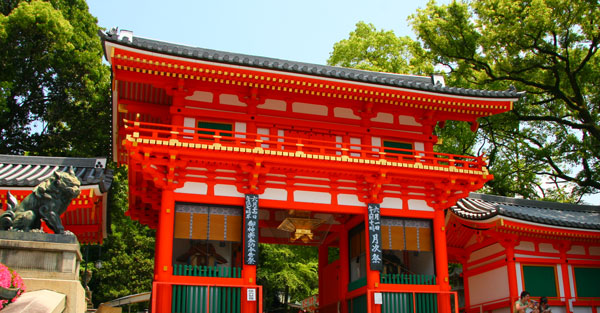
Yasaka Shrine at the Heart of Gion District


BEST SEASON TO VISIT

I find that it really depends on how well you tolerate huge crowds. I mean seriously huge crowds.

The most popular seasons are:
- Sakura (cherry blossom) season in April
- Koyo (autumn foliage) season in mid-late November
- Festival season in July (Gion Matsuri) and August (Obon)


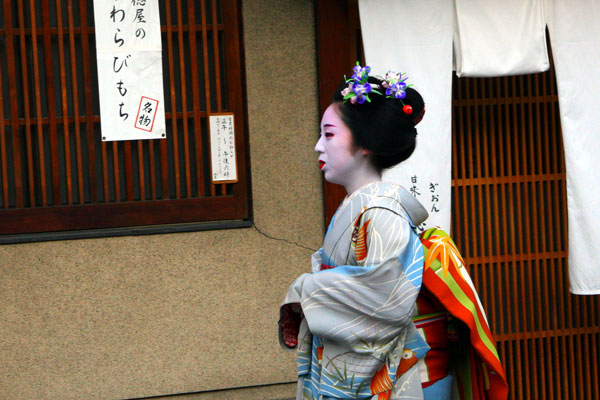
A real Maiko -- you can tell from her graceful manner and her quick bows to every picture-taking tourist and stopped car


These are all beautiful times of the year to visit, as long as you're comfortable with the extreme crowdedness from foreign as well as domestic tourists at every popular sight. Also, summer in Kyoto is very hot and humid -- for the past several years the August average daytime temperature has reached 33-34 degrees Celcius with 60-plus percent humidity. The weather in Sakura and Koyo season is much nicer, with daytime temperature around 17-19 degrees Celcius and not too much rain.


Hurrying Away to the Next Appointment


For the other months of the year, late December to February are generally cold (daytime high of 10 degrees or less), but the airfare is cheapest, the city least crowded, and many hotels have low season rates. It begins to warm up in March, and the temperature stays quite comfortable up to late May; this is generally shoulder season except when the Sakura is in full bloom, however stay clear of the Golden Week domestic holiday in late April-early May. The Aoi Matsuri festival is held annually on May 15. The rainy season start mid June, which lasts until July when the hot humid weather kicks in and runs through September. July and August is also peak travel season for domestic tourists so hotel prices won't be cheap. The Jidai Matsuri festival is held on October 22, when the weather should be dry and cool, and by December it cools all the way down to single-digit temperature.

We ended up choosing mid May due to several factors: comfortable weather, reasonable airfare, medium level of crowdedness, and catching the Aoi Matsuri (May 15) was an added bonus.


Tanuki Statues -- One of My Favorite Folk Craft Items


FOOD

Please see my next article on Kyoto's local cuisine ... it's too long to put into this article.