Pages

Saturday, August 4, 2007

Day 3 - Tsukiji Sushi and Ramen Stadium

Day Three (Tue):Shinjuku - Tsukiji Market - Odaiba (Palette Town, Daikanransha, Venus Fort, Toyota Mega Web, Decks Tokyo Beach, Aquacity) - Shinjuku
Breakfast:Sausage Roll and some other Japanese pastry items, Kobeya (bread store chain), Shinjuku
Brunch:Chef's select sushi at world's largest fish market...one hour lineup
Sushi Dai, Tsukiji Shijo (Jonai)
Snack:A small wooden box full of fresh uni
Purchased at some fish stall inside Tsukiji market
Dinner:3 bowls of ramen, each from a different geographical region
  • Tonkotsu Ramen, Wakura from Fukuoka
  • Lobster Miso Ramen, Ganso Ichijou Ryu from Tokyo
  • Hokkaido Butter Ramen, Manraiken from Sapporo>
Ramen Kokugikan's 2nd Campaign, Aquacity, Odaiba


Tsukiji Market

I think this place originally made its name among foreign tourists as the place to watch daily auctions of several-hundred-pound frozen tunas...until the fish-poking tourists were totally barred from the event in early 2005. I say that's good call; I'm more interested in the freshness of the sashimi cuts than getting up at 4AM to see the auction anyway.

So we set out rather leisurely and arrived at 9:30AM, even munching down some Japanese bakery items in the process (Kobeya's sausage roll, at 150 yen, tasted so good when morning hunger hit). It's not hard to find, just hard to cross the streets with no sidewalks and many small trucks and fork lifts full of seafood weaving around us.

When we did our Tsukiji Jonai (inner market) sushi stall research at Japanese language sites, somehow most of the user opinions converged on two restaurants. And when we arrived, only those two restaurants (out of a row of ten or so) sported lineups. One was having a very long lineup, and then other had a lineup of only two or three people. The choice was easy.


Gourmet Spot #4: Freshest Sushi. Period. - Sushi Dai, Tsukiji Shijo Jonai


We picked the one with the longest lineup! A full 60 minutes of wait!

Zannen! The other place, Daiwa Sushi (four stalls down the row in the picture), probably is just as good. I even brought a coupon for two pieces of Magurozuke (just print out this page and take it to the chef)! Next time, I promise.

And when we finally sat down, we were served by a younger chef, who spoke with us partly in English. We wanted to sample a large variety of different seafood, and ordered two different sets: one 2000-yen-set and one 3500-yen Omakase-set.


Both came with a miso soup infused with the seafood of the day (turned out to be a red-skinned fish, possibly Kinmedai), followed by 10 pieces of nigiri and four pieces of roll. The Omakase set would finish off with one extra piece of sushi of our choice. Apart from that, the price of the ingredients chosen was the difference between the two sets.

Incredible freshness! It was so unbelievably fresh and I chowed down so fast that I often forgot to take photos of each piece. Oh well, here is some of the cheaper set:


Kohada on the left, a Shiromi type fish on the right (Tai perhaps? I wasn't sure)


Ika on the left, Magurozuke on the right. Note the shine on the Ika.


Nama Shirasu (white bait)


Both sets came with the same rolls. I don't remember exactly, but these look like (from the left) Chu Toro, Mentaiko, another Chu Toro, and Kappa.

Especially worth mentioning is the Ikura on the right. Back in Vancouver, my wife and I can't stand Ikura for its fishy taste. But this particular piece was simply unbelievable, so smooth it was like an egg yolk melting in the mouth. It didn't taste anything like fish roe. It was amazing.


The more expensive set contained the Ootoro (left) and a Chu Toro. Not the fattiest Ootoro I've ever had, but definitely the freshest.

There was also an incredibly fresh piece of Uni! It was a dark yellow Uni with a strong sea water taste, but incredibly sweet. But regrettably it disappeared off the plate so fast that I forgot to take a picture.


Hirame on the left. I forgot what the piece on the right was. Please leave me a comment at the bottom if you know...


The Shiraebi on the left was incredible! Simply the freshest, sweetest shrimps I had ever tasted...and think about the effort it took to peel these tiny shrimps! And the Aji on the right...just look at the shine on that fish.


This was another highlight of the meal. The Anago was so sweet and soft it melted on the tongue. Not a huge piece like the Anago Ipponyaki we had on Day 8, but unbelievably tasty.


Decisions decisions. For the last piece of the Omakase set, we chose the Akagai on the right. I think most people might choose the Ootoro, but that Akagai was well worth it. On the left is an Akami of the cheaper set.

Bill for two persons:
2000 yen set2000 yen
Omakase Set 3500 yen
(apply 5% tax) 
Total5775 yen


Gourmet Spot #5: Fresh Uni by the box - Tsukiji Shijo

Whew! We were so full now that we needed a walk. And so we dangerously crossed the street over to the fish vendors in search of one of my favorite sashimi items.


Uni! Boxes and boxes of it. I was sure now that my cholesterol would take quite a hike during these holidays...I hoped I would work off some of it with our 10-hours-walking-per-day routine.


A small box for 450 yen. Two layers of fresh, firm deluxe uni. These were the small Jo-Uni from Hokkaido, each piece being only slightly larger than a fingernail. I actually wanted to find uni in the shell. Oh well, more excuses for another trip in the future.


Odaiba

Scary Ferris Wheel! We took the slow and slightly scenic Suijo Bus to Palette Town to try the huge Daikanransha, once the world's largest Ferris Wheel. Our box swayed with the wind when we were 20 stories high in the air. Luckily my worst fear of an earthquake didn't materialize. 900 yen per person for 15 minutes of anxiousness hardly seemed a bargain, until we won a 5000 yen Disney plush toy in the "10 Million Passengers Lucky Draw" after the ride.

Odaiba is the perfect Tokyoite date spot, with a female-oriented mall for her, a gigantic Toyota showroom for him, sandy (albeit man-made) beaches and parks, the giant Ferris Wheel, a TV studio with many attractions, and tons of restaurants inside some very unique malls. Try these sites if you wish for more general information. I'm going to talk about ramen.


Gourmet Spot #6: A duel of 6 ramen shops - Ramen Kokugikan, Aquacity, Odaiba


What a great (money-grabbing) idea! For a limited time between Jan 2005 and Dec 2007, Aquacity is organizing a ramen fair where six ramen shops from different geographical regions will open shop in an enclosed area in the mall. The shops will switch every six months, totalling 36 shops in six campaigns over three years. For ramen lovers like myself, it's the perfect chance to sample authentic ramen from different parts of Japan in the same venue.

The six shops available during my visit were:
  • Wakura from Fukuoka, a Hakata Tonkotsu (pork bone soup) Ramen specialist
  • Tokufuku from Tokushima, using a Tonkotsu and chicken base
  • Rokkakuya from Yokohama, using a Tonkotsu Shoyu base and very thick noodles
  • Ganso Ichijo Ryu from Tokyo, using a special lobster miso made specially for this event
  • Tendou from Yamagata, using a free-range chicken and seafood dashi base
  • Manraiken from Sapporo, using a miso base with melted Hokkaido butter


I figured I could probably finish 3 bowls of mini ramen (550 yen each). My wife though could only finish one bowl. With the target of sampling three different regions of Japan, here we go!


First up, Hakata Tonkotsu specialist, "Wakura" from Fukuoka.


5 stars for the toppings, 4 stars for the soup.
Not that the soup wasn't good enough, but wait till the next bowl! The pork slices were indescribably delicious...they basically melted in the mouth like Matsuzaka beef. Perfect balance of meat and fat. And the Nitamago (soft-boiled egg marinated in soy sauce) was perfectly soft in the yolk.


Next up, "Ganso Ichijo Ryu Ganko Ramen" from Tokyo


3.5 stars for the toppings, 5 stars for the soup.
The topping was above average but not spetacular. It was the mini size and so didn't come with the Nitamago. But the soup...it was a very strong, slightly spicy, mildly lobster-like, aka miso broth. That was spectacular.


Finally, from the Sapporo Ramen Yokocho, "Manraiken"


4 stars for the toppings, 4 stars for the soup.
Fresh sweet Hokkaido corn. And a slice of creamy Hokkaido butter which greatly enhanced the smell and creaminess of the entire bowl. The toppings would lose to Wakura and the soup would lose to Ganso Ichijo Ryu, but overall it was still excellent.


I actually debated whether to try a Shoyu ramen specialist instead of Manraiken, which (like most ramen shops out of Hokkaido) used a miso based broth like Ganso Ichijo Ryu. But the butter miso broth erased that second thought.

Bill for two persons:
Mini Ramen x 42200 yen
(no tax)
Total2200 yen


We were so tired that evening that we skipped Roppongi and went back to the hotel and watched NTV. I should write something about the great programming in Japanese TV sometime.

Oh why can't I get NTV and TBS in Canada...

Day 4 - Train Bento and 370-Year-Old Ryokan

Day Four (Wed):Shinjuku - Hakone Yumoto - Owakudani - Togendai - Hakone Checkpoint - Cedar Avenue - Ichinoyu Honkan
Breakfast:Japanese pastries
Unknown bread shop, Shinjuku
Lunch:Deluxe Ekiben lunchboxes on the train
  • Gagaku Bento by Ginza Daimasu
  • Daimyo Bento by Wako Sangyo
Odakyu Romance Car
Dinner:Dinner course at a 370-year-old Ryokan...unbelievable tofu and fish
Ichinoyu Honkan, Tonosawa, Hakone


The Brand New Odakyu Romance Car

We took a wonderful side trip to Hakone.

Some may say that it's a tourist trap. Yes it is very commercialized, and certainly not the gateway to Mother Nature it's often advertised to be. But still it's a wonderful Japanese hotspring resort area with very rich history. And certainly no more commercialized than Whistler or many areas around Lake Tahoe.


We bought Hakone Weekday Passes, then added the extra 870 yen to take the new (put into service just 6 months ago) Romance Car VSE 50000 and reserved for the rear Temboseki (scenic seat, with 270-degree panoramic windows) many days in advance. We also reserved two special (and a little expensive) Ekiben.

Gourmet Spot #7: Deluxe Ekiben - Odakyu Romance Car, Shinjuku to Hakone Yumoto

Usually Ekiben are like cheap train Bento boxes that you eat on the train or at the station. Not cheap like Ramen, but 1000 yen would buy a reasonably good meal. I looked at the pretty pictures on the Romance Car menu at the Odakyu site and decided on trying the extravagant stuff.


The most expensive Bento on the menu this was! At "only" 2500 yen (which is very expensive for a bento. A lunch set at the excellent Sushi Dai yesterday started at 2000 yen.)


And this is the "cheaper" one, at 1300 yen. That's right. We spent almost 4000 yen just on lunch boxes.


Matsutake mushrooms! No wonder it was expensive. Matsutake and chestnuts...gotta be autumn. The huge portions included that big shrimp in the background and various items I had never tried before and may never again. A deluxe Shokado Bento on a train. This Bento was produced by Ginza Daimasu, the 90-year-old restaurant located on the expensive Ginza Dori.


Even the 1300 yen one contained fishroe-coated shrimp, autumn chestnuts, barbecued fish and of course lots of delicious goodies we've never tried before. This Bento was produced by Wakou Sangyou, an Ekiben supplier to Odakyu.

Bill for two persons:
Ginza Daimasu Gagaku Bento2500 yen
Daimyo Bento1300 yen
(no tax) 
Total3800 yen


Hakone


We stayed at the 370-year-old Ryokan "Ichinoyu Honkan", located at Tonosawa. I can't say enough good things about this Ryokan. Everything from the traditional character of our 8-tatami room, ease of access, and most importantly the food, was excellent. The hotspring setup wasn't as nice as the more expensive Ryokans, but nevertheless a steal at 8000 yen a night including two meals.


There it was! We saw Fujisan! It was a perfect, sunny day with no fog whatsoever, and it happened just when we came over the ridge riding the Hakone Ropeway near Owakudani. We have friends who have been to Hakone many times and still have never seen Mount Fuji due to the unpredictable weather. We felt so blessed.


What's on the skewer? Huge Sazae snails from the local bay waters...more like a conch than a snail at this size. A cheap 250 yen for the skewer. There was also Yaki Ika for 400 yen at another stall, but we were too full after finishing off the remainder of this morning's Ekiben.

We also did the typical tourist spots like the ridiculous pirate ship, the Hakone Checkpoint, and the Cedar Avenue.


Gourmet Spot #8: Traditional Ryokan dinner - Ichinoyu Honkan, Tonosawa, Hakone

Dinner was served at 7:00PM at the dining hall located at the top floor of the Ryokan. It was a spacious hall with a sparkling wood floor and an extravagant western-influenced ceiling from the Taisho era. As in most small-town Ryokans, dinner was a multi course set meal using the best seasonal ingredients, mostly from the local area.


The first dish (middle) was actually a Yofu (western-influenced) salad, with smoked salmon, vegetables with a mustard dressing, and some Japanese favorites such as Satoimo.

The second dish (white bowl in the foreground) was an understated and often overlooked dish, but it was definitely the star of the meal -- Tofu. It was the best Tofu I've ever had. Definitely the best vegetarian item (if we don't count the shrimp) I've ever had. I never dreamed that Tofu could take on such a texture of softness but slightly resistant to the tongue, and incredibly smooth. The closest analogy to a western ingredient I can think of is...now don't be surprised...cream cheese. Only even softer and even smoother, and with a very rich taste of soya bean, and bathed in a wonderful Dashi broth.

The third dish (metal pots on the left) was a Tounyuu Nabe. Seafood, pork, various vegetables, Shiitake and enoki mushrooms were placed in a hotpot of soy milk and cooked. Delicate flavors in a pot to warm up the Autumn night.

The fourth dish, not photographed, was an Ika Yakisoba. We were quite full by now and I didn't focus on really finishing it, because...


Bam! Right when we started to wonder whether to finish that Yakisoba, the server brought us this two-pound monster of a braised fish.

I don't think I've ever had a one-pound fish to myself. And this was at the end of a meal. But this fish looked and smelled so good that my wife and I started to work on it immediately. It was a Kinmedai from the local Sagami Bay waters (I asked the server lady at the end of the meal), a local favorite at this time of year. I had seen sectioned Kinmedai served in claypots of rice, but had never seen an entire fish of this size served to two people. The sauce for this Kinmedai Nitsuke was of a sweet shoyu base, perfect for the soft, oily meat of the fish.

At this point, we wondered how they could afford to charge only 8000 yen per person.

Bill for two persons:
Room + Dinner + Breakfast7800 yen per person
(Hotspring tax 150 yen per person) 
Total15900 yen


Evening was hotspring time. Each room had 30 minutes of reserved time at the private Onsen. The two public Onsen (one for each sex; every night at 12AM they switched the male and female Onsens) were also free. It was so soothing for my weary feet that I just didn't want to get up. After trying all three of the Ryokan's hotspring baths in the span of about 10 hours, I could have sworn all my travel aches were gone.

Day 5 - 150-Year-Old Soba Maker and Izakaya Below Train Tracks

Day Five (Wed):Ichinoyu Honkan - Sounji Temple - Odawara Castle - Nijubashi (Imperial Palace) - Yurakucho - Ginza - Shinjuku
Breakfast:Traditional Ryokan breakfast
Ichinoyu Honkan, Tonosawa, Hakone
Lunch:Handmade Soba at a 150-Year-Old Specialist
  • Hiroshima oysters and soba in broth
  • Cold soba set with Kakiage
Hashimoto, Odawara
Dinner:Izakaya Below the JR Tracks...pop quiz: what's a chicken wing gyoza?
Shin Hinomoto, Yurakucho


Odawara Castle and Sounji Temple

We would return to Tokyo in the afternoon, but not before visiting the historic town of Odawara.

Breakfast was served at the dining hall again, and consisted of the usual Japanese breakfast items such as Saba Shioyaki (grilled salted mackerel), pickled vegetables, and Natto on rice. I forgot to take a photo.

We visited the historical sites of Sounji and Odawara Castle to pay tribute to the Odawara Hojos and Toyotomi Hideyoshi of the Sengoku era. The most powerful sight in the Sounji temple was in a section missed by many tourists. Deep within the burial grounds, the five once-powerful rulers of the Hojo clan laid together in silence, each occupying no more than 3 square meters of real estate.

If you ever try to get to Sounji on foot from the Hakone Yumoto station, DO NOT take the so called "Chikamichi" (short cut) as the sign tells you. It's no shorter than the longer road (turn left after the red bridge) and it was a unnecessary uphill climb followed by a steep downhill path.


The reconstructed Odawara Castle, although no Himeji, was a very nice photo-op on a sunny day. The perfectly-square stone base, white plaster walls, and dark ornate roofline all made for great shots. There was also a Chrysanthemum competition outside the base of the castle, and of course the sad elephant, and the caged monkeys constantly chasing each others' tails.

We had to catch a 12:47PM train back to Shinjuku, and so decided to go for an early lunch at a generations-old local establishment.


Gourmet Spot #9: Handmade Soba at a 150-Year-Old Specialist - Hashimoto, Odawara


I knew it was old but I didn't know it was that old until I saw the wooden sign (top right). Queen Victoria was a young woman when this place first opened.

My idea of a traditional soba meal was cold soba on a bamboo tray and tempura made with seasonal local ingredients. But my wife surprised me when she decided to order hot soba in a broth, served with an ingredient from far away:


Oysters from Hiroshima! I thought that was probably a mistake, until I tried one bite of the oyster...

The entire oyster was very, very juicy and soft. And very fresh. That was the surprise highlight of the meal! I thought I could *taste* the sea water of Hiroshima through the oyster. Not a traditional soba dish, but I thought it was more spectacular than my more conservative dish of...


Kakiage (mixed tempura patty) and cold Zaru Soba. There were so many shrimps that some of the shrimps weren't even covered by the tempura patty. The tempura was slightly oily and wouldn't be as terrific as Funebashiya's (see Day 7) at Shinjuku. But still a very delicious and filling meal.

Bill for two persons:
Kake Soba with Hiroshima Oysters1050 yen
Kakiage Tenseiro1260 yen
(tax inclusive) 
Total2310 yen


Yurakucho

We returned to Shinjuku riding the non-Romance-Car Odakyu train, which stopped at a lot of places despite its Tokkyu (express) designation. After checking in at Shinjuku Washington again (this time we got a newer, non-smoking room), we hurried to the Tokyo Station to take some pictures of Nijubashi bridge at sunset. We merrily snapped photos along the way and ended up at Yurakucho just in time for an early dinner.

Anyone who has been to Yurakucho in the evening rush hour can tell you about the sea of salarymen crowds pushing through the narrow pavement, right beside the lanterns of udon stands and fortune tellers underneath the roaring train tracks. In an impressive display of Japanese space utilization mastery, the whole area under the tracks has developed into an ecosystem of little eateries and miscellaneous businesses that gradually wake up every evening. Hungry middle-aged men in suits would squeeze into these tiny and dimly lit establishments for a few skewers of Yakitori and beer.

Unfortunately most weren't open when we got there at 6:30PM, and those that were didn't look very enticing. In the midst of our search my wife stopped me - her sense of smell had guided us to the dirty outlet of a kitchen fan.


Gourmet Spot #10: Chicken Wing Gyoza Under the Train Tracks - Shin Hinomoto, Yurakucho


That kitchen fan belonged to a split level Izakaya right underneath the JR tracks. It was like a big tent/cave in there, a typical downtown drinking place with an atypical feature...an English (not just English-speaking!) guy managing the place. The guy was about as stand-out as you can get in a Yurakucho Izakaya: white, bald and standing extremely tall beside his dark-haired clients, with whom he chatted and joked in fluent Japanese. It was too early for the normal Izakaya crowd and so it wasn't at all crowded.


My wife's favorite, the Yaki Ika. As mentioned on Day 4, we missed a chance to order one from a street-stall at Hakone Machi, so we made up by ordering this huge one. The smell and taste of the char marks was so wonderful at the end of a long walk.


Suzuki Shioyaki (broiled salted sea bass). The meat was a little too dry for my taste, but the crispy skin was pretty good. Oh well, not every Izakaya can do both perfectly every time.

The next dish was a mystery. My wife wanted Gyoza, and on the menu there's something called Teba Gyoza, which literally means chicken wing dumplings. Now what the heck is a chicken wing dumpling?

Normally, when I consider a Gyoza, it's a minced meat or vegetable filling wrapped inside a thin piece of dough. Typical fillings are pork, chicken, beef, hakusai etc, and chicken wing meat certainly wouldn't look out of place. Since it's a filling wrapped in a piece of Gyoza dough, it's the dough that is the constant. The dough makes a gyoza a gyoza.


But this was totally backwards! This is a Gyoza in the exact opposite definition -- that the filling, not the dough wrapping, makes a gyoza a gyoza. It was the traditional Gyoza filling of minced pork and hakusai wrapped inside a bone-removed, charcoal broiled chicken wing. Unbelievable...

And the taste was amazing of course. How could a lover of Japanese food resist a Gyoza with a tender, juicy filling, and whose wrapping was a boneless, slow charcoal-grilled wing?

Bill for two persons:
Yaki Ika~700 yen
Suzuki Shioyaki~500 yen
Teba Gyoza~600 yen
Lemonade Chuhai~400 yen
(apply 5% tax) 
Total~ 2300 yen


Kyohou Grapes

After dinner we wandered over to the classy Ginza, but of course we were too poor for the Bally shoes and Ferragamo scarves (having spent much of our budget on food). We took a long stroll back to the Tokyo Station area looking for some Monjayaki, but my wife was already too tired and so we rode the Yamanote back to Shinjuku.


But before returning to the hotel, we bought these wonderful Kyohou Grapes from the food market of a department store basement. Kyohou is a area in the Nagano Prefecture known for its top quality grapes. *Sweet like candy* and very juicy and soft. It wasn't cheap though at 700 yen.

Day 2 - Matsuzaka Steak and Yakitori

Day Two (Mon):Shinjuku - Sanrio Puroland (Tama Centre) - Kichijoji - Mitaka no Mori Ghibli Museum - Kichijoji - Shinjuku
Breakfast:Salmon and Mentaiko Onigiri
Purchased at some convenience store in the subway
Lunch:A5 rank Matsuzaka steak at a butcher shop/steak house
Steak House Satou, Kichijoji
Dinner:Yakitori and Shumai at an 80-year-old izakaya
Iseya Honten, Kichijoji


Tama Centre

Our first breakfast in Tokyo followed the tradition of typical Tokyoites -- convenience store Onigiri (rice balls) eaten at a train station. Both the salmon and the mentaiko was quite good at 147 yen each.

This was a day for touring our own childhood. At 8:30AM We took the Keio train to Tama Centre to see the Sanrio Puroland (home of the Hello Kitty, at my wife's request). The tickets (or rather, vouchers for the tickets) were purchased the previous night at a ticket vendor for 2500 yen each, quite a deal compared with 4400 yen at the gate.

The morning commute in the Shinjuku underground was much better than I expected (really nothing compared with the chaotic Admiralty station in Hong Kong). We got to Tama Centre almost AN HOUR early and went for some light shopping.

I'm not going to describe Hello Kitty's home in much detail since there are tons of travel journals doing just that. It's not a huge place, but I can appreciate the attractiveness to Hello Kitty fans. The selection of the licensed merchandises is probably one of the largest in the world. My wife would certainly agree that the three hours of entertainment was more than worth the 2500 yen ticket for her. And for me, the entertainment was watching her eyes light up. Although, the full price of 4400 yen would have been too stiff.

The next stop would complete another THING TO DO BEFORE I DIE. The famed Matsuzaka Beef.


Gourmet Spot #2: A5 Rank Matsuzaka Beef Teppanyaki - Steak House Satou, Kichijoji

Ever heard of Kobe beef? Kobe, Matsuzaka and Oumi are considered to be the three most prestigious cattle-producing regions in Japan. Not that other regions can't produce top quality cattles, but traditionally these three were the more well-known and commanded the top prices.

I can go on and on about Kuroge Wagyu (black-haired Japanese cattle), but the important part is: Japanese beef are typically ranked according to their marbling content and distribution using two systems. At fine steak or shabu shabu restaurants, you would typically find the prestigious A5 ranked Kuroge Wagyu. And A5 Kuroge Wagyu produced in Matsuzaka would usually command very high prices (think 15000+ yen meals). But hey, I said this is a once in a lifetime trip remember?


With some research we ended up getting our top quality Matsuzaka steak at a fraction of the price. There is a place in Kichijoji where the ground floor is a store selling fine meats, including certified Matsuzaka beef. It's difficult to miss it since the lineup for their deep fried minced beef patty (150 yen) is half a block long. And the 2nd floor is a small, slightly cramped restaurant serving the meat sold downstairs. Welcome to Steak House Satou.

DIRECTIONS:

Multiple readers have asked for better directions to this popular restaurant. I hope this is better...

Kichijoji is in the western part of Tokyo. The easiest way is to go to Shinjuku's JR station, and take the "Chuo Line" westbound (towards Takao). It's about 8 stations (if you happen to get on a "Local" train -- less stations if you get on a "Kaisoku" (fast train)), you should get there in about 15 minutes.

Once you get to Kichijoji Station, exit the station from the North Exit. Then follow the map in the following link:
http://gourmet.yahoo.co.jp/0006713464/P001410/coupon/

The crosshair in the map is the location. It's less than 5 minutes walking distance. Not everyone knows about the steak house upstairs, but everyone in Kichijoji knows about the meat shop downstairs. Grab a younger guy and ask about "Satou Nikuya" (Satou meat shop) if you can't find it. If you see a big lineup in front of a meat shop, that's the place.

When you get there, there's a narrow, steep staircase on the right side of the store. That's the entrance to the Steak House. Chances are you'll line up for 30 minutes or more. Good luck!


We arrived way past the typical lunch hour and still ended up in the lineup slowly advancing up the steep stairwell for 30 minutes. It was well spent as we were seated at the counter right in front of the chef. The menu choices were:
Matsuzaka Beef Oil Yaki870 yen
Wagyu steak2500 yen
A bigger Wagyu steak3500 yen
Chef Omakase Set 5000 yen

Remembering the purpose of our trip, we had to order the most expensive set. 180 grams of Chef's select Matsuzaka steak, served with a choice of red, white or Japanese wine. We also ordered the Oil Yaki set, just to see how the cheaper Matsuzaka cuts compares to the steak.


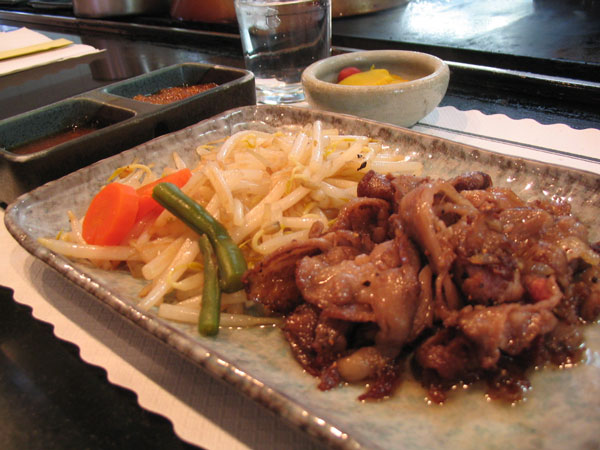
Here comes the Matsuzaka Beef Oil Yaki. Pretty good portion for a measly price. It turned out to be very thin slices of probably bits and pieces of the Matsuzaka cattle. And now the taste...

... was incredible! The slices contained such a balance of meat and fat that the softness and oiliness filled every bite. After a couple bites came the steak we were waiting for.


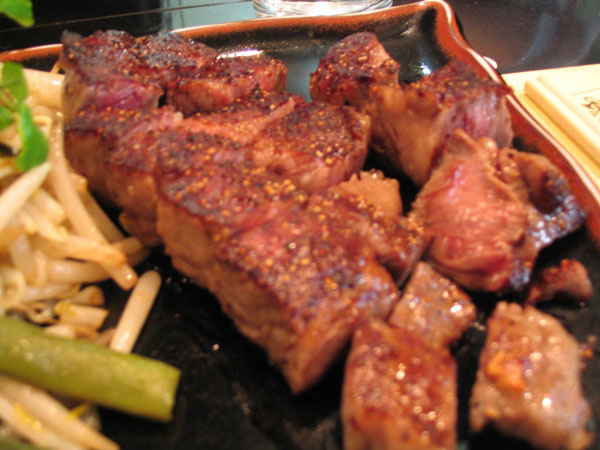
We actually watched the chef taking this steak (actually two steaks) out of the huge fridge and cut it into cubes as the beef sizzled on the Teppan. I ordered medium rare and waited as the smoky smell of oil and red meat filled the room. I don't know how I managed the patience to finish the salad before taking my first bite of the steak cubes.

Sugoi! So much oil and juice flowed down the tongue even before the bite. And upon the bite, the cube practically disintegrated. Like the cube was composed of many bits and slices of meat and was gently held together by the marbling fat. I can't describe it but it was certainly one of the best meals of my life.


Incredible juiciness and texture. Coupled with the dipping sauce it was heaven.

One last note that the glass of wine, the silky smooth Koshi no Kambai, was quite an excellent match for the texture of the Wagyu. Everything was top quality.

Bill for two persons:
Matsuzaka Beef Oil Yaki870 yen
Chef Omakase Matsuzaka Steak Set5000 yen
(apply tax)
Total6164 yen


Mitaka no Mori Ghibli Museum

What can I say, it's a museum of all things Miyazaki Hayao, complete with a reconstruction of his working studio and a rather complete (and fun) explanation of the animation production process. And for the real Miyazaki fans, a whole library of his complete scene-by-scene sketches from Totoro to Howl's Moving Castle and more. Too bad photos aren't allowed.

There was also a limited time display of Alps no Shojo Heidi, and the short film on display on that day was Kujiratori, a story of elementary school kids' imaginary whale hunt.

How come adults aren't allowed to enter the Neko Bus plush toy?


Gourmet Spot #3: Cheap 80-year-old Yakitori Joint - Iseya Honten, Kichijoji

I've heard about this place a lot over the web, a neighborhood drinking place serving 80 yen (yes, that's correct) yakitori skewers in Kichijoji for generations. That's as Japanese as it gets, I thought, and had to go visit.

And it was worth the trip, as long as cleanliness and seating comfort was no object. Naturally my wife enjoyed the place less than I did, but it was quite a cultural experience. We shared a small wobbly folding table with a young couple, who finished a large bottle of beer and a pile of yakitoris and other dishes and were gone within twenty minutes.


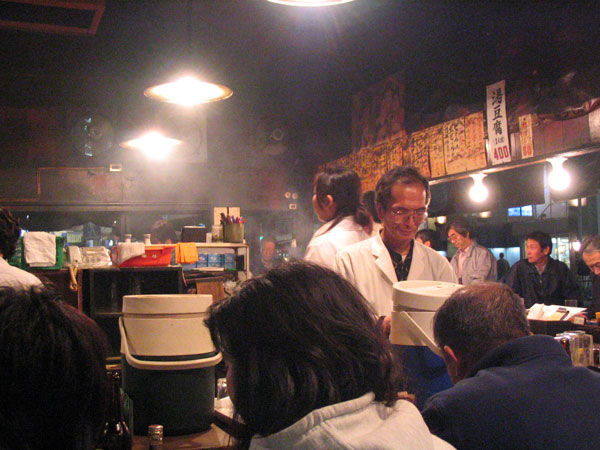
There's a paper menu, but for the large salarymen crowd the menu was right overhead. Notice the smokey fume inside this place. You could smell the yakitori from a block away.


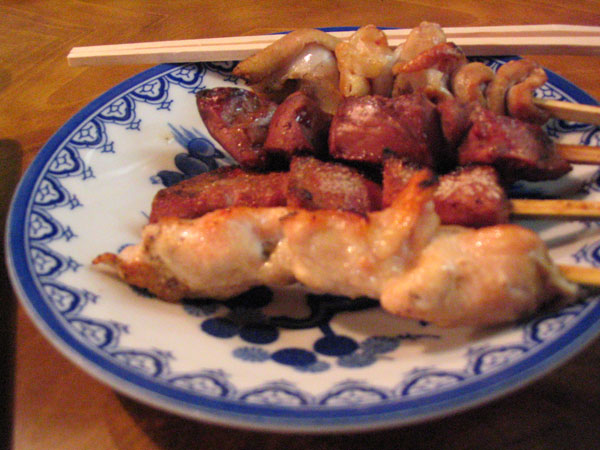
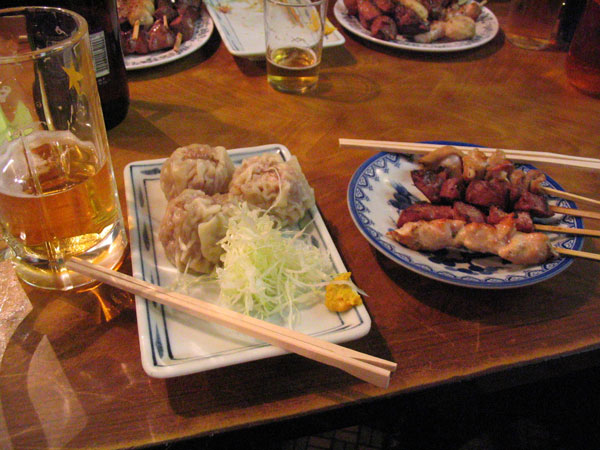
An order of Kushi Mix and 2 draft beers to sample the place. 320 yen for 4 sticks. I think that was one yakitori, one liver, one heart, and one skin. It was worth the 80 yen but not spetacular, especially since I'm not a big fan of medium rare liver. We later ordered a Nankotsu (soft bone), a Tsukune (minced chicken ball), and Gyuutan (beef tongue), and the Tsukune and tongue made up for the lost points.


We ordered Shuumai after the young couples. This was easily the best dish. Juicy and very soft in texture, it went very well with the green onion slices. I suddenly realized that a comparison of the Cantonese and Japanese Shuumai sums up the differences between the two cuisines quite nicely.


Neighborhood drama time! At this point an older man was standing over a client sitting nearest to the entrance at the counter. A cook (the standing guy in the white coat) came to the older man and a struggle ensued. The cook basically pushed the guy right out of the store amidst a series of yells. Was the older man pestering the client for some free yakitori? All I saw was that the client commended the cook after that man left. That in itself had that made the visit worthwhile.

Bill for two persons:
Nama Biiru x 2900 yen
Kushi Mix320 yen
Nankotsu, Tsukune, Gyuutan240 yen
Shuumai330 yen
(apply tax)
Total1880 yen

Day 1 - Poisonous Fugu

Day One (Sun):Narita Airport - Nippori - Shinjuku
Lunch:On the plane
Dinner:Fugu course at a specialist restaurant

Torafukutei (not the TorafuGUtei chain), Shinjuku


Narita Airport

Yahoo Japan's weather prediction lied! It was supposed to be a day of sun and clouds, but our plane descended towards a wet and dark Narita. And it's only 2:15PM!

The first impression of Narita from the sky is...how come there's so much farmland and green fields..I thought it's a suburb of Tokyo. (I realized later that it's in the next prefecture.)

An old officer was directing the traffic (Japan passport holders to the left side, Gaijin to the right) at the entrance to the immigration lineup for foreigners and speaking something to us (in Japanese of course) as we walked by. Hmm...I think he probably knew that most people in the lineup won't understand what he said.

Now how do I buy a regular (the cheapest fare) Keisei ticket to Shinjuku? I wasn't sure if the ticket counter spoke any English and so I started punching the buttons on a ticket vending machine. The buttons had names of some of the platforms on it, but somehow I thought the calculation was backwards. So I ended up going to the ticket counter.

The guy spoke English! Well, two word sentences, but better than my Japanese anyway. Two tickets to Nippori. Onegaishimasu. Hai? 4000 yen? Uh no, the cheaper ticket... Okay 2 tickets to Nippori for 2000 yen. That's not too bad.

We hopped on a Tokkyu (express, ie. skipping smaller stations) train towards Tokyo on the Keisei line and spent most of the 80 minutes watching the ornate house roofs and our fellow passengers...why are high school kids dressed in school uniform on a Sunday? The 1000 yen ticket got us to Nippori but now we've got to hop on the JR Yamanote line to Shinjuku. Ticket window time again. Okay Japanese 101 here we go.

Me: Shinjuku ni. (presenting our two Keisei tickets)
Attendant: Sambyaku hachiju en

Sugoi! My first conversation in Japanese in years lasted two words. And we got tickets to Shinjuku!

Shinjuku

The Yamanote was only slightly crowded, as it was a dark and rainy late afternoon on a Sunday. The next hour after arriving at Shinjuku came a big test of navigation and speed -- I had to pickup reservation of my Odakyu Romance Car tickets before it closes at 6PM, AND get two Sanrio Puroland tickets from the ticket vendors outside of Shinjuku Nishiguchi before they close at 7PM. All that in a totally foreign landscape of convoluted but interconnected paths. And pouring rain. And I had to leave my wife to guard the luggage. It was not fun. Even the two Tokyoites I asked (my Japanese miraculously came alive..don't ask me how) didn't know where the Odakyu ticket centre for Gaijin was (I went to the Odakyu ticket centre for locals but my reservation wasn't inside their system). Somehow I found a small English sign and found the ticket centre exactly at 6PM.

To get to the hotel in pouring rain we decided to take the bus, which I knew was called Shintoshin Junkansen (new city centre roundtrip). We jaywalked (with luggage and all) to the big bus loop only to find out that our bus only stops where we originally came out of the subway. Orz...

So we dropped off our luggage at Shinjuku Washington (checking in was smooth...the frontdesk spoke fluent English) and headed to our first real tour spot -- the FUGU restaurant.

Gourmet Spot #1: The Poisonous Fugu -
Torafukutei, Shinjuku
[UPDATE July 2008: The Shinjuku branch's site is down and it may have closed its doors. If interested, please check out the Ikebukuro branch.]

This is fugu (pufferfish).

Its legendary status is in part due to the fact that its liver and ovaries contain enough poison to kill many adults, and there is no antidote once you discover the main symptom of lip and tongue numbing. People die every year, but the unique sweetness of the meat still draws millions of fans. And we were about to add to the fan list.

The restaurant was called Torafukutei, not to be confused with the TorafuGUtei chain. I chose this place because the dinner courses were very reasonably priced for a fugu restaurant, where 10000+ yen courses are quite normal. After all, you live or die depending on the skill of the chef.

We were given a private room of traditional dark wood decor with lantern lighting. The waitress spoke some English, "This is fish. And beef hotpot," as she pointed to the 5000-yen-upwards courses. I think she was very surprised when we ordered one 3000 yen and one 4000 yen course AND THEN produced a 10%-off-coupon from Hotpepper.
[UPDATE July 2008: Coupon no longer available online -- pick up a printed copy of Hotpepper lying around subway stations maybe.]


The first course was Fugu Kawa Yubiki -- a boiled fugu skin salad with ponzu and red pepper. Like most fish skin it was quite chewy, but had to depend on the sauce to bring out its flavor.


We ordered a cup of hirezake (wine infused with fugu fin). The waitress lighted up the fugu fin and covered the cup to infuse the flavor of the flame broiled fin. Very intensely fragrant. It's said to get people drunk easily, but didn't fell a light drinker like me.


Here comes my favorite dish of this meal. For a 3000-4000 yen meal We expected about 6-8 slices of Tessa (fugu sashimi), but we got 20 per person! I'm not sure how Tessa was supposed to taste (at 3000 yen it surely wasn't wild fugu), but the sweetness of the meat was very noticeable and distinct. Not the mirugai kind of sweetness, but a more subtle *umami* taste. And the chewiness of the meat brought me to keep chewing and tasting the meat for a long time.


Then a waiter brought the stove for our Sumiyaki Fugu (charcoal broiled). Note the two sauces. I liked the darker sauce the best, but I had no idea what it was (Aka Miso + Mirin?).


And this is how the broiled fugu looked like. We joked about how similar the texture was to chicken breast, except the taste was of a sweet and *very* fresh fish.


Then came the big Tecchiri, which was a hotpot of fugu chunks (with bones) and vegetables. By now all of the fish except for the head and the internal organs were used in this meal (just count...skin, fillet, fin, meat and bones).


Another waitress came and prepared the last dish for us. She was surprised when I asked to take a picture...Watashi mo?...and then giggled and posed. The dish consisted of mixing cooked rice and eggs to the remaining soup in the hotpot.


Last but not least, the Zosui. It seemed that the the entire sweetness of the fish went into the broth. It was incredibly *umami* for a fish broth.

I did get a little diarrhea symptom right after the meal...food poisoning? The scary thought crossed my mind for an quick instant, and then my reasoning told me that fugu poisoning wasn't like that!

Daimanzoku! Crossing off one item on my list of THINGS TO DO BEFORE I DIE. (This would sound much more ominous before the meal.)

Food Bill for 2 persons:
Yaki Fugu Set3129 yen
Tecchiri Set4179 yen
Hirezake735 yen
(apply -10% coupon and 5% service charge)
Total~7600 yen