Pages

Saturday, February 7, 2009

Traveling the Ancient Nakasendo Highway - Part 2: Tsumago-juku


This article is about a remarkably charming place with a notably hard-to-pronounce name.

Are you a photographer? Then come and frame your perfect moment.

Or are you a history bluff? Then come and live in Japan's feudal past.

But most likely, you're a casual tourist like me -- then come and experience one of the most unique and beautiful towns in Japan.


In any case, this article is what I remember of our stay at Tsumago-juku, IMHO the most picturesque town within Japan's historic Kiso Valley, and one of my favorites small towns anywhere in Japan. While some may argue that it has been attentively manicured into somewhat of a tourist trap, its undeniable aesthetic quality has been widely recognized by domestic tourists since the 1960s.


In fact Tsumago-juku is probably one of my top three favorite photographic destinations in Japan, just below the internationally famous Kyoto and the UNESCO World Heritage Site of Shirakawago on my list. Japanese photographers and painters had re-discovered this place several decades ago, and were at least partially responsible for bringing its historical and touristic significance to the attention of conservationists. Most Japanese would have at least heard of its name, but somehow it has remained outside of the radar for most tourists -- which is precisely why I highly recommend it.


You're probably asking ... where exactly is Tsumago-juku?

It's conveniently located about 1.5 hours east of Nagoya, easily within day-trip distance if you're staying anywhere near Nagoya, and a fantastic place to spend a night if you're traveling between Tokyo and Kyoto/Osaka. It's not on the Shinkansen (bullet train) route, which is also why it has been able to preserve that rustic small town charm.


That's not to say you won't encounter any crowds ... this is Japan after all. Everyday multiple bus-loads of Taiwanese, Korean and domestic tourists get dumped at the entrance of the town and are given less than an hour to rush through the sights and do their obligatory souvenir shopping. But after the departure of the day-trippers, the bustling town once again reverts to its old rural self that has persisted for the past four centuries.


As I've mentioned in the previous article in this series, Tsumago-juku was one of the 69 official "post-towns," or rest areas, along the old Nakasendo highway that connected the Emperor's ceremonial court in Kyoto with the Shogun's government in present-day Tokyo. The stretch of the ancient route through the town still serves as the main street where the majority of the town's traditional handicraft studios and Minshuku guesthouses are found.


You've got to admire the local government's will in its conservation effort here. In addition to pedestrianizing the main street, all electrical poles, lamp posts and any utility infrastructure that appeared remotely modern had been relocated to underground. So as we strolled into town on a late Friday afternoon, the first impression was just an endless row of individually styled but uniformly antique, two-storey wooden Machiya houses, dimly illuminated by nothing but the faint glow of paper lanterns hanging from the roof of the first floor. That was a magical stroll back to the 1800's.


As if the sunset wasn't impressive enough, the evening would get even better. The entire town became a totally unreal dreamscape ... old wooden houses, the swaying of lanterns in the wind, the dim rectangular glow emitting out of the latticed windows, the light reflections on the smooth cobblestone footpaths, the dark sidestreets ... It's like dreamwalking into a movie where a masked Ninja may jump out at any moment to assassinate a traveling Daimyo. Okay that's my imagination ... but you get the picture.


I highly recommend spending a night in town -- not only for the eeriely unique evening walk, but also for the chance to have the entire town to yourself in the early morning when you can claim all your favorite photospots without any obstruction. A day-trip is doable, but prepare to rub shoulders with coach-loads of tourists inside the souvenir shops and at the several famous sights in town.


One of the most well-known (and well-photographed) attractions in Tsumago-juku is the restored Kosatsuba, the feudal government's official bulletin board announcing the Shogun's edicts and laws to the townspeople and passing travelers. Announcements were handwritten on wooden plaques and strategically positioned here at the most conspicuous spot along the main street, such that nobody could be excused for not observing the laws. The plaques we see today may be modern day replicas, but the contents are genuine historical decrees. The edict at the top dates from 7th Year of the Meiwa reign (Year 1770 in the Western world), announcing an attractive reward for informers against local insurgents consisting of:

- 100 Ryo of Silver ... which was already a lot of money, plus ...

- One officially engraved sword, a great honour for a commoner during an era when only the Samurai class could carry swords.


But my favorite attraction was a place I consider a goldmine of photographic opportunities -- the homey and yet visually impressive former residence of the Hayashi family. Also known by its feudal era designation of Waki-Honjin, this beautiful complex of immaculate rooms and gardens was once the town's second best official reception house for traveling royalties and government personnels. Today it has been preserved as an Important Cultural Property, crowned with a new interpretive museum right next door.


Here you won't find the opulence of Kyoto or even the refined taste of Kanazawa -- instead you'll see a raw, unpretentiously rural residence of a locally influential clan. Back in the days when two government officials would potentially crash into town at the same time, this was where the lower-ranked would grudgingly rough it for a night ... so to speak. As we were welcome into the same greeting rooms that used to receive traveling Daimyos, the old Tatami-mat floors were still adorned by the two square Irori firepits, their flickering flames maintained by museum curators.


If you're patient enough to get past the broken English, the curators will tell you a cool story behind an ordinary-looking table now regarded as one of the museum's great treasures. When Emperor Meiji visited Tsumago in 1880, the local carpenters had to design a new table without the use of any nails, since the nail's head signified the Emperor and hitting on it with a hammer was considered taboo. And while you're there, don't miss the royal toilet built specifically for, but (reputedly) never used by, the Emperor.


There's also a famous love story behind this building. A daughter of the Waki-Honjin's master became the first love of a son of the master of the Honjin at Magome-juku, the next post-town on the other side of the hill. It would have been the perfect marriage if the two were born ten years earlier, but this was right after the Meiji Restoration, when Japan emerged from centuries of cultural stagnancy and opened itself to revolutionary ideas from the Western world. So the boy ended up being sent to school in Tokyo and the girl ended up marrying another man ... or that's how the legend goes. The undisputed fact is that the talented boy became the great poet and novelist Shimazaki Toson, and excerpts from his poem "First Love" is now displayed at the second floor of the Waki-Honjin.


And in case you're wondering what happened to the residence of THE wealthiest family, the original Tsumago Honjin burned down years ago and a replica was rebuilt at the same spot in 1995. But even though the reconstruction has resulted in a traditional, fine-looking modern-day Honjin, it's no comparison to the historical atmosphere of the Waki-Honjin ... the smoky kitchen and its earthen stoves, the under-staircase cabinets, and the colourful carps splashing in the courtyard garden. I would be content to just sit here for hours, and enjoy the good life as it was in the 19th Century.


Regardless of whether you're a photographer or not, definitely don't miss the beauty of the Waki-Honjin. As of early 2009, 700 yen (CAD$7) would get you joint access to the Waki-Honjin, the Honjin, and the interpretive museum, collectively the only attractions in Tsumago that charged admission fees. Further down the street you would find free access to the half-empty shells of several feudal period houses (eg.Kami-sagaya and Shimo-sagaya), good places for brief rests especially on weekends when handicraft artists bring out their wares and give free demonstrations.


One can make a valid point that Tsumago-juku has been over-commercialized into somewhat of a tourist trap, but that also makes it quite a decent place to hunt for authentic, traditional souvenirs among its couple dozen craft shops and studios. Along the length of the main street you'll find anything from hand-made Washi paper to antique furnitures to ... well ... all kinds of fascinating stuff you don't really need. If you're in the market for a pair of wooden clogs for whatever reason (eg. I use mine for taking out garbage), the Eiraku-ya shop pictured here has been producing Geta clogs made of local Nezuko wood for the past 90 years.


But to domestic tourists, perhaps the biggest attraction in Tsumago is the whole nostalgia of the town and of the charming townspeople, and the amazing nonchalant lifestyle enviable to anyone coming from the megapolis of Tokyo or even nearby Nagoya. It's the kind of simple contentment in sitting at the front veranda and watching the funneling of raindrops down the curved roof tiles, or an "Ohayou!" from the elderly Obaasan as she carries her rice seedlings to the field.


So now you can see why I'm recommending an overnight stay if possible, as a daytrip is hardly enough for anything more than just photos and a superficial tour. If you're curious about life in rural Japan but never had the chance, this would be one of the best places for a delicious sampling of the simple life. In fact we loved it so much that we spent two nights in this valley, one at Tsumago-juku and one at Magome-juku, and none at Nagoya.


In case you're worried about the practicality of staying at such a small and rural town, it's actually not as rough as it sounds. Nagoya is less than two hours away (see TRANSPORTATION section at the end), and the town is surprisingly functional with many modern necessities -- general store, medical clinic, police station, post office -- except everything is still trapped inside traditional Edo Period townhouses.


One more recommendation ... if you've come this far, you may as well allocate a few more hours to visit the equally charming Magome-juku, the next post-town along the old Nakasendo route at only 25 minutes away by bus. The last time I checked (early 2009), Tsumago-juku and Magome-juku were putting together a joint proposal towards recognition as a UNESCO World Heritage Site for their preservation of late-feudal period townscapes. And if you have even more time, you should consider a 2.5 hour hike into Magome-juku through the old Nakasendo mountain path itself, a satisfying experience to which I'll probably dedicate an entire article in the future.


RESTAURANT CHOICES

A small concentration of informal eateries can be found on the main street, serving simple Teishoku lunch sets, Soba noodles, and the locally famous Gohei-mochi rice cakes. Note that these eateries typically open only for lunch, so make sure you have other arrangements for dinner.

Lunch at Tsumago-juku wasn't even part of our original plan, as I wanted to start our anticipated 2.5 hour hike to Magome-juku in the late morning and have lunch somewhere along the hiking route. But as we replenished our supplies before the hike, the local store owner informed us that there weren't any restaurants past the point of O-Tsumago, and that our best bet would be to fill-up at the "Gohei-mochi san" around the corner.

It was our first visit to the region of Aichi-Nagano and we had never tried Gohei-mochi before, so that's not a bad proposition I thought ...


Food Review: SHINYA (Tsumago-juku)
Address: Nagano-ken Nagiso-machi Azuma Terashita
Hours: 10:00 - 17:00
Website/Map: From Tumago.jp (Japanese)
Directions: Starting from the Information Centre at the centre of the town, walk along the main street towards the southern end. Shinya is near the end of the town, on the right hand side.


So around the corner we walked, where it stood this old take-out stand / noodle-house with about four tables run by an elderly couple. It was a typical setup with Ojiisan pounding the rice and blanching noodles at the back of the kitchen, and Obaasan working the cashier and helping out with boiling soup for the noodles.


I remember the smiling Obaasan "douzo"-ing us to sit down, but I don't remember there being a menu sheet -- the eatery's entire repetoire of four or five items were simply posted on the walls: plain Soba noodles, Soba noodles with Sanzai (wild-harvested vegetables), Soba noodles with a raw egg, and Gohei-mochi rice cakes. Nothing fancy, and nothing over a few hundred yen. It's just a charming little Soba-ya located along the Nakasendo hiking route, with a little fridge of beverages at the front to lure in the occasional thirsty hiker.


Arriving after 10 minutes was my top-of-the-line Tsukimi ("moon viewing") Soba noodles, metaphorically named after the floating egg yolk and served with local wild vegetables. My wife had the Sanzai Soba, which was just the Tsukimi Soba minus the egg for 100 yen less. The handmade Soba was a little greener than the supermarket variety and was served in a light-tasting Dashi broth.


And the Gohei-mochi was EXCELLENT ... that store owner sure knew what he's talking about! I was pleasantly surprised that they weren't made of mochi-rice, but heavily-pounded balls of plain rice brushed with a sweet soy-and-walnut-based sauce and grilled over the charcoal flame. While the outside was grilled to a deeply aromatic, semi-crispy skin, the inside maintained a soft and chewy texture with the rice having been pounded halfway from individual grains into smooth glue. Pictured here was only ONE OF THE SIX mochis ... the rest had been chomped down by the two of us in a hurry.

Bill for Two Persons
Tsukimi Soba800 yen
Sanzai Soba700 yen
Gohei-mochi (6 pieces)500 yen
Ramune Soft-drink120 yen
TOTAL2120 yen (CAD$21)


ACCOMMODATION CHOICES

Staying within Tsumago-juku means that you'll definitely get the full Japanese experience at one of the traditional Machiya townhouses, many dating back to the 19th Century, as there are simply no Westernized hotels. The three full-service Ryokans all charge around 10000 yen (CAD$100) per person including dinner and breakfast, while the independently operated Minshuku guesthouses charge around 8000 yen (CAD$80). Or if you're willing to make the 15 minute walk to the little hamlet of O-tsumago, some of the Minshukus there offer the same package for around 7500 yen. It's also possible to book a night's stay without the dinner and breakfast, but where are you going to get your dinner with the entire town closing down around 18:00?


There is no official English booking website at the time of writing (Jan 2009), so the easiest way to book is to directly email the Kiso Reservation Centre at chojiya@janis.or.jp. Provide the following in simple, point form English:

- your date of arrival
- number of nights
- total number of people in the group
- number of rooms required
- whether you want dinner and breakfast
- whether you want a RYOKAN (full-service inn) or a MINSHUKU (guesthouse)


You can specify a certain Ryokan or Minshuku and get them to book it for you, or they'll just book you into one that has experience serving foreign guests. In any case they'll reply with a humorous computer-translated English email to confirm your booking. Here is what I received:

"This time thank you very much for a reservation of the lodging to wife basket inn trip basket bottom Saga-ya ..."

You've got to feel sorry for the guy -- I think he's really trying his best, but the computer-generated translation was just barely comprehensible. After having a good laugh for about 10 minutes, I wrote them again in Japanese and asked for a Japanese confirmation email for the Minshuku we wanted ...


Hotel Review: SHIMO-SAGAYA (Tsumago-juku)
Address: Nagano-ken Nagiso-machi Azuma Terashita 805-1
Price: 8300 yen per person per night, including dinner and breakfast (the pricing scheme advertised on the website is no longer current)
Website/Map: http://www.takenet.or.jp/~sagaya
How To Book: By email to chojiya@janis.or.jp
Directions: Starting from the Information Centre at the centre of the town, walk along the main street towards the south until you see the crooked tree (see the photo at the beginning of the article). There's a tiny little lane on the right hand side, a few houses before the tree. Shimo-sagaya is inside that lane on the left hand side.


This actually turned out to be one of the most memorable stays of the trip ... but not for the reason we expected.

We booked our Minshuku based on a friend's recommendation -- the little Shimo-sagaya hidden just off an attractive stretch of the main street. On one side stood the famous crooked tree featured in every Tsumago-juku brochure, and on the other side, the 200-year-old Ryokan Matsushiro-ya.

Now, this Minshuku is not to be confused with the OTHER Shimo-sagaya next door, a two-centuries-old empty shell of one of the town's oldest houses and a designated historical monument. The Shimo-sagaya Minshuku isn't quite that old, and the interior has been recently renovated to a comfort level approaching some Ryokans. A pleasant surprise for sure ... but not quite enough to make a memorable stay.


The big surprise awaited us at the dinner table, where our full 10-course meal was accompanied by a glass of plum wine as an aperitif. It was a exhaustive sampling of the region's local delicacies including horse sashimi, a salad of Kogomi ferns, wild bamboo shoots and Zenmai ferns as a simmered dish, a dish of tempura and a freshwater fish.

But no, that's still not the memorable part ... the REAL surprise was ...


Deep fried grasshoppers in a sweet mirin-soy-sauce glaze. I have to confess that this wasn't my first encounter with insects as a delicacy, and I wouldn't have been too surprised if this was Bangkok or even Beijing. But right in the middle of Japan? That's a bit of an eye-opener for a self-proclaimed Japanese food lover like me.

As with most insects, the climax of the whole experience was in the anticipation rather than the actual tasting or swallowing. To my tastebuds these little crunchy creatures was little different from anchovies, except without the saltiness of the sea, and the sweetness of the marinate prevented me from really discerning the natural flavor of grasshoppers. Besides, my significant half, the half who possesses the most sensitive tastebuds, natually didn't touch her portion at all.


Though the rest of the meal didn't present further surprises or any superb culinary wonders, the general quality of the dishes were quite good for a family-run Minshuku. The tempura featured my favorite springtime topping again -- the wildly fragrant Yamaudo leaves served with Matcha salt for dipping.


For the FIFTH straight evening an Iwana trout landed on my dinner tray, only this time the fish was simmered in a sweet soy-sauce (Iwana Kanro-ni) instead of being roasted on a skewer, which was a much welcome change. To this day I'm still not a big fan of Iwana trouts, from which one can hardly escape when traveling through the mountains of Central Japan.

At dinner we sat beside a young Thai couple on their honeymoon, along with three other pairs of Japanese tourists arriving on that same day. That's a total of five rooms, which probably was the full capacity of this little Minshuku. Unlike some of the even older Minshuku houses we've stayed at, there was no Irori firepit in the middle of the dinner room around which the guests could gather.


The breakfast was quite decent again, in addition to just being large and filling. I was a little surprised when I saw the scrambled eggs ... scrambled eggs in a rural Japanese breakfast? Or perhaps our hosts deliberately avoided serving raw eggs as a courtesy to the four foreigners? I would never find out, but I did see the Japanese guests happily chomping down the same scrambled eggs that we got.


Our stay at Shimo-sagaya was quite pleasant overall: a spotlessly clean 6-Tatami-mats room, decent dinner and breakfast, and a location that's very tough to beat. Of course the washrooms and bathroom were communal, but that's just how 99.9% of the Minshukus work. Perhaps the nicest feature of all was a full ENGLISH manual of the Minshuku, covering everything from operating the room's Air-Con to meal arrangements to sightseeing recommendations. IMHO this little Minshuku is bound to receive a lot more international tourists for years to come.


TRANSPORTATION

If you're coming from Tokyo, Osaka or Kyoto, take the Shinkansen train to Nagoya first.

Tsumago-juku is located near the Nagiso Station on JR's Chuo Main Line, east of Nagoya (1.5 hours by local train) and west of Matsumoto (2.5 hours). Note that Express Trains do not stop at Nagiso -- you can take the Express Train to save time getting to the vicinity, but you'd have to get off at the nearest major station of Nakatsugawa and wait for the next local train anyway.

So just to make it clear and easy ... if you're coming from Nagoya, just take the local train towards Matsumoto/Shiojiri. And if you're coming from Matsumoto, just take the local train towards Nagoya and enjoy the countryside scenery for a while!

Once you get to Nagiso you have a few options to reach Tsumago-juku:
(1) Hike into Tsumago-juku, taking about an hour to go through a scenic stretch of the old Nakasendo path
(2) Hire a taxi if you see one around, which should cost perhaps 1200 yen (CAD$12) for the short 5 minute drive. It would make sense if you have three people or more.
(3) Take the bus like we did, which costs 300 yen per person for the 7 minute ride. I haven't come across an accurate and up-to-date English timetable for the bus, but at least the Official Timetable marks "Tsumago", "Nagiso" and "Magome" in English. I've translated the rest below:

NAGISO - TSUMAGO

Daily; 300 yen each way

Nagiso - Tsumago
08:15 - 08:22
10:40 - 10:47
12:35 - 12:42
15:00 - 15:07
17:40 - 17:47

Tsumago - Nagiso
07:44 - 07:53
09:14 - 09:23
11:54 - 12:03
13:39 - 13:48
16:04 - 16:13


NAGISO - TSUMAGO - MAGOME

Daily March to November; Weekends only December to February
Additional service from mid July to end of August

Nagiso to Tsumago 300 yen
Tsumago to Magome 600 yen
Nagiso to Magome 800 yen

Nagiso - Tsumago - Magome
10:10 - 10:17 - 10:45
12:35 - 12:42 - 13:10
14:20 - 14:27 - 14:55

Magome - Tsumago - Nagiso
10:55 - 11:21 - 11:30
13:15 - 13:41 - 13:50
15:00 - 15:26 - 15:35

At Nagiso, the bus stops right outside the train station, usually picking up a small crowd of tourist and daily commuters. The Nagiso - Tsumago - Magome bus is particularly useful for anyone planning on using Tsumago as a base for visiting Magome (or vice versa).


USEFUL LINKS

SIGHTSEEING:
Tourism Association (Japanese) - http://www.tumago.jp
An excellent English introduction - http://www.town.nagiso.nagano.jp/html/english/engtop.htm

TRANSPORTATION:
Bus Schedule (Japanese) - http://www.rosenzu.com/ontake/nagiso.html
Train Schedule Search - http://www.hyperdia.com/

ACCOMMODATION:
Official Reservation Centre (Japanese) - http://www.janis.or.jp/users/chojiya/chojiya.htm
English Reservation Agent - http://www.japaneseguesthouses.com/db/tsumago/
Minsuku Shimo-sagaya - http://www.takenet.or.jp/~sagaya/index4.html
Minshuku Daikichi (Japanese) - http://www17.plala.or.jp/daikiti/
Ryokan Matsushiroya (Japanese) - http://www17.ocn.ne.jp/~hatago-m/

Tuesday, January 20, 2009

Traveling the Ancient Nakasendo Highway - Part 1: Narai-juku


This is the first of a series of articles on what I consider to be one of Japan's world-class destinations, a chain of beautiful historic towns along an ancient highway where time has seemingly stood still since the 1800's. It's one of those rare magical places on earth where you can still read the Shogun's old edicts upon the entrance into town, learn the region's indigenous dance from your eighth-generation Ryokan host after a sumptuous countryside supper, then take an evening stroll along an entire town of wooden Machiya houses with the only illumination coming from the dim row of paper lanterns overhanging the second floor veranda.


This was also our last major destination before our flight home from Nagoya, the beginning of the end of this long train-and-bus trip through West-Central Japan. As we waved goodbye to Matsumoto on a sunny Friday afternoon, a local train took us into the ancient Kiso Valley where we're planning to spend a couple nights among the three best-preserved towns along the feudal-era "highway" of Nakasendo, with a little hiking in between should the weather permit. The names of these towns? Narai-juku, Tsumago-juku, and Magome-juku.


What's with all these "-juku" suffixes? Well, these are the remaining "Shuku-ba", or post-towns, along the old trade route that stretched from Kyoto to present-day Tokyo, and among the last places in Japan where complete functional towns from the Edo-Period have been successfully preserved. Designated 400 years ago by the Shogun's government as official rest stops for travelers, the original settlements and the ancient mountain path that gave birth to them date back at least another thousand years prior. So we're talking about an entire series of towns whose sole purpose of existence was to cater to the flow of ancient traders and travelers, and bustling with traditional inns, teahouses and sundry shops throughout most of their long histories.


Since the railroad effectively replaced the old mountain path a hundred years ago, the towns fell into slow disintegration for decades until the government realized their significance and nationally declared them as Protected Areas of Traditional Architecture. As today's visitors stroll into town with their camera lenses, all they picture is but a fraction of the town's former glory. And nowhere is this more evident than at Narai-juku, our first stop within the Kiso Valley.


Getting to Narai-juku is easy -- just hop off the infrequent local train at the Narai Station of the Chuo Main Line. Once revered as "Narai's Thousand Houses," this small town used to be the major population centre of the region, and today remains the only town served by the JR Train out of the three we visited. The old Nakasendo still serves as the town's main street, albeit paved and parked with the odd Toyota trucks as a reminder that you ARE in the 21st Century.


Even though there's a museum and a few old temples and shrines in town, to us the main attraction here was the town itself and the descendents of the townspeople who had been continually inhabiting these inter-connected rowhouses for centuries. As we were just admiring the wooden facades of each house and soaking up the atmosphere, the local children walked by us with their genuine smiles and "Konnichi-wa!" greetings, then proceeded to scoop up a fresh afterschool drink from one of the many springwater wells along the street. But behind this refreshing friendliness lies the sad observation that these may well be the only elementary school aged children out of a town of several hundred people -- a common phenomenon in this era of urbanization and greying population in Japan. I hate to speculate what would happen to this beautiful valley in thirty years when the older generation passes on.


The main industry in town seems to be the production of traditional lacquerware, as we encountered no less than half a dozen lacquerware studios along the main street, including the lovely Matsuzakaya pictured here. In case you're wondering ... no, this has absolutely no connection with the Matsuzakaya Department Store, and instead has been a local fixture at this remote little town for over a hundred years. Fourth-generation lacquerware artist Uehara-san still handcrafts his nature-inspired motifs into most of the shop's offerings, which ranges from little chopstick stands to large ornamental sculptures. After watching the old master painstakingly polish his latest creations, we ended up buying a teardrop-shaped ladle with red maple leaf motifs (fit for a Canadian, eh?) for measuring tea leaves, for about 600 yen (CAD$6).


Just down the street from Matsuzakaya, the heavy wooden plaque of another lacquerware store (Shibata Shikkiten) hangs beneath a traditional second floor veranda. The smaller plaques on the right state the owner's name of "Shibata Nobuo", as well as the phone number -- "Number 18" -- which gives you an idea of just how small and close-knitted this town is.


The red-white-and-blue of an old barber shop flanks the square gate leading to the village's main Buddhist temple, the Daihoji. The writing on the right pillar states the temple's most famous artefact, which is ironically a quasi-Christian statue known as the "Maria" Jizo. The enigmatic stone statue of a seated female holding a child with an engraved cross is claimed by the townspeople as a Virgin Mary figure disguised as a Buddhist Jizo, referring to an era when when Christianity was banned under the edict of the Shogun.


Unlike the more elaborately feudal towns of Tsumago-juku and Magome-juku, here in Narai-juku time seems to have proceeded in slow motion over the past century, producing an interesting mosaic from different eras of Japan's history. The 160-year-old official reception house from the Shogun'speriod evolved into a Taisho-era (1920's) coffee house that still serves a delicious relic from its time -- rich, smooth "syphon" coffee brewed using vacuum coffee makers. Long considered too time-consuming and mostly eliminated in the Western world, this brewing method is still hailed as the ultimate way to produce top quality, silky smooth coffee in different corners of Japan. If you have time to sit down for a romantic afternoon date, a coffee-and-cake set goes for 750 yen (CAD$7.5) at the time of writing -- not a bad way to pass time while waiting for the next train.


Appearing to pop right out of a 1950's movie set, the unpretentious general store is simply a goldmine of old advertisement signages you wouldn't expect to find outside of museums and movie studios. I just LOVE that old signage of "Matsushita Electrical Appliances," better known nowadays as Panasonic both within Japan and abroad. The other signages advertises two competing brands of a local herbal pill known as Hyakuso-gan, an age-old remedy for gastro-intestinal problems. And then there are the old coin-operated toy dispensers at the store front, weathered and rusted for who knows how many decades. For anyone over 30 who spent at least part of the childhood anywhere in East Asia, this is an absolutlely magical scene reminescent of childhood, of the walk home from school, and of the warmth of elderly storekeepers selling everyone's favorite snacks.


Contributing further to the small-town charm, an oversized ball of cedar twigs announces the presence of the local Sake brewery, in a fashion similar to Austrian Heurigers placing pine twigs to announce the availability of their new wine. The pride of Narai-juku, the Sugi-no-mori brewery has been handcrafting its namesake wine since Year 1793, and is currently operating under 8th Generation brewmaster Hirano Kyuhei. I did check the price out of sheer curiosity: 2500 yen (CAD$25) for a litre of Junmai (pure, non-diluted) Sake, and 7500 yen (CAD$75) for the top-of-the-line Daiginjo ... definitely not on the cheap side as far as Jizake (local brew) goes.


As you might have expected from a town of this size, there didn't seem to be many choices as far as lunch options went. The intriguing Echigoya, with its large signs advertizing mortar-ground, handmade Soba noodles and Gohei-mochi rice cakes, seemed like a decent spot for an informal meal. Prices were relatively cheap -- 1000 yen for a Mountain Vegetable Teishoku set to 2000 yen for a full meal with carp sashimi and grilled Iwana trout -- but we decided to save our room for dinner.


One of the unmistakable signs of springtime in rural Japan is the chirping of nesting swallows underneath old roofs, and in this case, right on top of the name plate of a certain Hara-san.


The shine of a new fire truck was vaguely visible through the wooden lattice of this traditional-looking enclosure, which upon closer examination turned out to be part of the local fire department. With the historic town made up of two connected chains of highly flammable wooden townhouses, it's no surprise that fire prevention is placed at the highest of priorities.


Suddenly a farmer's market appeared out of nowhere and became immediately surrounded by customers who seemed to be waiting for its arrival. Want to bring home an organic Japanese Kabocha squash for dinner? That would be 400 yen. Daikon radishes had been sold out at 200 yen each, while lettuces were still available at two for 100 yen.


And the street goes on and on, with even more lacquerware studios and Minshuku guesthouses and little sidestreets leading to various temples and shrines along the way, until the edge of the town where the main street turns into a cobblestone-and-dirt path -- the REAL Nakasendo -- which winds its way into the wilderness towards the next post-town. So you get the idea ... if hiking is your passion, you could follow the Nakasendo and go on for days, eventually reaching our next destinations of Tsumago-juku and Magome-juku. For ourselves, the speed and comfort of the modern train was good enough.


TRANSPORTATION

Narai-juku is located a little over two hours east of Nagoya on JR's Chuo Main Line, or about 45 minutes west of Matsumoto from the opposite direction. If you're coming from Tokyo, an Express train will get you to Matsumoto in 2.5 hours, where you can then transfer to Narai on a local train. Or if you're from Osaka or Kyoto, simply take the Shinkansen to Nagoya and transfer from there. So it's relatively convenient -- but there are a few caveats to be aware of:


(1) Narai Station is served by local trains only, so visitors coming in from Nagoya on Express trains will need to get off at the larger station of Kiso-Fukushima and wait for the next local train in the direction of Shiojiri/Matsumoto. Visitors coming from Matsumoto should simply take the local train in the Nagoya direction ... otherwise you'll zoom right past Narai. Check the latest timetable at Hyperdia before your trip.


(2) Beware of the "One Man" train, indicated by the above Katakana writings. Some of the local trains along this route are operated as "One Man" trains, where a single conductor (which could be one man or one woman) stands at the first car of the train to examine your ticket and let you off the train ... but this applies only to the smallest local stations such as Narai which does not have a ticket kiosk of its own. In simple terms, the passenger who wishes to get off at such a station needs to sit in the first car, present his ticket to the conductor upon the train arriving at the station, and the conductor will ensure that the cost of the ticket is enough to cover the train fare, then let the passenger off the train by opening only the door closest to the front of the train. We didn't know how it worked the first time, and we would have missed Narai had a middle-aged lady not directed us to hurry to the front of the train as it pulled into the station. Long story short -- just sit at the first car and stay close to the conductor.


(3) If you're not staying overnight and need a place to stash your backpacks like we did, there's an attendant inside the train station who will keep your luggage for about 300 yen a piece ... but you ABSOLUTELY need to get them back before 17:00.


MY WIFE'S CORNER


The old Narai-juku gained its prosperity as the gateway to the mountain pass of Torii-toge, where the Nakasendo Highway crosses Japan's continental divide to reach the other side of the Southern Japan Alps. Well known for the heavy snow dumps in the winter, these mountain ranges are equally famous for the summertime production of high quality fruits such as the famous Kyoho Grapes. The words on this pendant simply spells "Arupusu," the Japanization of "Alps" and a reference to the large, syrupy sweet grapes grown right here in the Nagano Prefecture. This was purchased somewhere between Matsumoto and Narai-juku for about 450 yen.

Thursday, January 8, 2009

Curious about Horse Meat in Matsumoto


I must confess that I always, ALWAYS fall for exotic local cuisines wherever I go. It's not that I don't appreciate the cuteness of rabbits or that I don't get grossed out by grasshoppers ... but if it ends up on the dinner plate of the locals, then give me my portion too onegai-shimasu! So when I heard about the local specialty of BASASHI while planning our visit to Matsumoto ... well you know the rest of the story ...

What's BASASHI? I'm not going to dance around trying to euphemize these two simple words ... BA as in horse, and SASHI as in sashimi. Enough said. Your imagination is exactly correct ... we're talking thin, bloody slices of raw horse meat. So if beef sashimi is beyond your acceptance, you should stop reading roughly halfway down this article.


But don't let the culinary history of the locals deter you from visiting one of Japan's most beautiful original castles. Matsumoto may present an impression a modern industrial city upon your arrival at the train station, but take a slow walk along the city's narrow side streets and you'll soon encounter vestiges of its glorious feudal past as a fortified stronghold.

Strategically situated along an ancient mountain route between the Shogun's government in Edo (modern-day Tokyo) and the Emperor in Kyoto, Matsumoto has always been an important castle town in Central Japan and still boasts one of the most recognizable national symbols, the one big tourist attraction any high school student in Japan could name ...


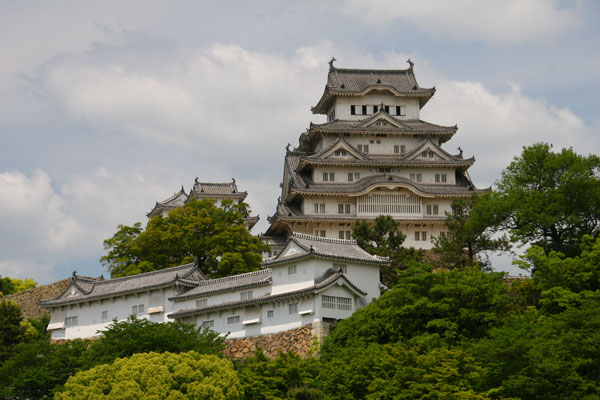
The imposing, black-lacquered Matsumoto Castle dating from the 16th Century, best known as one of the "Four National Treasure Castles" of Japan and on par with the more internationally famous Himeji. And to keep itself on par with Himeji, the city is actually putting together an application for the castle to be recognized as a UNESCO World Heritage Site. But to the Japanese themselves, Matsumoto Castle is already widely recognized as THE perfect opposite of Himeji Castle, with its dark masculine defensive structures forming a stark contrast against Himeji's white plaster walls -- hence the nickname for Matsumoto's "Crow Castle" versus the "White Egret" of Himeji. For a quick visual comparison, here's a picture of Himeji from our previous visit:


As one can see, Himeji is more artistically ostentatious with its sprinkling of roof-top ornaments along the curving rooflines, and its perfectly white plastered walls decorated with large slatted windows. Matsumoto on the other hand is all about strong, masculine straight lines, rectangular crenellations, and a sloping stone base protected by a 20-metres-wide moat. Both are undisputable masterpieces of Japanese architecture, but if I have to pick just one favorite castle ... for me it would be Matsumoto.


Either Matsumoto or Himeji would make a great half-day trip if you're in the neighborhood of Kansai or Central Japan. Unlike the modern concrete-constructed museums like the Osaka Castle or the Nagoya Castle, here you get to walk on the same creaky wooden planks that had been smoothened by the feet of the warlords and his troops for centuries, climb the steep wooden staircases all the way to the top, and stick your head into the defensive crenellations and archer holes.


One of the many staircases leading to the top floors. It's not surprising that many visitors choose to descend the stairs facing inwards, as the act of carrying one's own shoes in a bag with one hand and tip-toeing down the steep stairs in nothing but slipper socks proves a little too intimidating. We managed quite okay as we've gotten quite used to carrying our own shoes at this point of our long journey.


The large collection of historical armours and weapons nicely focussed on one general theme -- the widespread use of firearms at the period of the Castle's construction in the late 16th Century and its effect on Japanese military technology of the time. There were castle construction plans and models, miniature cannons and arquebuses, and helmets and breastplates designed specifically to withstand arquebus shots, as pictured above. These designs must have seen limited use though, as the war ended soon after in Year 1600.


If you get easily bored by exhibits and explanation like me, there's always nice views of the castle grounds just outside the windows. Samurai residences and administrative manor houses were burned down through the course of history and no longer remains, and is now replaced by the lush greenery of the castle park. In case you're wondering where we were able to find this large window among the castle's little crenellation openings, this picture was taken from the Tsukimi-yagura (moon-viewing tower), a newer wing built during peacetime.


Of course the best view is always afforded at the very top of the Tenshu tower, which stands at 6 storeys and 29 metres high above the surrounding park. This is the westerly view on a sunny but slightly foggy day, with the quasi-westernized tower of the Old Kaichi school visible in the background. Unfortunately this is probably the best viewing direction IMHO, as the other three directions all have big ugly rectangular buildings in the foreground blocking the view, reminding the visitor that this is a 21st Century industrial city after all.


There are a few other attractions besides the castle. The Old Kaichi school, Japan's first westernized elementary school dating from 1873, is located just a block west of the castle. The world's largest Wasabi plantation is located near the town of Hotaka roughly 30 minutes to the north by train, if you're interested in a unique farm visit with Wasabi-flavored beer and ice-cream. But aside from these plus a handful of little specialty museums (eg.the Ukiyo-e Museum), the city really starts to drop off in terms of tourism resources. My own evaluation is that Matsumoto is a small and pleasant city to spend a day, but it's really no match for Hida Takayama or Kanazawa if you have time for only one city in Central Japan. And this is precisely why we didn't even stay overnight here -- IMHO there are more interesting places to stay in Central Japan, as I'll explain in the next few articles.


WHAT ABOUT THE HORSE SASHIMI?

OK. I've kept some of you waiting long enough. If horse meat is a taboo in your culture or if you have no interest in reading about Horse Sashimi, you can stop now. Otherwise ... I know I'll get flamed for this ...


Food Review: MIKAWAYA (Matsumoto)
Address: Nagano-ken Matsumoto-shi Chuo 3-8-14
Hours: 11:30-14:00, 17:00-21:00; Closed on Sundays
Website/Map: From Gurume Pia (Japanese)
Directions: Exiting JR Matsumoto station and walk East along Route 143 for about 8 blocks. At this point Route 143 will follow a smaller street (Ohashi Dori) to the left ... so turn left to keep following it. Finally, turn right at the next block. Mikawaya is the large antique-looking house on the right hand side of the street, right across from the Ryukoji temple. If you get lost, just politely ask a young guy where Ryukoji is. The whole walk should take about 15 minutes ... or you can take the Town Sneaker shuttle bus' Northern Course and get off at "Ohashi Dori Minami" (see Transportation section below).


If you're just waiting to see me digging into my plate of bloodied Horse Sashimi like a wild man, you may be mildly disappointed. Our review candidate is actually one of the highly cultured culinary establishments of Matsumoto, a historical institution frequented by local dignitaries and men of literature. Today it is still housed within a venerable two-storey-tall Machiya townhouse with authentic dark wood lattice windows on white plastered walls. You'd think it's a museum of some sort except for the subtle greeting written on the old Noren curtain with a few simple words:

Matsumoto Mikawaya, established in the 16th year of Emperor Meiji (Year 1883 in the Western world)


Before going further I have to point out that I live in Canada where the consumption of horses is considered somewhat taboo, due largely to the public perception of horses as companion animals or pets. But I also understand that serving horse meat is quite the norm in some regions of Italy, France, China and Japan ... incidentally all culinarily influential nations with great gourmet traditions. And on this trip to Central Japan, I felt that I owed myself an excursion to a culinary institution that specializes in this regional delicacy which I have no chance of trying out at home. That, is precisely why I chose to come to Mikawaya.

Prior to arriving in Japan I did my homework on Japanese foodie websites such as Tabelog, just to see other peoples' opinion on what to order and what to avoid at Mikawaya. Apparently the two most popular dishes here were the Sakura-nabe (literally "cherry blossom hotpot"), which appeared to be very similar to Sukiyaki but with horse meat replacing beef, and the Basashi, which was thinly-sliced raw horse meat served with a grated ginger soy sauce. As we arrived on a slow Friday afternoon, the only other client, a conservatively dressed Ojisan in his fifties, was having precisely the Sakura-nabe. In fact each table had a natural gas stove set-up just for Sakura-nabe, as you can see in the picture above. Surrounding us with its square wooden beams and latticed windows, Mikawaya was exactly how I imagined it to be -- antique, dimly illuminated, and tastefully Japanese.


Even the menu took the form of a handwritten ledger book from a century back, with each offering and its price written simply in calligraphy brush strokes of black ink. A set meal of Basashi Teishoku cost 1995 yen (CAD$20), a side order of Basashi cost 1575 yen (CAD$16), while a side order of horse meat skewers cost 1470 yen (CAD$15) ... and if you can't read Japanese? I guess you'll just have to take their word for it.

But the bad news came on the flip side of the menu -- the Sakura-nabe was available for 2940 yen (CAD$30) per person, but the minimum order was for two people. Now we had two choices: either both of us would share the Sakura-nabe, or I would order the Basashi Teishoku and leave my wife the freedom to order something else other than horse meat. Not a tough choice, given the fact that she was generally less adventurous than I was towards unfamiliar cuisine. Within 15 minutes I got what I'd been wishing for ... and then some ...


Whoa!! I never had Basashi before, and I had expected just a few thin slices of raw but only slightly moist horse meat, perhaps even torched on the outside and pre-mixed with a dressing -- kind of like how Beef Carpaccio is served in Izakayas throughout Japan. I certainly didn't expect it to be a large fillet of thickly sliced horse meat, only slightly cold, soft and still dripping with blood. Seriously ... picking up each slice with my chopsticks revealed a small dab of blood on the plate ... it was THAT raw. Now I'm not a squeamish eater -- sea cucumber intestines and coagulated chicken blood are among thing that I actually enjoy eating -- but thick, blood-soaked slices of meat that was starting to approach room temperature if I didn't finish it within the next few minutes? Just by the looks of it, that's blurring the line between enjoyment and bravado.

But of course, I had learned my lessons through travelling that I should never judge a dish by its looks. I started to rub into each slice of Basashi a generous helping of grated ginger, which I knew was provided for neutralizing any strong and unwelcome taste in the meat, and then dipped them into Sashimi soy sauce. As the bloodiness of the meat was still bothering me a little, I initiated the first slice into my mouth with a small ball of rice, as if I was having Sushi ...

And it's actually not bad! Once I got past the psychological barrier, the meat revealed a delicate sweetness accentuated by the Sashimi soy sauce and, needless to emphasize, the juiciness of the fillet cut. The texture was little different from lean beef, except that it was incredibly tender -- much more so than I would expect from a beef cut of similar leaness. Before long I was having my Basashi without the rice, and started to truly enjoy my lunch without further hesitation.

Towards the end I did find the Basashi portion a little too large for me ... I guess the blood and everything else was getting to me after all. Like any decent Teishoku set, the meal did come with all the fixings such as a soup, a cold appetizer dish, and of course steamed rice and pickles. The 1995 yen (CAD$20) was quite worthwhile for a full and interesting meal that I'll surely remember for years.


And for my wife? The tasting of one slice was quite enough Basashi for her, as she went back to work on her Pork Misoyaki. Unfortunately the quality of the pork was no different from what can be expected at any little family-run eatery, and certainly not worthy of the Mikawaya name. Perhaps we should have had the Sakura-nabe for two, which should be interesting but also twice as expensive.


It was probably not the best time to ponder this sensitive question, especially right after such a full and gracious meal ... but where DOES Mikawaya's horse meat come from? The restaurant's own literature claims that it only sources a domestic Japanese breed known as Dosanko, all supplied by licensed farms in Hokkaido. I don't know if this is supposed to make me feel better, as I've previously heard many stories of how race horse stables often file a "change of usage" for their sub-standard and retired race horses and sell them into the food chain. There are even rumours about the 1987 Kentucky Derby champ ending up in a Japanese stable upon retirement and ... well you can imagine his ending. Not that I don't trust Mikawaya's declaration though -- a 120-year-old restaurant of such high acclaim is probably the safest place to find truly uncontaminated, farmed horse meat -- but this is just something that unsuspecting culinary tourists may want to keep an eye on.

The final verdict? For me it was more of a cultural adventure than a food tasting really. The sweet tenderness of the Basashi was certainly interesting to try, but frankly the cold, dripping bloodiness started to lose its appeal after five or six slices. A half order of it would serve very well as an appetizer though, and following it with a Sakura-nabe for two would be a perfect introduction to horse meat.

Bill for Two Persons
Basashi Teishoku1995 yen
Pork Misoyaki Teishoku840 yen
TOTAL2835 yen (CAD$28)


TRANSPORTATION

As one of the major JR stations in Central Japan, Matsumoto is served by Express Trains directly from Tokyo and Nagoya. Tokyo's Shinjuku Station is only 2.5 hours and 6700 yen (CAD$67) away, while the Express Train to Nagoya takes only 2 hours and cost 6000 yen. From Osaka or Kyoto it's probably easiest to just transfer through Nagoya.

If you're starting out from Tokyo, a much cheaper and almost-as-fast alternative is to take the JR Highway Bus outside the Shinjuku Station, costing half the price of the train (3400 yen) and getting you there in 3 hours.

But my own suggestion would be to combine your visit to Matsumoto with a trip to Takayama -- and a side trip to Kamikochi and see the National Park if you have the time. All this can be done by taking the Nohi Bus, which operates a Matsumoto-Takayama bus route with multiple daily departures taking 2.5 hours each way. The connection to Kamikochi is roughly halfway between the two cities, where you can get off at the hotspring resort of Hirayu Onsen (see article on Kamikochi for more information) and transfer to a short bus ride to Kamikochi. And the best part is ... Nohi Bus has a wonderful deal -- a 3-DAY, 6400 YEN BUS PASS with unlimited hop-on hop-off between Matsumoto, Takayama, Kamikochi, Shirahone Onsen, and the five Oku-Hida Onsengo towns from Hirayu Onsen to Shin-Hotaka.

You can see the Bus Timetables and details about the 3-Day "Norikura-Kamikochi Open Ticket" at Nohi Bus' English Website. Just one word of caution if you plan to use the bus pass -- it is sold only at Takayama's Nohi Bus terminal, which means that you'll have to get to Takayama first and then travel to Matsumoto and Kamikochi using the pass. It's still quite a deal nonetheless, if it fits into your travel plans. Otherwise you'll need to buy your bus tickets one by one.


Once you get here, central Matsumoto is really small enough to explore on foot, as the Castle is only about 20 minutes walk from the JR Station. But if you're lazy like us, an alternative is to take the above mini shuttle bus known as the Town Sneaker. There are a total of three routes, and we found the "Northern Course" to be the most useful, as it covers the Castle (get off at "Matsumoto Castle Kuromon"), the Old Kaichi School (bus stop "Takajomachi"), and the Mikawaya restaurant (bus stop "Ohashi Dori Minami"). It's 190 yen (CAD$2) per ride and 500 yen (CAD$5) for a Day Pass, which is not a bad deal since you get 60 yen off the Castle Admission simply by flashing your Town Sneaker Day Pass. Check the Town Sneaker's English site for the latest timetable.


MY WIFE'S CORNER


The world's largest scale cultivation of Wasabi -- the Daio Wasabi Farm -- is located just 30 minutes north of Matsumoto. This is a matter of great pride to the citizens of this region, as the Wasabi plant is notorious for requiring the cleanest of water sources for growth. Even though Wasabi may be best known for its use in Sushi, virtually none of the Sushi-ya we've ever visited in Japan served freshly-grated Wasabi ... I guess even the Japanese are getting used to the powdered stuff nowadays. This cellphone pendant is called ... guess what ... the Wasabi Version, and is marked for sale only within the Nagano Prefecture. So technically you may find this in Matsumoto, Nagano, Suwa, and even as far south as Tsumago.