This article is a tribute to my favorite area of Kyoto, abound with breathtaking sights and yet amazingly disproportionate in terms of tourist numbers. If it's ever possible to find an oasis of peace within the beaten paths of Kyoto, this would be my top pick.
If you've never heard of the areas of Saga or Oku-Saga, you're not alone -- chances are it has very little or no coverage in your guidebook. Local photographers hail the vicinities as a mecca for Koyo (autumn foliage) in mid-late November, with amazing traditional sceneries and relatively fewer tourists to get in the way of a good picture. In any other season, you'll encounter the occasional Kyoto-ite families on day-excursion, but that's about it. No huge multi-national armies of tourists until you complete the hour-long leisurely walk back to Arashiyama.
So what's stopping all the Western tourists? The main issue is the logistical question of HOW TO GET THERE AND BACK, but hopefully it won't be a problem for you since I will try to give some decent directions below. Assuming that transportation is no problem, you can now read the rest of this article and decide for yourself whether a visit to Oku-Saga is worth your time.
If you get off the bus like we did, you'll arrive at the front entrance of Otagi Nenbutsuji. This ancient temple was last rebuilt in the 13th Century in Northeastern Kyoto and moved to its present location in the 1920's, but its fame is mostly owing to a much more recent creation ...
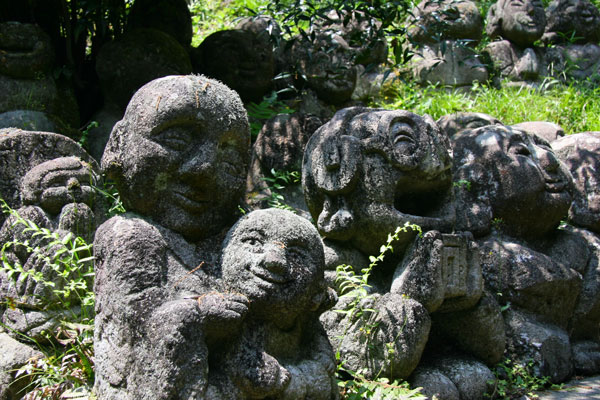
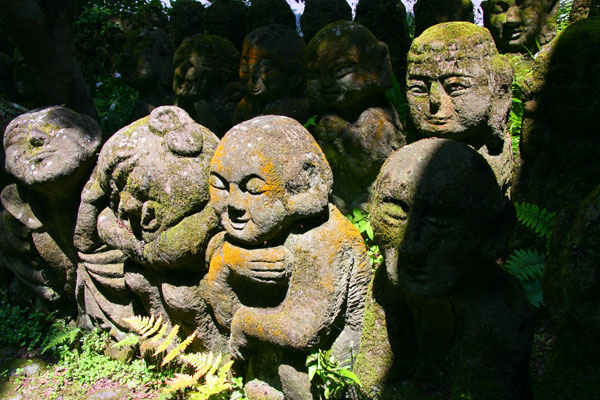
Kawaii (cute) or Kowai (scary)? The temple complex was covered by a carpet of little humorous Rakan statues, spreadout over the entire hillside. If you've ever wondered how THE SMURFS would look in Japanese, this is the closest I've ever seen. Actually my wife found them somewhat creepy as all they do is to look at you and smile.
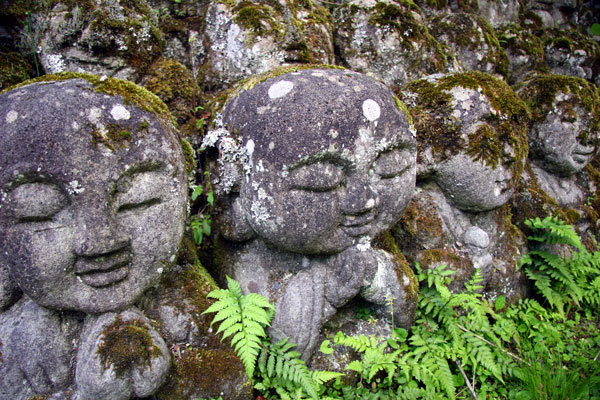
Semi-covered in moss and ancient-looking nowadays, creation of the Rakans actually started in 1981 when the dilapidating temple called out to its followers to hand-craft and donate 500 stone statues in order to revive the temple. The call was met with enthusiastic responses all over the country and the number of statues reached 1200 by the early 1990's. Today Otagi Nenbutsuji calls itself the "Temple of 1200 Rakans", but I doubt if even the temple itself knows the exact number. Walking around the temple grounds it really felt like being surrounded by a thousand little smiling gnomes with untelling intention.
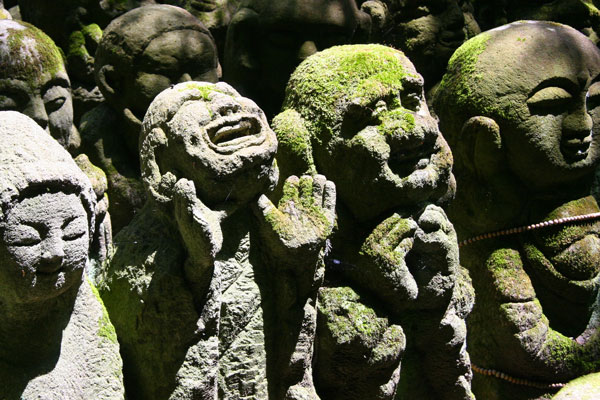
The Rakans were mostly carved by amateurs under the instruction of the late Nishimura Kocho, who was the head of the temple and also a master sculptor and professor at Tokyo University of the Arts. As the statues came from so many different donors, each Rakan has his own unique design with a facial expression or body gesture.
There were adult Rakans, child Rakans, blank-faced, contented, serious, ecstatic, dancing, drinking, with the positive side of human-nature being the general theme. With the Japanese society's fixation on everything Kawaii, it's no wonder that Otagi Nenbutsuji has been successfully restaged as a star attraction of the Saga area.
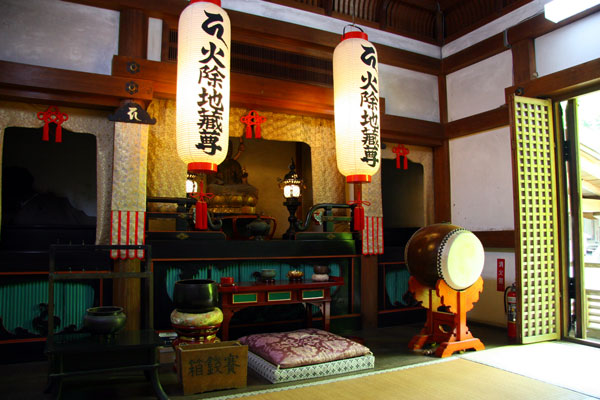
Inside one of the temple's little halls you'll find this "Fire Prevention" Jizo statue dating from Heian Period (8th to 12th Century). As Japanese buildings are traditionally built entirely of wood, fire hazards has been a paramount concern throughout the entire history of Kyoto. To this day the temple still holds a veneration for the Jizo on the 24th of each month.
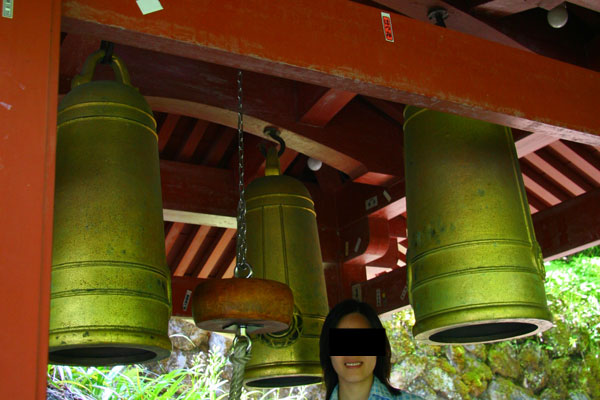
We came across this little bell pavilion as we were climbing the stairs to the upper part of the temple grounds. But instead of the typical humongous bronze bell, there were these three smaller bells painted in gold and bearing the inscriptions of "Buddha", "Dharma", and "Monk". It was a quiet day and we seemed to be the only visitors at the temple, and we just couldn't resist the fun of ringing one of these bells.
As we struck one of the bells a couple times with the wooden hammer, the quick and light footsteps of a resident monk came down the stairs. The young monk in grey robes walked into the pavilion and bowed to us, then with one hand in prayer position and another grabbing the hammer, he struck all three bells in clockwise order in quick succession. So now we know -- each bell sounds a different key and we're supposed to strike a harmonious chord with all three ringing at the same time. I wonder if the monk was really just "passing by" ...
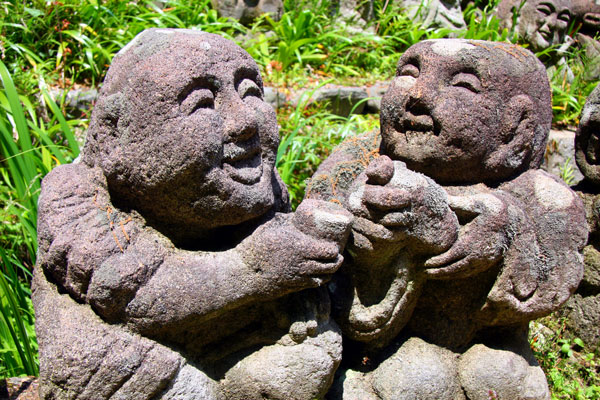
This is really a top quality attraction IMHO, a one-of-a-kind sight you won't easily find anywhere else in Japan. And if you enjoy taking pictures in your travels, it's just impossible not to come back with interesting photos when surrounded by such a foreign yet familiar display of human emotions.
Official Website: http://www.otagiji.org
Address: Kyoto-shi Ukyo-ku Saga-Toriimoto Fukayamachi 2-5
Hours: 08:00 - 17:00 Daily (according to official site)
Admission: 300 yen (Aug 2008)
Directions: See general travel directions at bottom of article
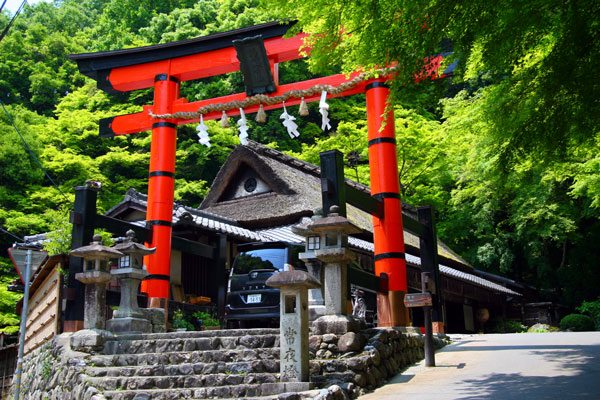
Exiting the Otagi temple and just a couple hundred metres to the south, the hiking path opens up into an old village with a row of thatched roof houses under a bright red Torii gate. This is the famous scenic area known as Saga-Toriimoto, and the traditional heart of the Oku-Saga (inner Saga District).

The Saga District had been used as an open cemetery by Kyoto residents since time immemorial, and up to recent times this has been the boundary where the periphery of Kyoto meets the countryside beyond. The modern village still retains a mixture of wooden latticed, tile roofed townhouses, and the simpler, thatched roofed farmhouses. For its preservation of traditional townscape, the immediate area surrounding the Torii gate (Saga-Toriimoto) has been designated as one of the four Traditional Structure Conservation Districts with the City of Kyoto, which places it on the same level of cultural and aesthetic importance as the famous Gion and Sanneizaka. Considering the 1200-year-old history of Kyoto, this is no small recognition.
The Torii gate is simply named Ichi-no-Torii, as it is the "First Torii" to greet a pilgrim on his hike up the Otagi Hill en route to the hilltop shrine. The thatched roof houses are mostly upscale Kaiseki restaurants that has been serving top Kyoto-cuisine at this remote mountain-side for the past 400 years. Historically this was the location where the local Ayu (sweetfish) fishermen filled their buckets with fresh oxygenated water before transporting the live catch into the Imperial Palace in central Kyoto, and today this is still the place for fresh wild-caught Ayu -- if you're willing to pay top money for it.

I did find out what the prices were at one of these restaurants. Tsutaya served a summer-special 7-course lunch centering around Ayu at 10000 yen (CAD$100), and the price range for set lunches started no less than 8000 yen and went all the way up to 15000 yen. In other words, sadly way out of my budget.

There IS a cheaper option if you just want the pleasure of a traditional snack under the serene surroundings of the thatched roofs. Hiranoya, the restaurant/teahouse next to the Torii, serves a tea set with Dango rice-flour balls and salted cherry blossom flavored tea for 840 yen.
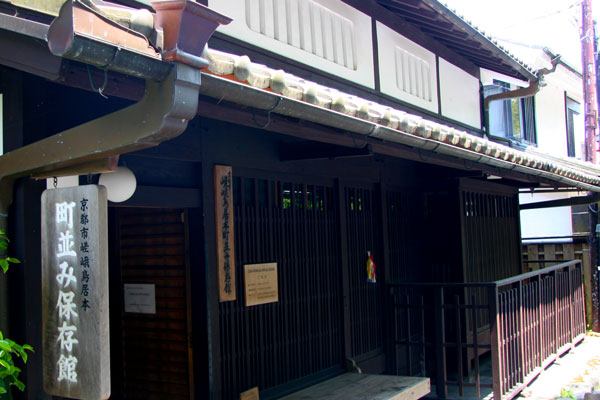
Further down the street stands a row of traditional Machiya townhouses, one of which has been renovated and converted into the Saga-Toriimoto Town Conservation Museum (my translation). This is part of the City of Kyoto's effort to revitalize old, deserted Machiya neighborhoods through preservation and effective renewal of usage, in this case preserving a prototypical Japanese style townhouse with raised Tatami floors, a facade with intricate wooden lattices (koshi) at the entrance and mullioned windows (mushiko) on the second floor.
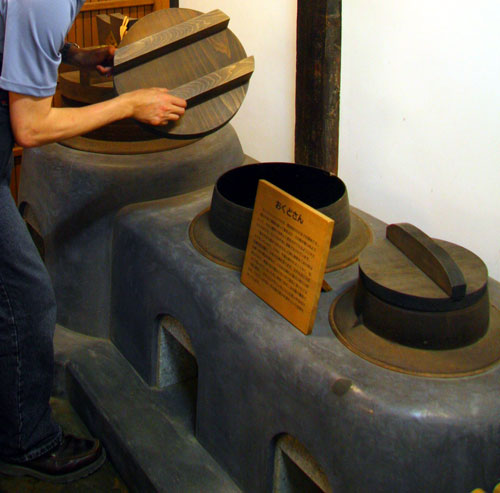
The interior still displays some Meiji Era features such as an in-house water well, a horse stable, smoke vents, and a coal-burning earthen kitchen. Not a huge place, but admission is free so it's not a bad place to drop-in for a few photos. It's open everyday from 10:00 to 16:00 except Mondays and New Years holidays.
Another few minutes walk south of the Torii stands another temple complex with a somewhat familiar name -- the Adashino Nenbutsuji. This is the original "Nenbutsuji" in this area, before Otagi Nenbutsuji was moved here in 1922. If Otagi Nenbutsuji is supposed to display the playful, nonchalant side of the Japanese, then Adashino Nenbutsuji must be the deep, solemn side of the balance.
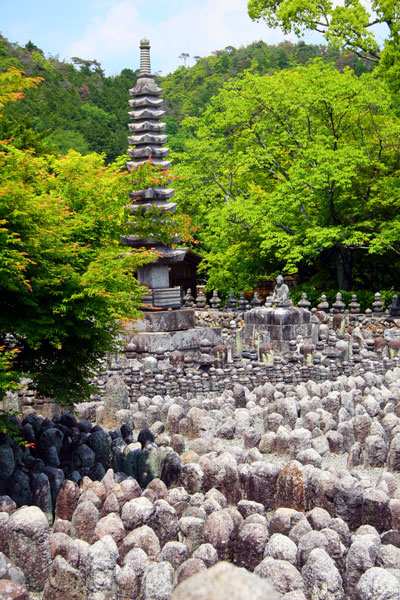
Approaching the centre of the temple you'll come across this sombre scene with thousands of stone stacks arranged in narrow rows. Each stack consists of one or more crude stone Buddhas originally belonging to a certain burial, some dating back over a thousand years. As we mentioned, this area was part of a huge open burial field since the 9th Century. Kyoto residents would bring their dead here, for open-air burial (ie.exposing the body to the elements) in the ancient times and earth burial in the latter centuries.
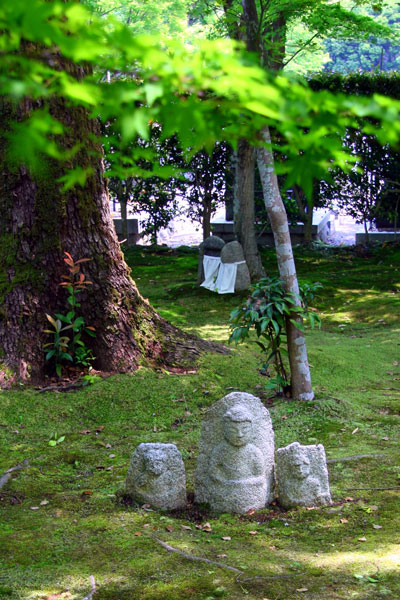
Watching over the random, nameless graves for a millenium, the weathered Buddhas were were later exhumed and collected into the temple. Today followers come and pay respect to the dead while tourists take in the extraordinary scene composed by the sheer number of stone stacks. And if you're really into dark solemn sights, for two evenings in late August the temple holds a candle-offering to the 8000 or so stone Buddhas in a ritual known as Sento-Kuyo ("Dedication of 1000 Lamps"). I've only seen pictures and that looks downright eerie.
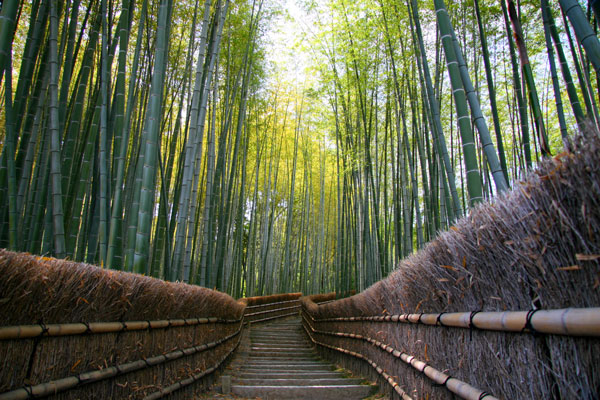
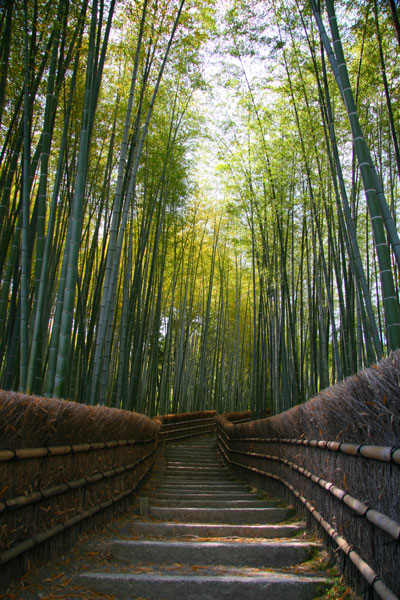
There's also a less macabre reason to visit Adashino Nenbutsuji -- towards the back of the temple there is a remarkably well-tended footpath winding through a towering bamboo grove. This may look familiar if you've been to the neighboring district of Arashiyama, whose bustling bamboo path is probably the most famous in Japan. But in Arashiyama it's almost impossible to enjoy a quiet walk in solitude, or to get a clear photo without fellow tourists inside the frame. Here you pay the 500 yen (CAD$5) admission to see the stone Buddhas, and get the bamboo grove as a bonus. This works well for peace seekers like us.
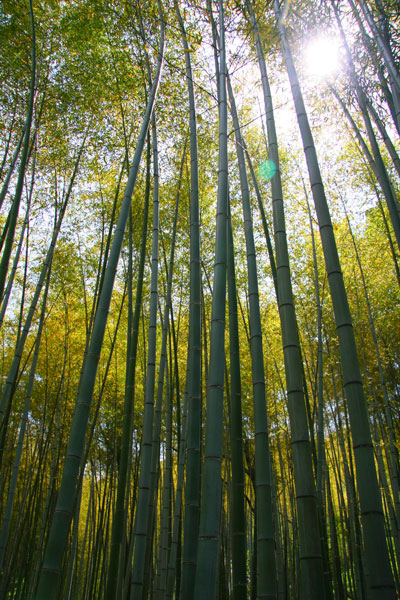
There's just an indescribable, minimalist beauty in the air when surrounded by the greenery on all sides, especially with the crackling sound of huge 50-feet-tall bamboos bending under the wind. Ever watched "Crouching Tiger Hidden Dragon" and the bamboo grove fight sequence? This is it -- a giant wall of breathtaking green in tranquil seclusion -- minus the masked assassins.
In other words, undisturbed serenity. And that, is precisely what Arashiyama lacks.
Official Website: http://www.nenbutsuji.jp
Address: Kyoto-shi Ukyo-ku Saga-Toriimoto Adashino-cho 17
Hours: 09:00 - 16:30 Daily (according to official site)
Admission: 500 yen (Aug 2008)
Directions: See general travel directions at bottom of article
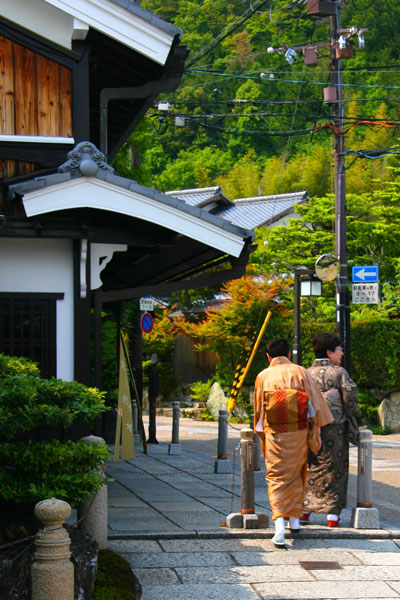
Outside the Adashino temple the street of Saga continues southward in the direction of Arashiyama. The neighborhood paths are still lined with antiquated residences and the odd noodle house catering to tourists and hikers. Every few blocks stands a confectionery stand serving Kusamochi ricecakes and tea under a large red umbrella. Women in kimonos occasionally grace the street corners where the Noren curtains of century-old shops drift in the wind.
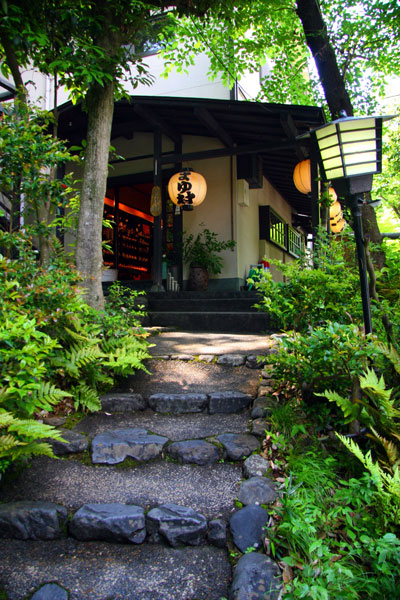
Elegant little shops peek from their semi-concealed locations at the side of the road. I would have mistook this as someone's resident if I didn't see the small store sign, but it turned out to be a unique little shop selling handicraft art made from silkworm cocoons. Don't ask me what happens to the silkworms -- but the resulted artworks are quite funny and authentically Japanese, and certainly beats the generic dolls and plastic sushi you'll find elsewhere. Besides, they seat you down and serve you free tea and traditional candy, so it's not a bad place for a break.
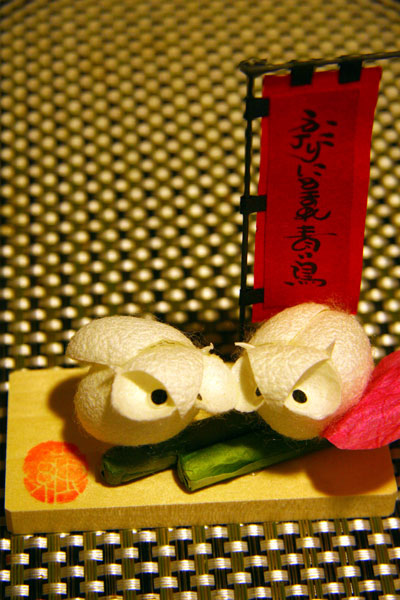
I would have preferred an armpit-scratching ape, but my wife chose this pair of cuddly owls. If you're interested in browsing what's recently popular and available, you can go to their website in Japanese.
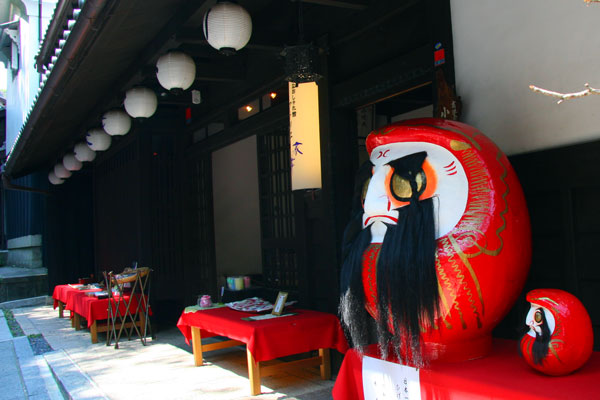
Some of the better preserved townhouses from the feudal era has been converted into souvenir shops. If it is any consolation to conservationists, at least the merchandises are mostly tasteful artistic creations such as hand-crafted pottery or bamboo tools. Here a pair of Daruma doll adorn the entrance of a store selling traditional Kyo-Yuzen textiles.

I love Tanuki figurines! As you probably know by now if you've been following the past articles. These human-sized statues here are much bigger than the ones typically found outside restaurants and Ryokans, and probably cost several hundred thousand yen.
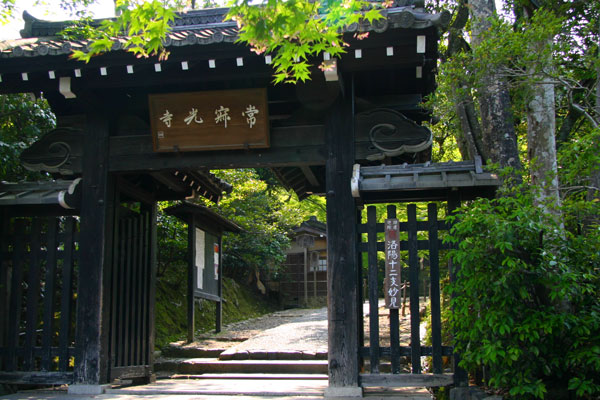
These photos from our early summer visit may look peaceful and leisurely, but this whole area from Saga to Arashiyama gets fairly crowded during the Autumn foliage season in November, when the many temples dotting the countryside roads become packed with international tourists, professional photographers, and TV crews. The Jojakkoji temple in this picture is one such tourist spot that receives most of its visitors in November alone.
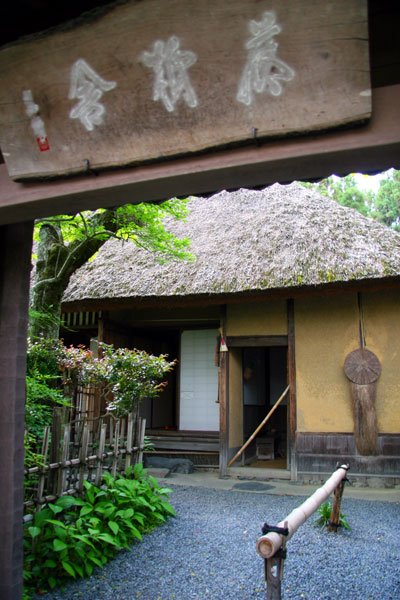
As we walked further south, we approached the Arashiyama area where the sights are somewhat randomly dispersed. Literature buffs would pay a visit to the Rakushisha ("house of fallen persimmons"), the former residence of some famous poet (actually a student of Haiku master Matsuo Basho).
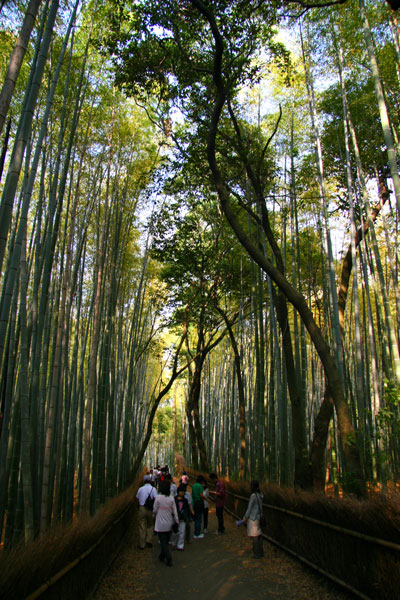
If you're still wondering what the famous bamboo path of Arashiyama looks like, this is it -- again a long, well-maintained trail through a large grove of giant bamboos. Beautiful, but justifiably popular with domestic and foreign tourists. And almost impossible to get an unobstructed picture unless you arrive in the early morning or at dusk.
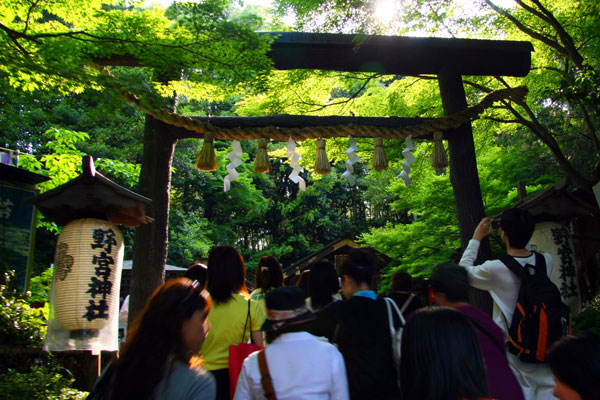
Right in the middle of the bamboo path stood a little shrine absolutely packed with worshippers, who all seemed to be lining up to touch a smooth black rock. That's the o-Kameishi ("Turtle Rock") of the Nonomiya shrine, and yes we did walk up and felt it, and yes it was very smooth from centuries of hand polishing.
This is almost the end of the walk. In case you're thinking what happened to the popular Arashiyama sights of Tenryuji temple and Togetsukyo bridge, yes we skipped them. We would have visited Tenryuji if it was Autumn Foliage season. And the Togetsukyo bridge -- when our bus passed by we saw the concrete bridge and its huge crowds and congested traffic, and we decided it's not worth our time. Sorry for being harsh.
SAMPLE ITINERARY
For readers' reference I've posted a sample itinerary very similar to what we did. A total of 9 temples, shrines and general spots of tourist interest are listed, but I'm only recommending those marked with *asterrisks*.
Kyoto Station --> take Kyoto Bus #72 (52 min, 270 yen) -->
Get off at Otagiji-mae --> see *Otagi Nenbutsuji* -->
5 min walk --> *Saga Torii-moto* --> 5 min walk -->
*Adashino Nenbutsuji* --> 10 min walk --> Gioji --> 7 min walk -->
Nizon-in -- 5 min walk --> Rakushisha --> 5 min walk -->
Jojakkoji --> 10 min walk --> Bamboo Path --> 5 min walk -->
Nonomiya Jinja --> 8 min walk --> *Tenryuji* --> 15 min walk -->
JR Saga-Arashiyama Station --> JR train (230 yen) -->
back to Kyoto Station
The entire walking distance is 75 minutes non-stop, and it took us more than 4 hours after a few temple visits, shopping, desserts, and occasionally simply chilling out and enjoying the view. Time well spent in my opinion, after all it took us 16 hours to fly to Japan.
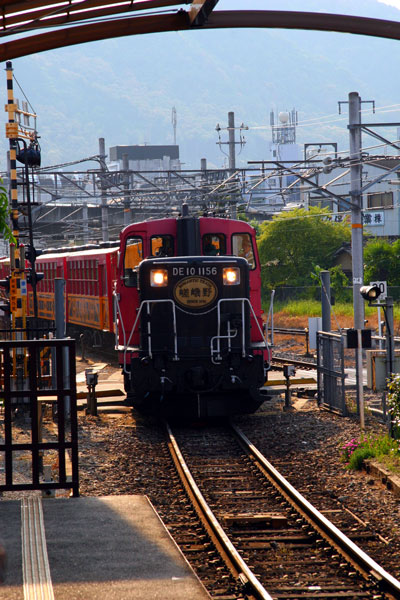
After getting to Arashiyama we didn't head back to central Kyoto right away, and instead took the Sagano Scenic Railway for a short tour. Promoted on its brochures as the "Romantic Train", this is a narrow-guage diesel locomotive pulling five little semi-open carriages, tunneling through the steep gorges of the Hozu River. The scenery is supposed to be spectacular in the Autumn Foliage season, but we took it in May, and my verdict is that once is enough for me.

The endpoint of the little rail line arrived at Kameoka, where traditional narrow boats would take tourists through the rapids of the Hozu River and back to Arashiyama for 3900 yen (CAD$39). We didn't, and so we walked a few minutes to the JR Umahori Station and took the train all the way back to Kyoto Station for 320 yen (CAD$3.2).
| DIRECTIONS: Now here's the deal -- there's no subway station, JR station, or even City Bus service, which is probably why most Western guidebooks try to skim over this area. But there IS a regular bus service (#72 or #74) by the private Kyoto Bus company, which connects the Oku-Saga area to the main transportation hub of Kyoto Station. There's also another bus (#62 or #64) that connects to Sanjo-Keihan, right next to the tourist district of Gion. Here is the easiest way to get to Oku-Saga, according to my experience: - Go to the bus terminal outside Kyoto Station and find "Bus Stop C6" ("Basu Noriba C6" if you ask the locals) - At this particular bus stop, take "Kyoto Bus #72 or #74" - Tell the bus driver you want to get off at "Otagi-ji Mae", then sit close to the driver. - After about an hour you'll get off right in front of Otagi Nenbutsuji temple I think that's simple enough for even novice travelers. Just note that Kyoto Bus company is separate from the public City Bus system, so don't plan on using the City Bus Daypass. This trip cost 270 yen (CAD$2.7) in 2008 -- very cheap as far as bus fare in Japan goes. The latest bus schedule is available only in Japanese at http://www.kyotobus.jp/, so I've written down the scheduled times currently as of Aug 2008. Bus #72 departs Kyoto Station at 07:01, 08:05, 08:41, 09:17, 10:11, 11:08, 11:48, 12:48, 13:48, 14:49, 15:49, 17:44 on weekdays, and with slightly different departure times on weekends and holidays. The bus trip takes approximately 52 minutes. You can take the same bus (in opposite direction) on the way back, but I'd prefer taking a slow scenic stroll to Saga-Arashiyama station, roughly 75-minutes walking distance to the south, then take the JR train back to Kyoto Station for 230 yen (CAD$2.3). Or if you've got time to spare, walk over to the Torokko Saga station of the Sagano Scenic Railway, and see if you can buy a ticket for the next train. If you do take the Torokko train, you'll end up near JR's Umahori station where you can take the train back to Kyoto. |