A fellow traveler once asked my wife what her favorite Japanese town was, and her answer was firm and simple -- Uji. Uji? Though the traveler had spent several years living in Japan, he hadn't even heard of it. I guess that's just how underrated as a tourist destination it is, especially to foreigners.
To the Japanese though, Uji is famous for several things -- World Heritage temples, Tales of Genji, but mostly, its ancient tradition of growing the finest green tea. Oh, and delectable desserts and great scenery too. By the end of this article, you too will see why this is my wife's favorite Japanese town.
So where the heck is Uji?
Uji is a small city just south of Kyoto along the Uji-gawa river, just 20 minutes away from Kyoto Station, or an hour from Osaka by rapid trains. So if you're going to Kyoto or Osaka, it is within striking distance for a day-trip.
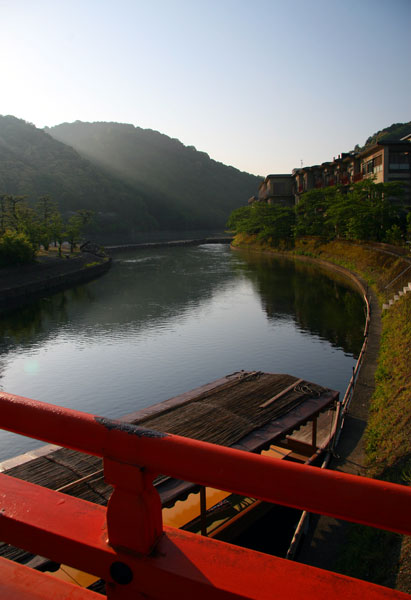
But forget day-trips. I would highly recommend spending a night in Uji if you can afford the time by any means, which would give you the opportunity to explore the beautiful riverbanks in the serenity of the early morning. In fact this was the only time that we were able to have the entire stretch of the river to ourselves, as the armies of domestic tourists (High School students again!) started to move in around 9 AM.
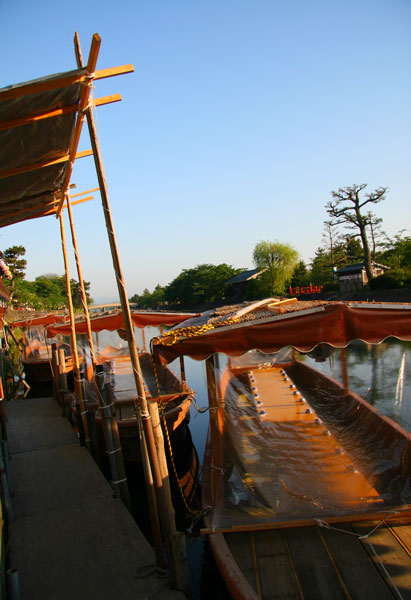
It was just a magical morning, with the river taking on a scenic quality akin to the upper Danube or China's Guilin. From traditional wooden houses along the banks to the row of little riverboats to the sun breaking through the morning mist ... this river scenery was as peaceful as I had ever seen, and it was only 20 minutes from cosmopolitan Kyoto.
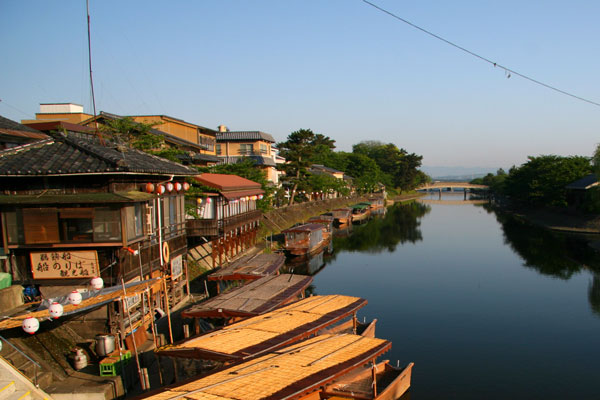
These are tour boats which you may hire at any time of the year, but during the summer they serve the special purpose of taking tourists to see the ancient tradition of Ukai, commonly known as cormorant fishing. No longer economically viable in most rivers, this ancient practice of using trained cormorants for fishing is preserved in a handful of locations in China and Japan, mainly due to interest from the tourism industry.
In Japan only a dozen of such locations remain, which is yet another reason to visit Uji, if you happen to be visiting in the summer. For about 1800 yen (CAD$18) you can join a one-hour tour of the river in a flat-bottom boat, complete with a close-up demonstration of Ukai and a chat with the master fisherman ... in Japanese of course. Each cormorant is controlled by the fishermen through a rope attached to the snare at the bottom of its neck, which prevents the bird from swallowing the fish ... well that's what the brochure says anyway. We didn't get the chance to see it since we visited in mid May, and the fishing season wouldn't start until mid June.

The 2008 Ukai season ran from June 14 to Sept 28 at 7 PM every evening, except for last-minute cancellations due to heavy rain. Reservation is required, but that's easy if you're staying at one of the hotels or Ryokans in town (your host should be happy to make the reservation for you). The schedule changes slightly every year, but if you're visiting the Kansai region from mid June to September, this is another great reason to visit Uji.

Let's continue with our morning walk. There are two charming little islands in the middle of the river, accessible via several little bridges along both shores, and famous for some old battle (actually it's Minamoto Yoshitsune's first battle, if you're a fan of NHK's TV drama series "Yoshitsune") and a 15 metre tall stone pagoda from the 13th-Century. Once every few hundred years a great flood would topple the pagoda and the locals would need to unearth and reassemble its sections, so this must be something they hold dearly. But the really cool thing was that it's part of the great view from our room's balcony in the traditional Ryokan -- more about that later in this article.
But the REALLY famous attraction of Uji, the one known to every school child in Japan, is the Byodo-in temple immortalized at the back of the ubiquitous 10-yen coin. This is what the coin looks like, courtesy of Wikimedia Commons.

And this is the real thing:

When you take out a coin and it looks exactly like the object in front of you, you know you're looking at a National Treasure of some sort. It's not only some National Treasure, but also included as part of Kyoto's UNESCO World Heritage Site and has become world famous. To the Japanese it is the most elegant symbol of Buddhist architecture, perfectly symmetrical and adorned all-around with intricate wood and metal carvings of priceless importance. This must be the ideal demonstration of the tranquility of Buddhist paradise on earth right?
Would you believe me if I tell you that I had to fight through an army of hundreds of zealous high school students just to take this one picture? And wait 15 minutes in the process while each student grabs a few different friends and strike three different poses while making the "V" sign? Unfortunately this is the reality of the most popular tourist sights in Japan -- and you will most likely endure the same.
But that's okay, you have to expect lineups in most countries when visiting the top sights. I'm just warning readers not to expect the same kind of peacefulness in the photo.
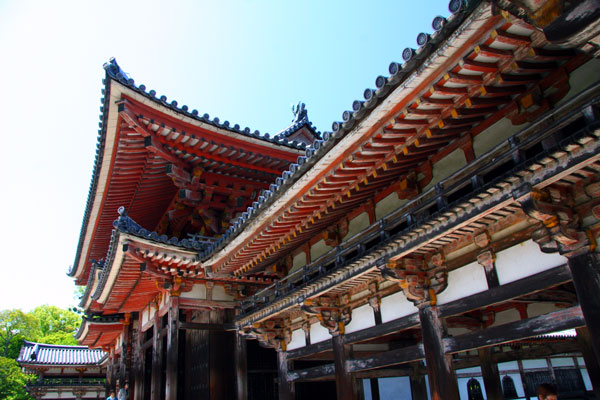
Most of the original carvings have been moved a few steps to the humidity-regulated new exhibition hall, where you can see the thousand-year-old artwork up-close and buy some good prints and souvenirs. For an extra 300 yen (CAD$3), you can enter the main Phoenix Hall in a guided (Japanese-language) tour where you can get close enough to touch and feel the ancient wood structure and see some of the painstakingly restored artwork.
And close enough to see THE bronze Phoenix at the top ... did I mention that the Phoenix is ALSO immortalized on the back of the 10000 yen bank note (see its picture at Japan's National Printing Bureau)? And the Japanese students around me were taking money out of the wallet and comparing it to the statue. That's just how famous the Byodo-in is to the Japanese.

There is one other equally ancient but lesser known structure of World Heritage fame -- the oldest existing Shinto shrine Uji-kami Jinja. Not as visually impressive, but entrance is free, it's open 24 hours, and it's much quieter than the bustling Byodo-in.
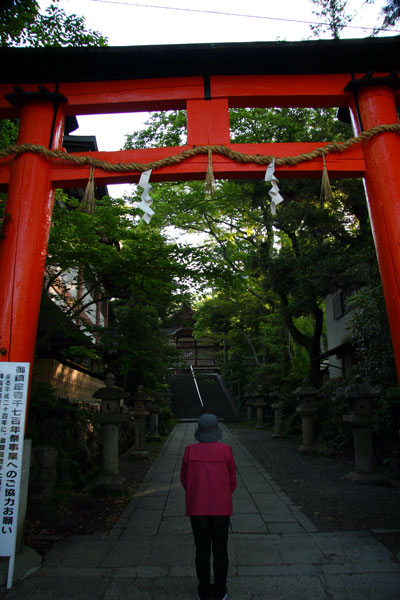
And since it's open 24 hours, we visited at 7 AM in the morning when we almost had the entire shrine complex to ourselves, barring one or two devoted worshipers.
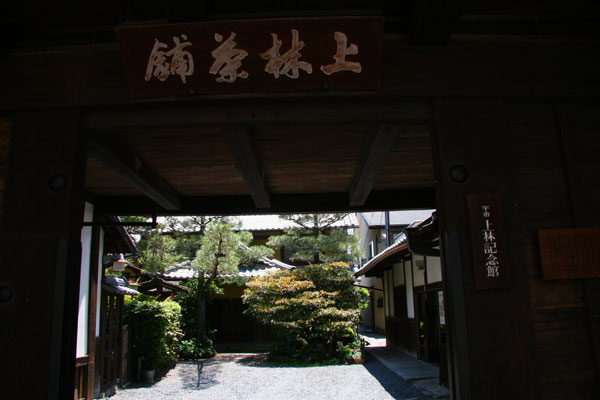
But there is one other aspect of Uji that is perhaps more famous than even the Byodo-in, a term synonymous with the name "Uji" in the Japanese language -- green tea. You can find Uji-cha in 500mL bottles and Uji Matcha flavored candy, biscuits or ice-cream at any 7-Eleven convenient store anywhere in Japan. One of Japan's favorite summertime desserts, the Uji-Kintoki, is Uji Matcha shaved ice paired with sweet Azuki beans from Kintoki. It's so popular I've even seen Uji-Kintoki flavored Kit-Kat. Being a tea-drinker, upon arrival I told myself that I MUST bring home some quality fine tea worthy of the Uji name.
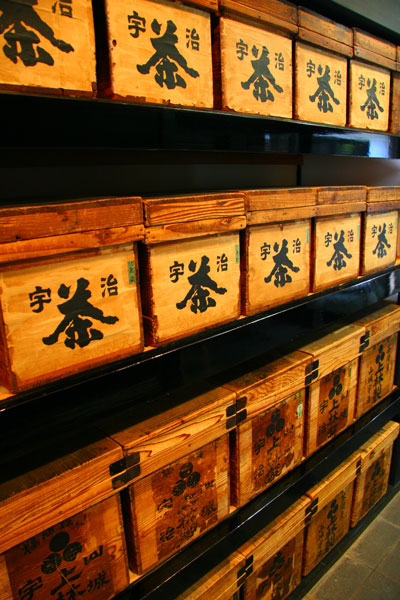
Now these aren't your typical neighbourhood tea shops -- many of the traders have existed for HUNDREDS of years and have been selling their quality tea to a very elite clientelle, century after century. But no shop is as prestigious as the venerable Kanbayashi, a 500-year-old tea trader and former supplier to the Shogun and the Imperial Court of Japan. The old Kanbayashi residence had been converted into the Uji-Kanbayashi Memorial House, exhibiting various tea-related artifacts and antique porcelain tea bowls.
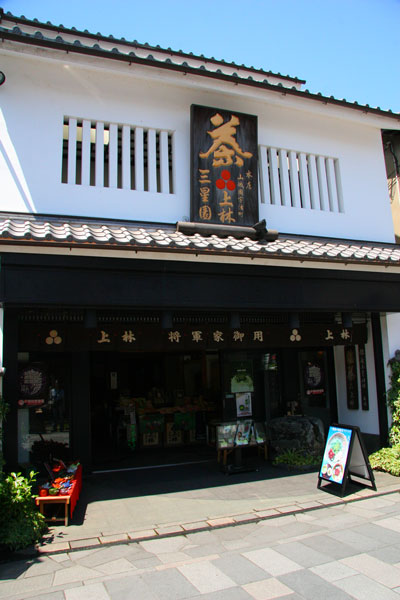
Nowadays there are several vendors claiming to be the successor to the Kanbayashi name, all conveniently located on the main tourist street (Byodo-in Omotesando), 2 minutes walking distance from the Byodo-in. You don't need to be the Shogun to shop here -- just expect to pay a bit more than at the neighboring shops.

And inside the stores you can see a demonstration -- well actually not a demonstration, but the real process of how steamed tea leaves are ground into Matcha powder. I'll leave it to your imagination of how the wonderfully refreshing aroma of fine tea permeates the store.
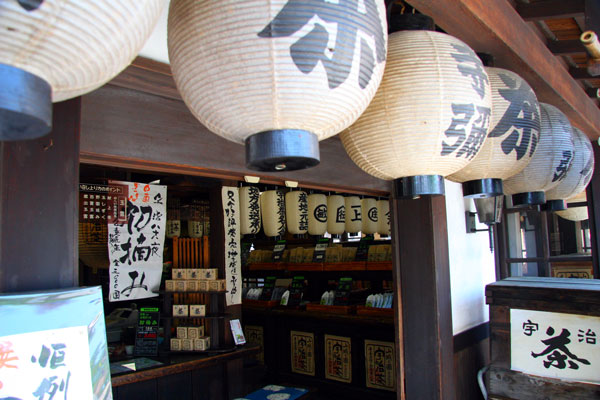
While doing our price comparison we walked into another one of these antiquated tea stores -- this one was a little newer, at 180-years-young, and gave us the best service. A lone female staff greeted us, ushered us to sit down, and served us cups after cups of several of their best-selling teas. One of them was the exact taste we had been looking for -- strong, fragrant, not too acidic, and with a pronounced aftertaste. She didn't tell me that it was this year's Hatsutsumi (first-pick), the youngest, greenest leaves collected in springtime's first picking and naturally one of the more expensive items in the store. Crap! Now the salesperson had me hooked on the good stuff!
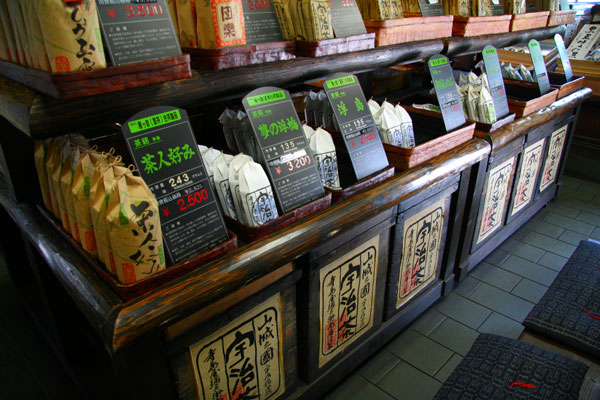
It turned out to be something like 2310 yen (CAD$23) for 70 grams (33 yen per gram), which would last about 8 small pots. There were other quality teas to choose from, such as these ones selling at 10 to 20 yen per gram, but now I knew I couldn't go back to the regular stuff ... oh well, I can afford $25 for good tea, but I had to make a mental note to myself that if I ever find myself in Bordeaux ...

Of course, we couldn't leave Uji without trying some of the famous Matcha-infused desserts. One of the cheaper options would be the "double Matcha" softserve ice-cream at a roadside bench. Smooth, strong and bitter-sweet, needless to say it was among the best softserve ice-creams I've ever had.
And this was just the beginning.
Food Review: NAKAMURA TOKICHI CAFE (Uji)
Address: Uji-shi Uji-Ichiban 10-Banchi
Hours: Daily 11:00-18:30 (According to Official Site, 2008)
Website/Map: http://www.tokichi.jp
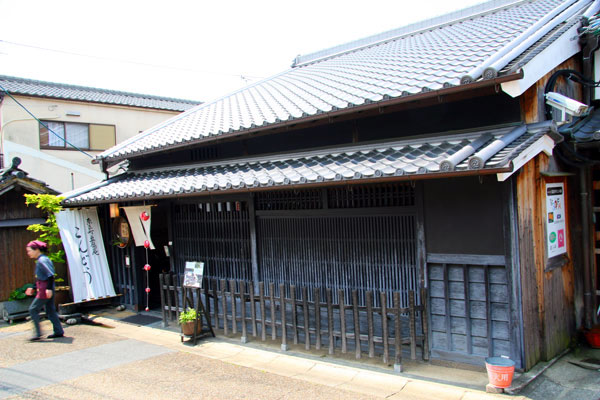
Directions: Easy. Exit the JR Uji train station, ignore the main road parallel to the train tracks, and you'll see a little street perpendicular to the main road straight ahead. Walk closer and you'll see the store curtain in the picture below, almost visible straight from the train station entrance. It's that close.

This has to be one of the most beautiful traditional store fronts I've seen in Japan -- the century-old entrance to the famous tea merchant and confectionist Nakamura Tokichi.
Matcha desserts are a must for any visit to Uji, and if you want a safe bet there are two well-celebrated Japanese dessert cafes to choose from. Ito Kyuemon is located near the Keihan Uji train station on the North side of the river. Nakamura Tokichi has two branches, the flagship branch being a stone's throw from the JR train station, and a second branch right on the main tourist street of Byodo-in Omotesando. Both confectionists have been around for at least 150 years and you really can't lose with either choice.
At the end we chose Nakamura Tokichi's main branch, mainly because it's a quick 100-metre dash to catch our train.

This is the most popular creation of the Tokichi cafe -- in fact as we looked around more than half of the clientelle was having this same item -- and it was very simply the best dessert I've ever had. It was a medley of the richest, creamiest, most flavorous Matcha ice-cream, a strong and slightly bitter Matcha jelly, sweet Azuki beans and Shiratama rice-flour balls, served in a frozen bamboo container. It was the most heavenly 720 yen (CAD$7.2) I have ever spent. I think it's simply called "Matcha Jelly", if you plan on ordering the same.
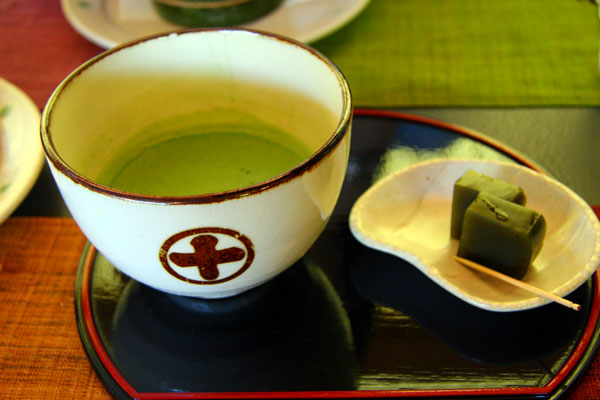
Yum ... but too much fusion desserts already and I didn't want to leave without a cup of genuine Uji Matcha. So we ordered the Usu-cha ("weak" Matcha) which was already an overwhelmingly strong tea ... I can only imagine what the strong version would taste like. As usual a small piece of traditional dessert came with the Matcha to balance its bitterness, this time a wonderful Matcha-flavored Yokan (bean jelly). Original price was 480 yen (CAD$4.8) but they would take 100 yen off any drink when ordered along with a dessert item.
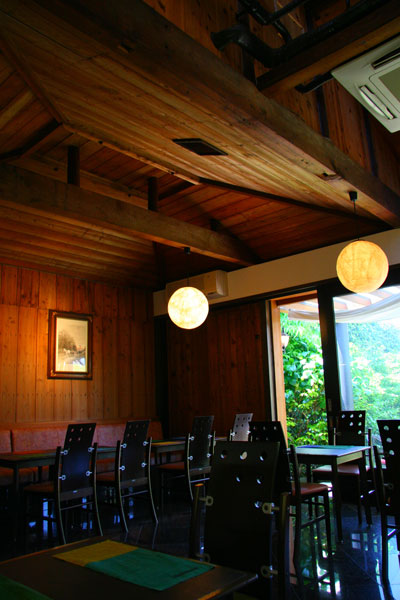
A wonderful place for desserts or a light lunch (they also serve simple rice dishes and Matcha-infused udon noodles) while waiting for the next train. I have no reservations for recommending this cafe -- we have very fond memories of the top quality desserts here.
Bill for Two Persons
| Matcha Jelly | 720 yen |
| Matcha Jelly | 720 yen |
| Usu-cha Matcha | 380 yen |
| TOTAL | 1820 yen (CAD$18.2) |
Hotel Review: RYORI-RYOKAN AISO (Uji)
Address: Uji-shi Uji-Tonokawa 3
Price: 7350 yen per person per night including Dinner + Breakfast;
Japanese-style tatami-room without private bathroom
Website/Map: http://www.wao.or.jp/aiso/
How To Book: Through the email address listed on official website
Directions: From the JR Uji train station, walk East towards the Byodo-in temple (ask people along the way -- just say Byodo-in and anyone can point you in the right direction). From Byodo-in's front gate, keep walking along the riverbank for another two minutes. When you see a little house built leaning right on top of the river on your left, that is Aiso's restaurant, and the building on your right is the Ryokan.
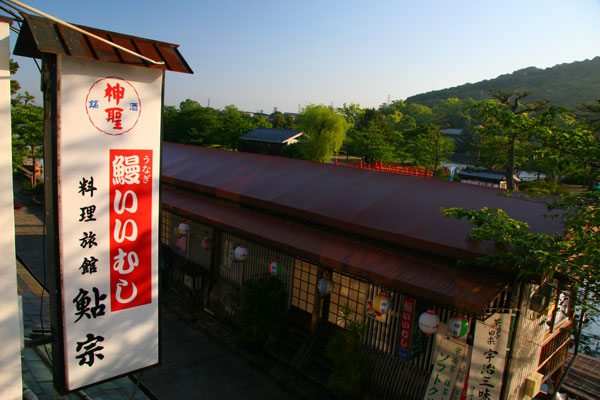
If you're want the most authentic Japanese experience at a reasonable price in your trip to Kansai, or anywhere in Japan even, this is a good place to start -- a traditional Ryokan right on the Uji-gawa river bank, 2 minutes walk from the centre of Uji's tourist attractions, spacious Tatami-mat rooms and comes with a nice traditional dinner and breakfast. 7350 yen (CAD$74) per person per night is a bargain in Kansai according to my experience -- just compare with the Ryokan pricing at neighboring Kyoto.

There were only two groups of guests that evening, the other group being a single guest (more about him later), and the two of us were given this huge 12 Tatami-mat room with a balcony overlooking the river. Everything in the room was as conventionally Japanese as it comes -- fluffy down-filled futons, a low table with snacks and tea, a small crappy TV from the 1980's, Yukatas (casual robes) to change into, and most importantly air-conditioning.
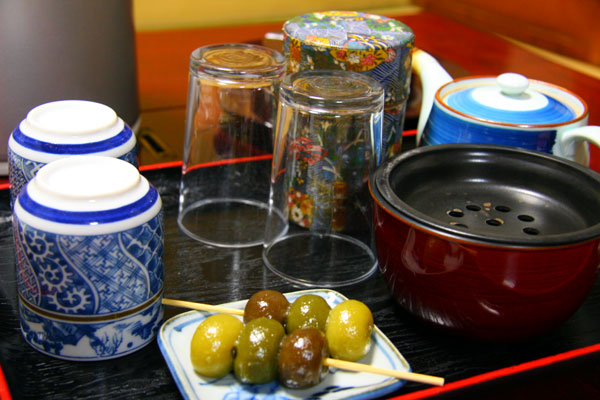
And of course all snacks we came across in Uji must be tea-flavored. Here it was glutinous rice-balls flavored with Matcha, Sencha, and Hojicha.
As in most traditional Ryokans the bathrooms and toilets are shared among guests, but that's not a problem here given the small scale of this Ryokan. Each guestroom is assigned a private time for bathing -- it's rather usual for guests staying in the same room to bathe together (ie.husband-wife, mother-daughter, father-son, close friends of the same sex etc) but you don't have to. Just lock the door. Simple.
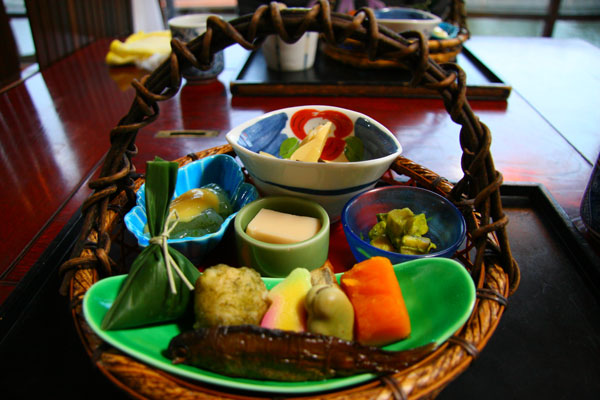
What about the food you ask, and was it worth the extra cost compare to staying at 7000-yen-per-double-room business hotels? Aiso calls itself a "Ryori-Ryokan", or gourmet-inn, so the profitability of their business has a certain degree of dependency on the quality of the food they serve. Guests would justifiable expect better food compared to other run-of-the-mill Ryokans. So, let's start examining the dinner and see if they live up to their name.
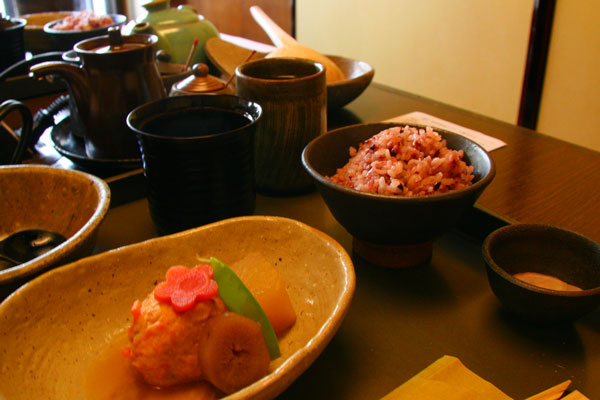
It's not an extravagant Kaiseki type meal -- we had the option of paying another 2000 yen per person for that and we chose not to -- but a simpler meal at the same quality (ie.same chefs) as the Kaiseki meals they serve. Everything inside this Kago-mori (assorted dishes in a basket) first course was very good, especially the simmered Ayu (sweet fish) as it was my first time having this savory, mildly fragrant fish. That time of the year (mid May) was supposed to be the best season for Ayu, when early spring's new hatchlings mature into young adults ... but I never had Ayu before so I can only recommend you to try it yourself.
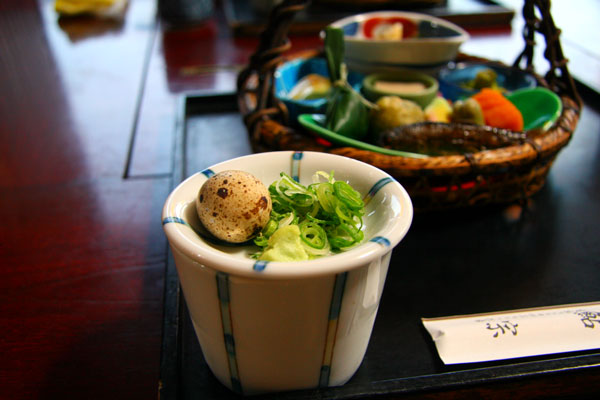
And remember the cormorants? The Ayu is the only type of fish they are trained to catch, and in fact the Ayu was the only reason of existence of the Ukai-fishing industry. Though I'm sure the fish ending up on my plate was farm-raised, as those caught by cormorants (and bearing the birds' beak marks) are highly prized and just ridiculously expensive IMHO.
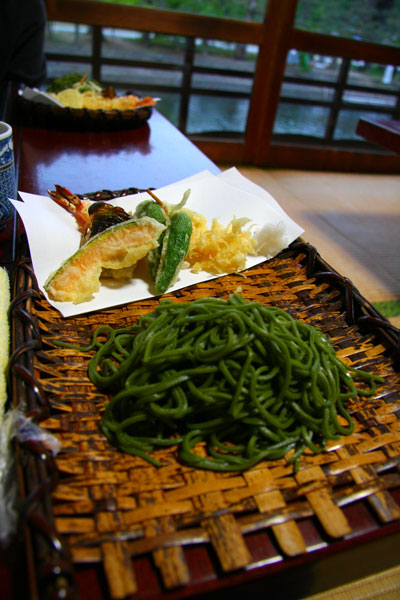
Another example of how tea finds itself into every meal here in Uji -- a generous portion of Matcha-infused Cha-soba noodles. This soba was hand-made by Aiso itself, and frozen packages of these noodles was one of the popular souvenir items sold at the Ryokan's lobby.
The tempura was good -- not excellent -- but then this wasn't a tempura-specialist restaurant and they weren't charging 4000 yen for it.

What's this, some kind of pilaf? Aiso calls it Unagi Iimushi, which is essentially steamed glutinous rice with a slice of Unagi, wrapped inside a bamboo skin. This is another souvenir item guests can buy from the Ryokan, but I thought it quite ordinary.
Aside from these pictures there were the typical miso soup (which was very good!), pickles and plain rice, in case the meal didn't fill me up enough.
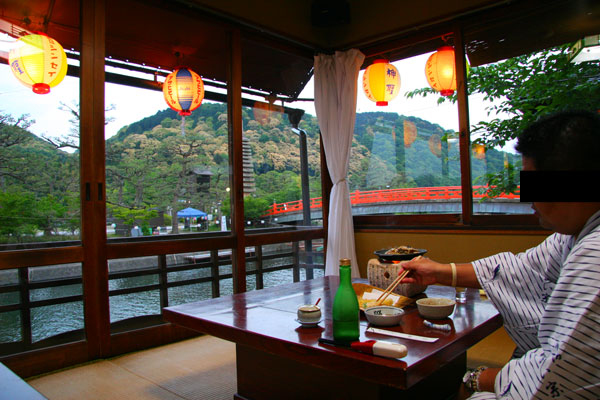
Did I mention the dining hall was right on top of the river? The great view was one of the factors making this meal so memorable, but the main reason was this friendly stranger who sat beside us and didn't speak for the first 3/4 of the meal ...
Then he spoke. I believe his first sentence was asking whether we're tourists and where we come from. And the second sentence was whether we drink. The next thing I knew, he summoned the waitress and bought us a bottle of Sake.
Maybe it's just me, but with a drink in hand, the conversation opened up and I spoke Japanese at a confidence level I never knew possible. Didn't make me fluent though, but I must have been speaking broken but coherent Japanese since we had almost no trouble communicating! That was a first for me, and I heard Japan's expat circle has coined a term for this phenomenon as Nomu-nication (Nomu = Drink + Communication).
Looking at the photos my wife took there were pictures of me being red and slightly drunk, and of me having a good time with our new friend M-san, so the cross-culture conversations must have been really fun. But maybe I wasn't too drunk, as I still remember M-san's work in the manufacturing industry, his travels to all over Japan to meet with corporate clients, his home in a small town in Western Honshu, his bicycling to work every morning for the sake of exercising, his disappointment at this year's Golden Week holiday, and his awe at the alien concept of our 3-week-long vacation. I'm laughing as I'm typing this article. It was such good times.
I thanked M-san for the wine, and he said don't mention it -- it's just Ichi-go Ichi-e. He then had to spend the next 10 minutes explaining to me what the term means, and asked me to write down an English translation. The best I came up with at the time was "chance encounter". It was chance that brought two strangers from different parts of the world together at a little Ryokan by the Uji-gawa river, and we may never see each other in our lifetimes, so we made the best of it and enjoyed the moment. Ichi-go Ichi-e.

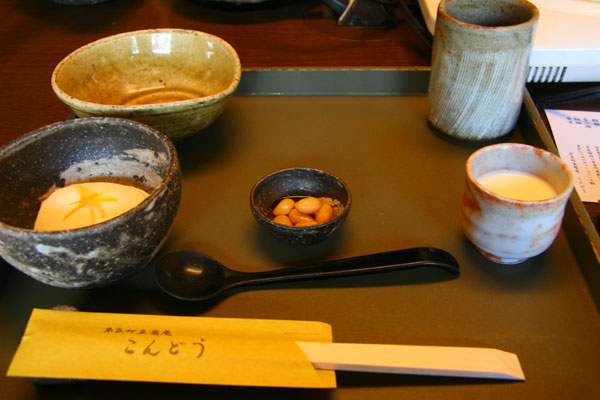
After a very good night of sleep (yes the Sake helped), we went for a long early morning walk and worked up a huge appetite for breakfast. M-san dropped by to say goodbye, then we had the entire Ryokan to ourselves. The breakfast had the typical combination of miso soup/grilled fish/plain rice, but also had an excellent Onsen Tamago in Dashi broth.
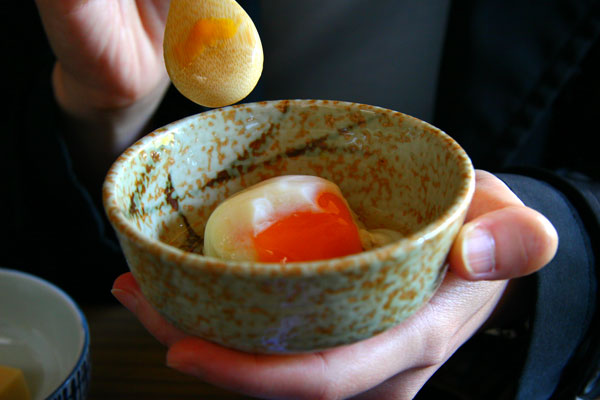
Looks similar to the Western poached egg at first glance, but the Onsen Tamago is really a soft-boiled yolk surrounded by even softer-boiled egg white. One recipe I've seen says 70 degree Celcius water for 30 minutes, but I've never attempted at home. In any case I know I can never make it this perfect -- melt-in-the-mouth egg whites and a soft yolk, complimented by a flavourous Dashi broth.
So was it worth the 7350 yen (CAD$74) at the end? Considering the dinner should be worth 2800 (price listed at the dining hall for outside guests) and the breakfast another 600, then we paid less than 4000 yen per person for accommodation alone including tax. A 12 Tatami-mat room with a view of the Uji-gawa river, situated at the heart of Uji's tourist district, and only 20 minutes to Kyoto by train. If I tell you it wasn't a bargain I don't think you'd believe me.
EDIT - Many thanks to Sue, who provided her own comments after staying in Ryokan Aiso:
To all who plan to stay in Ryokan Aiso. Please agreed a rate with the owner. He quoted me a 4795 yen per pax (without breakfast or dinner) per nite in the email but when i checked out, the bill stated 5500 yen per pax ( no breakfast or dinner). I just paid him the higher rate because i cant speak japanese and we didn't print his email.
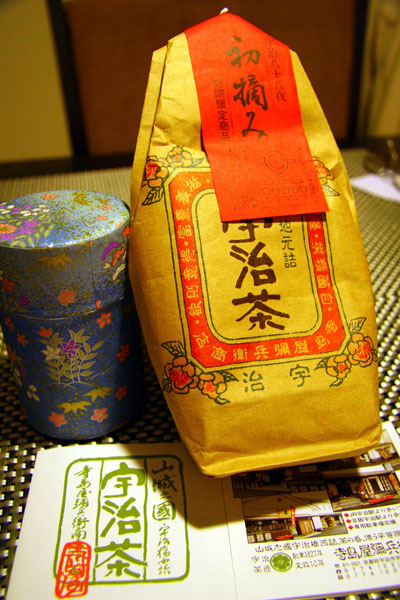
Now you know why Uji became my wife's favorite town in Japan -- there's just so much natural beauty, history, culture, excellent tea and of course her favorite desserts. A few months later I'm still slowly savouring my 2300 yen green tea, and whenever friends ask me about cool places to go in Kansai, I tell them about this hugely underrated place with a short name. Curious? Maybe this is your cup of tea too.
PRACTICAL INFO
Transportation
Uji is served by two separate rail companies. The Japan Rail (JR) line connects to Kyoto to the north (20 minutes by Rapid trains) and Nara to the south (30 minutes) and makes it most convenient for tourists staying in the Kansai region in general. The private Keihan Railway may also be useful if you want to directly transfer to the heart of Kyoto's traditional tourist district (Higashiyama) without going through Kyoto Station. The JR station is on the south side of the river where most of the sightseeing is, while the Keihan station is on the opposite side of the river.
Sights
Byodo-in - http://www.byodoin.or.jp/
Uji-kami Jinja - http://www.jnto.go.jp/
Traditional Ryokans
Ryori-Ryokan Aiso - http://www.wao.or.jp/aiso
Kimiya Minshuku - http://www.kimiya.jp/
Tohmi Ryokan - http://www.tohmi.com/
Fujigoyomi Ryokan - http://www.fujigoyomi.org/
Ujigawa Ryokan - http://www.ujigawaryokan.co.jp/
Cafes
Nakamura Tokichi - http://www.tokichi.jp
Ito Kyuemon - http://www.itohkyuemon.co.jp
Tea Shops
Kanbayashi - http://otya.co.jp/
Mitsuboshi-en - http://b-omotesando.com/shop/mitsuboshien/index.html
Kanbayashi Shunsho - http://www.shunsho.co.jp/
Yamada-en - http://www.yamadaen.jp/