Pages

Saturday, July 5, 2008

Kobe Beef in Kobe -- A Step-By-Step Photo Sequence

Food Review: STEAKLAND KOBE (Kobe)
Address: Kobe-shi Chuo-ku Kitanagasa-dori 1-8-2
Hours: Daily from 11:00-22:30 (According to Gurunabi)
Website/Map: http://r.gnavi.co.jp/k205300/map1.htm
Directions: Take a Hankyu or JR train to Kobe's Sannomiya station. The restaurant is right across from the "Hankyu Sannomiya" train station on the north side (NOT the "JR Sannomiya" train station), street level.


The main purpose of this article is to document a Kobe Steak dinner in Kobe using a sequence of photos. If I happen to be able to convince you to travel there and to be able provide you with the directions for finding this place, it would be my pleasure as well.

The steakhouse, Steakland Kobe, is located in an area of downtown Kobe known as Sannomiya, where you absolutely can't escape from tripping over restaurant menus advertising Kobe Beef every 50 metres or so. So even though it's the heart of the tourist district, serious competition helps keep pricing to a reasonable level. As of summer 2008, "reasonable level" should be about 3000 yen for each 100 grams of Kobe Beef, served as part of a dinner course. I've compile a PRICE COMPARISON of Kobe Steak restaurants in Kobe, at the bottom of this article, for those who are planning a trip to Kobe.
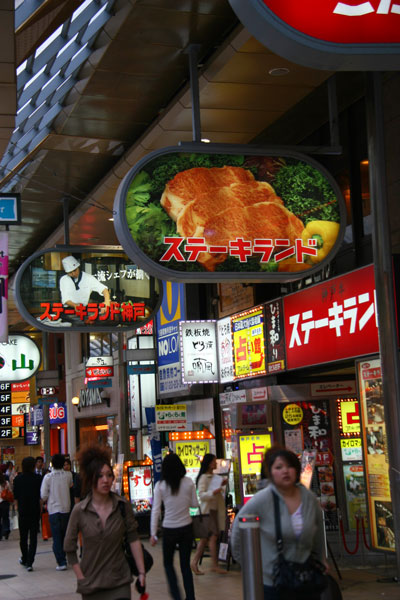

It's easy to find -- these two big elliptical store signs both belong to Steakland Kobe. The restaurant is on Sunset Street (Sansetto-dori) across the road from the north side of Hankyu Railway's Sannomiya station. Arriving at the JR Sannomiya station, it's less than five minute's walk to the west.
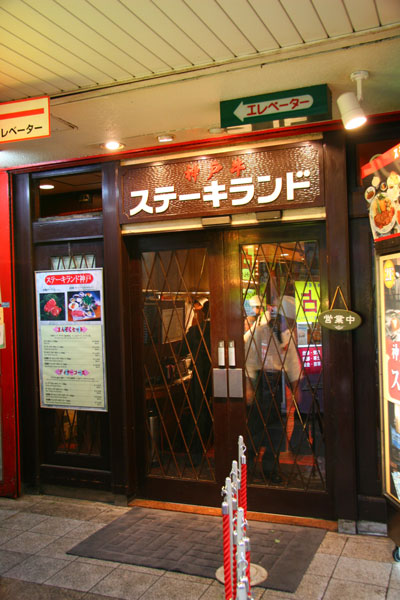

We arrived at 17:45 on a Monday -- too early for dinner for most city-dwelling Japanese. The open grill with the Teppanyaki chefs is on the main floor, while the second floor are mostly tables in a more private setting. If you wish to get prime seating in front of a chef, I would recommend arriving early like we did, or very late in the evening (restaurant closes at 22:30).
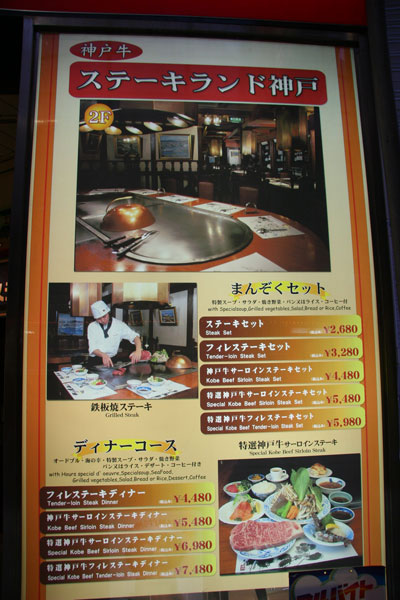

Prices are clearly listed outside the restaurant, in English and Japanese. The cheapest Kobe Steak on the menu is the 4480 yen "Kobe Beef Sirloin Steak Set" on the right side, and anything cheaper wasn't certified Kobe Beef. This is only medium grade Kobe Beef though -- for top grade melt-in-your-mouth quality, fork over 5480 yen for the "Special Kobe Beef Sirloin Steak Set".

If you're really hungry though, consider getting the "Dinner Courses" listed on the left side of the menu, which are identical to the "Sets" on the right side plus an hors d'oeuvres (probably prosciutto) and a side of seafood in the Teppanyaki.

We wanted quality at a reasonable price, and so we ordered one "Special Kobe Beef Sirloin Steak Set" (5480 yen) and one "Special Kobe Beef Tenderloin Steak Set" (5980 yen). Alright let's scroll ...
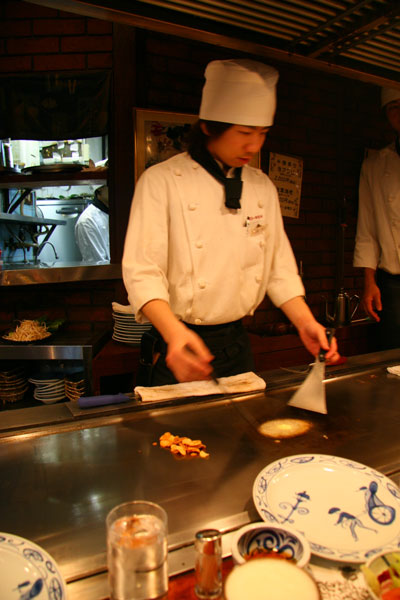

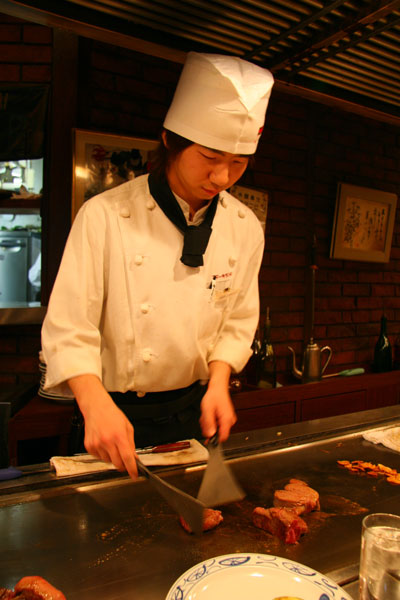
We were served by a younger chef who looked half the age of the restaurant's 60 years. First thing he did was melting a 3cm cube of butter and a throwing a scoopful of crispy deep-fried garlic slices on the Teppan.
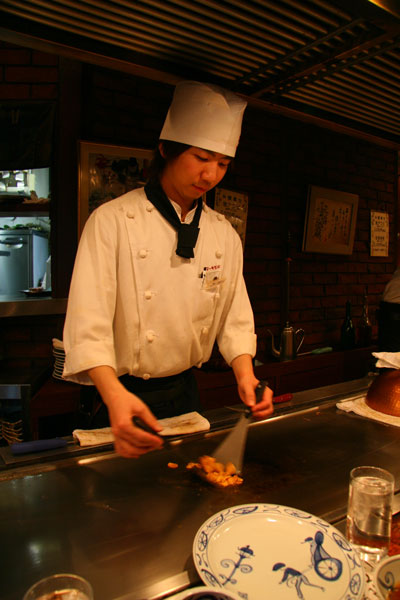

Refrying the garlic chips in butter was the predictable next step -- it's probably not the garlic that needs refrying, but the butter that needs to be infused with the delicious flavor. Note the iron spatulas, which seem to be a favorite tool of Teppanyaki chefs for stirring as well as cutting.
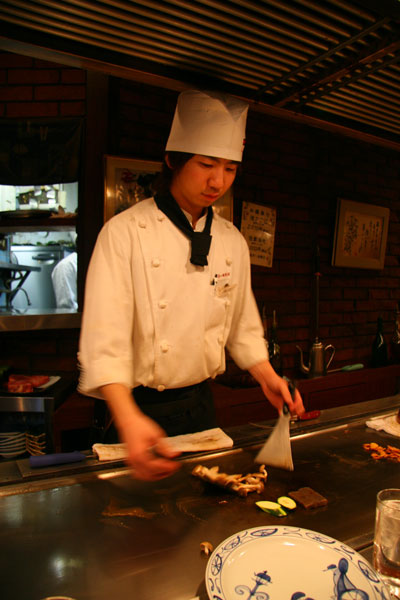

With the Teppan now properly coated in garlic butter, the Chef started saute-ing the sides -- a handful of Shimeji mushrooms and slices of Konnyaku jelly and cucumber. For me it was an interesting little cooking lesson, as I never knew that Konnyaku jelly could be sauteed like this.
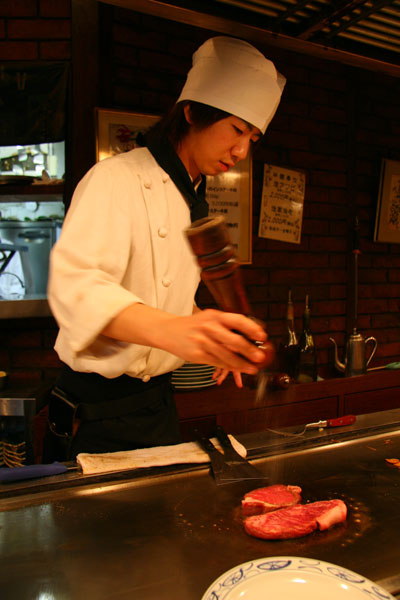

The grand entrance of the legendary Kobe Beef. Both the 200-gram sirloin and the 160-gram tenderloin were looking bigger than my impression of typical 6-to-7-ounce cuts in North American restaurants. The chef had now set the vegetables aside and given the steaks a light shake of salt and pepper.
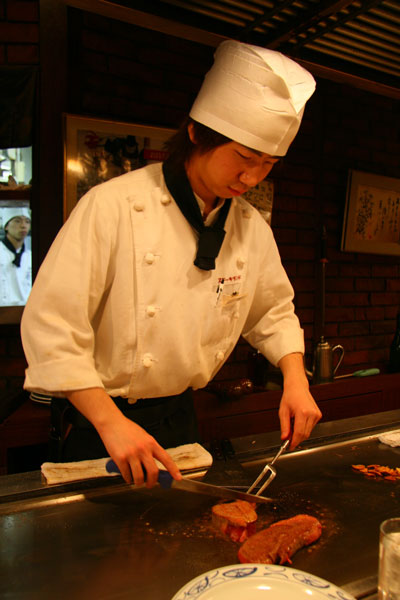

The chef exchanged his spatulas for knife and carving fork. For me this was somewhat unexpected, since I've been to a simliar Teppanyaki place in Tokyo where the chef sliced and diced my Matsuzaka Steak (just as expensive as Kobe Steak) into cubes using only the sharp edges of his spatulas.


The excess fat was trimmed away and left sizzling on the side for another purpose, while the steaks were cut into halves for even heating. Note the fried garlic slices being indirectly heated on the side.
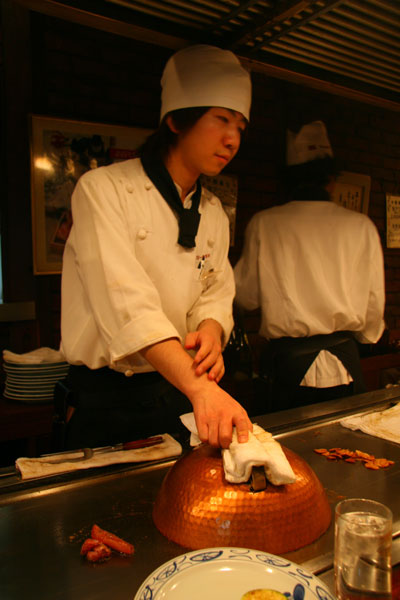

This is a step I hadn't seen before in Teppanyaki steak preparation -- for a short time (one minute or so) the chef covered the steaks and raised the temperature. I still can't figure out why this was necessary ... it didn't seem to provide better searing (see the colour of the steaks' surfaces in the next picture), and it certainly didn't require this procedure to properly cook the inside since the steak will be cubed and seared on all sides in the final stages as shown below. So this remains a mystery to me. If you know the reason, please post me a comment ...

Thanks to reader babedolphin who posted the following comment, here is why covering the steak is necessary for Kobe Steaks, with an excellent explanation about the differences between Kobe, Matsuzaka, and other top grade Wagyu beef strains. You have to read this ...

Written by babedolphin:

I believe the use of the copper cover for steaming the Kobe Wagyu steak slightly on the teppan, is because Kobe Beef's fat marbling isn't really too 'fine' in details, compared to say Matsuzaka Beef or other A4-A5 wagyus.

In fact Kobe/Hyogo and Matsuzaka beef are both equally bred so fat, that there's more fat than meat (80 to 20%?) than other A5 wagyus from throughout Japan, including Oumi (around 65/35% I guess). Its M12 A5 wagyu versus M9+-M10 A5 wagyu differences from other regions. Yet, Matsuzaka has softer marbles and pinker colours than Kobe despite both being of the same genetics, due to breeding program differences as well as Matsuzaka's controllee insisting on eating female メス牛 only.

Those thicker marbling strands of Kobe tend to insulate some meat and other melty fats too much so there is a bit of uneven cooking, or the fat simply can't melt.

I guess I'm not a big fan of Hyogo/Kobe beef in a sense, because at those intense 'fatty' levels, Matsuzaka beats it hands down due to the guarantee of using メス牛 alone, and its much more apparent when doing shabu-shabu/sukiyaki as Matsuzaka melts-in-mouth more at lower temperatures!

If I can't have Matsuzaka, I would rather do some Kyushu based, Gifu Hida, Yonezawa or other less fatty beef. Oumi is really good too I guess, better than Kobe, but less than Matsuzaka to my tastebud!


There you have it ... expert opinion from a true Wagyu connoisseur!


Switching back to the spatulas, the chef meticulously stood the steaks on each of its edges for even searing. That took a bit of patience -- if the steak wouldn't stand on its own on a particular edge, the chef would hold the steak up with his spatulas and gently press it onto the Teppan until that side is seared to the right degree.
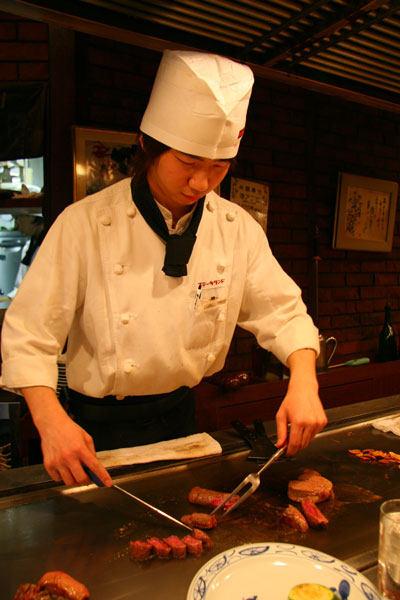

Back to knife and carving fork again. Thus began the process of dicing the steaks into the bite-sized cubes familiar to Teppanyaki fans. The chef also started dicing the trimmed fat into very small pieces and leaving it to be fried in its own oil. Note that the sirloin was really starting to take on a beautiful colour now.
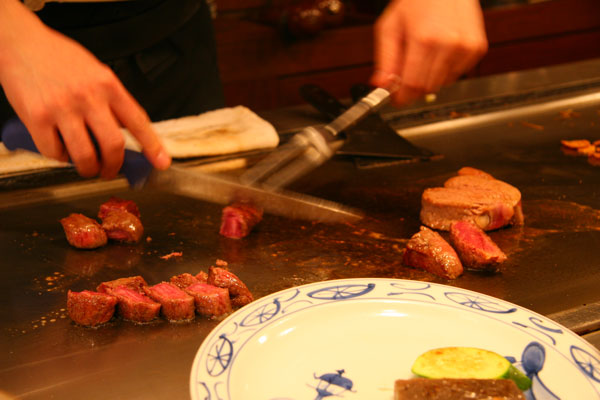

Like a Sashimi chef's cut, each stroke of the knife started with the chef resting the foot of the blade (the part nearest the handle) on the meat. Then in one long and clean stoke he slid the blade gently into the meat, ending with the knife's tip finally scratching the Teppan.
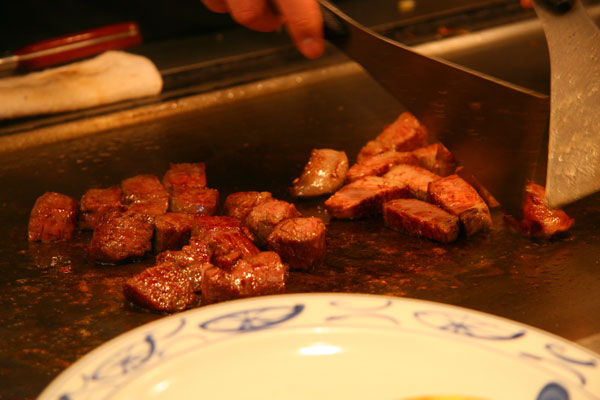

By now the oily smoke and aroma of charred red meat had saturated the entire room. The knife and fork were finally put to rest, as the chef switched back to spatulas to constantly turn and sear each individual piece. This seemed an eternity to us as we waited.
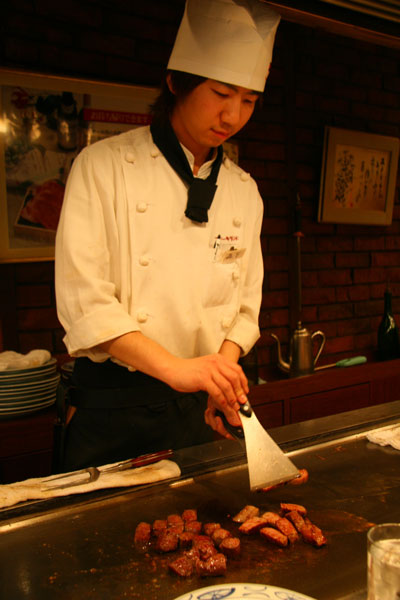

Ah...the long awaited moment. While the steak cubes went to the plate, the fried bits of trimmed fat (remember them?) went into a bowl of beef broth. I could hardly contain my drooling now.
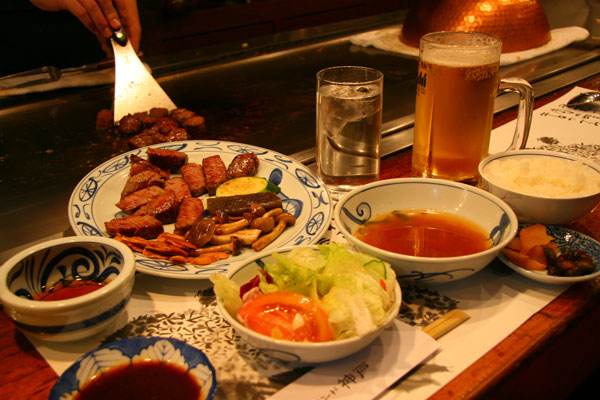

This is the entire tenderloin steak set -- 160 grams of Kobe Beef tenderloin with sauteed Shimeji mushrooms, Japanese cucumber, Konnyaku jelly and re-fried garlic chips. Served with a green salad in a Miso vinaigrette dressing, a clear beef broth, Konomono (Japanese pickles), rice, and a garlic-Ponzu dippling sauce.
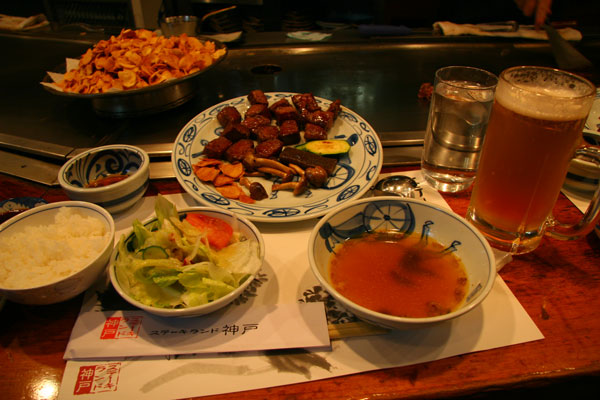

The sirloin steak set is identical except for the 200 grams of Kobe Beef sirloin.

Did I forget to mention the FREE BEER? Yes, FREE BEER. Print out their official coupon here (in Japanese, but you don't really need to understand it), and show it to your waitress upon ordering. You can choose between a free glass of house wine or a free pint of draft beer, and the coupon seemed to be good for one free drink for EACH guest in the party, as we received two pints.

Make sure you print it out just before your intended arrival date though, since the Coupon does have an expiry date.


Hmm ... I loved the sirloin with it intense beef flavors, and of course the softness of quality Wagyu Beef that disintegrates into a puddle of oily red meat under even the softest bite. I couldn't help comparing it to the top grade Matsuzaka Steak we had in Tokyo (see our Matsuzaka Steak review from 2005), and I thought them almost identical. My wife's tenderloin was a bit of a disappointment however -- nowhere as soft (I thought tenderloin was supposed to be the softest cut!), nowhere as flavorful, not quite as big (160 grams vs 200 grams), and more expensive too! OK. From now on I will always remember to order sirloin in Japanese steakhouses.

Bill for Two Persons
Special Kobe Beef Sirloin Steak Set5480 yen
Special Kobe Beef Tenderloin Steak Set5980 yen
Asahi Draft Beer x 20 yen (from Coupon)
TOTAL11460 yen (CAD$115)

That's it for Kobe Beef. If you're seriously planning a visit, may I offer my PRICE COMPARISON of Kobe Steak restaurants in Kobe at the bottom of this article.


WHAT ABOUT SIGHTSEEING IN KOBE?

The only sight we're really interested in was the sizzle of its melt-in-the-mouth steaks.

I'm not knocking Kobe's top tourist attractions -- they're just not for me. The number one attraction to domestic tourists is a loose collection of late 19th-Century European settler houses known as the Kitano Iijinkan, which is much less interesting to a Canadian. The night view from Mount Rokko is advertised as one of the unofficial "Top 3" of Japan, but the night view from the Northshore Mountains in Vancouver is spectacular too, especially in the middle of a downhill ski run. There are other attractions such as the Arima Hotspring and the Kobe Harbour, but I don't know ... I think I'm just more attracted to places like Himeji and Uji.
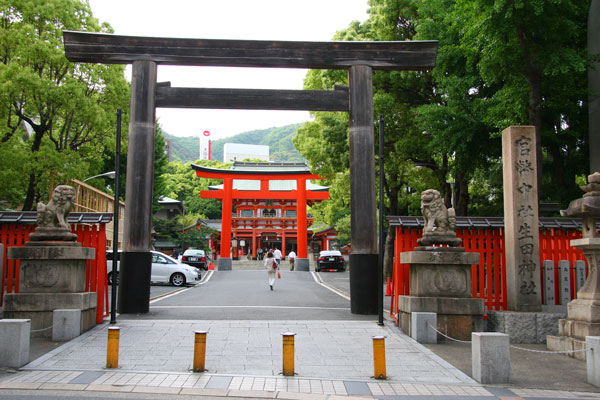

We did pass by the Ikuta Jinja shrine, only because it was conveniently located just five minutes walk from the restaurant. Your tourist brochures will advertise it as one of the oldest shrines in the country (3rd Century CE), but it won't tell you that the main structures were rebuilt just decades ago (even as late as 1995 after the great Hanshin Earthquake in fact).
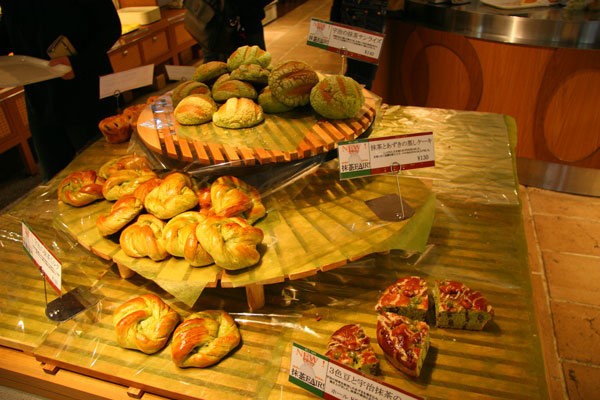

One of the first Japanese ports to open to European trade, Kobe is also famous for its Japanized versions of western confectioneries and patisserie such as these "Uji Matcha Sunrise" and "3-colour Beans and Uji Matcha Cake" at Fred's Bakery (www.freds.ne.jp) inside the Hankyu Sannomiya train station.
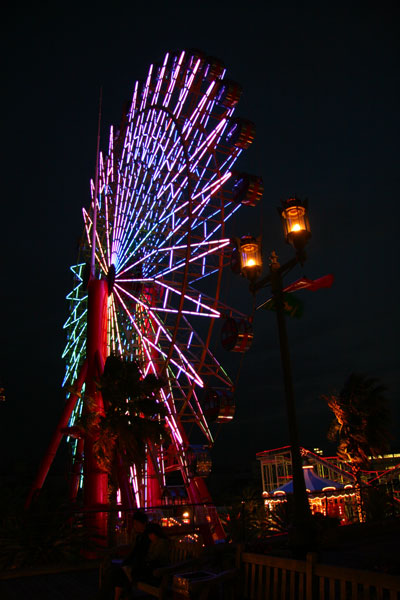

Ferris Wheel by the pier side -- if they're modelling this after Santa Monica Pier (www.santamonicapier.org), then it's very successful. This is situated next to a large semi-covered shopping complex, and only 10 minutes walk from the JR Sannomiya train station, so even if you're not interested in theme park rides, it's not a bad place to walk off that Kobe Steak.
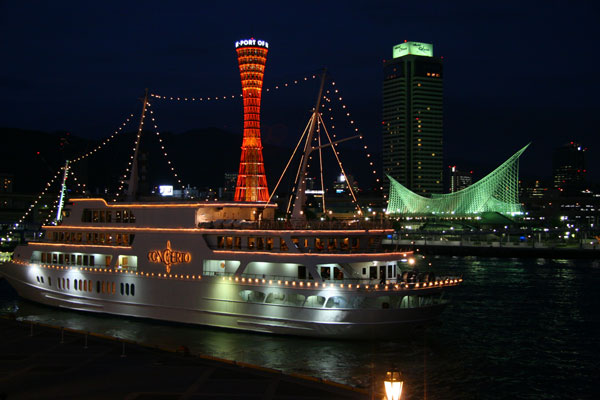

I finally got my favorite night shot of Kobe, just as the cruiseboat departed. For 2100 yen (CAD$21), the Concerto (www.kobeconcerto.com/english) will take you for a 90-minute roundtrip cruise around Kobe and Osaka Bay. The illuminated structures in the background are the Port Tower and Maritime Museum, an integral part of Kobe's coastline scenery.


Addendum: KOBE BEEF PRICE COMPARISON:

The following are the list of **reasonably priced** Kobe Beef restaurant I found during the course of my research. Prices listed are for the cheapest meal with certified genuine Kobe Beef only -- I had no interest in traveling all the way to Kobe only to have regular Wagyu beef.

RestaurantRemarks (dated July 2008)
Steakland KobeLunch/Dinner; 5480-5980 yen for 160-200 grams
Kobe Brand Tei MosaicLunch/Dinner; 4200-5600 yen for 150-200 grams
RengateiLunch Special 3000-4000 yen for 100 grams
Kishuya SumibiyakiLunch/Dinner; 4500-5500 yen for 100 grams
Gurirudo KobeLunch 4480-4980 yen for 100 grams; Dinner 6500 yen for 100 grams
WakkokuLunch 5040 yen for 150 grams; Dinner 7500-8500 yen for 180 grams
WataruLunch/Dinner; 3000 yen for 100 grams
Kobe Grill KoubouLunch/Dinner; 4980-7500 yen for 150 grams
KuukaiLunch/Dinner; 7950-yen-plus in a full course; unknown weight
Biftek no KawamuraLunch/Dinner; 8400-yen-plus for 110 grams in a full course
SetsugekkaDinner; 7350-8400 yen for 120-160 grams
A - 1Dinner; 6500 yen for 170 grams
Ooi NikutenLunch/Dinner; 10000-yen-plus for 150 grams
Kobe SteakLunch 5000 yen; Dinner 7000 yen; Unknown weight
Steak AoyamaLunch 5000 yen unknown weight; Dinner 8900 yen for 150 grams

Now you should be equipped with enough information to ensure a satisfying visit. Now the only question is which airline to book, right?

Saturday, June 28, 2008

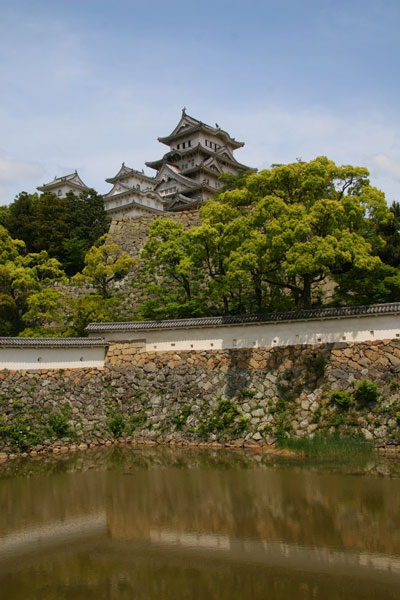
Taking the Long Way Up Himeji Castle


Himeji's glorious white castle is justifiably popular -- as a UNESCO World Heritage site, as a permanent feature on tourist brochures, and as an icon of Samurai films from Kurosawa (Ran) to Tom Cruise (The Last Samurai). And being only an hour from Osaka by train, it gets on the itinerary of most international and domestic tourists visiting the Kansai region.

The problem is, the Castle is so famous as a historical monument that it has become the only reason to visit for foreign tourists. From what I observe of fellow Gaijins, the typical itinerary seems to involve spending two hours touring the Castle (some even managed to drag around huge pieces of luggage in the process), then quickly leaving for the next destination. But with an entire day on our hands, we had a little more time to stumble into the Himeji that the locals know.

It's perfectly understandable why everyone just heads straight to the Castle -- it's the most impressive thing we saw emerging out of the train station, a perfectly white, stately architectural jewel standing only a kilometre away at the end of a wide boulevard (Otemae-dori). But we took the road less travelled ...


Actually it turned out to be the road most travelled, a crowded labyrinth of inter-connected covered arcades running the entire length of the Otemae-dori on the boulevard's right side. Only after returning to Canada did we find out that this was the main shopping district to the locals. You're less likely to encounter souvenir shops than some shoe store's liquidation sale (where my wife spent 30 minutes). We also bought some beautiful Furoshiki (Japanese handkerchiefs), a couple of cloth sacks, cosmetics and hair products, and some snacks and drinks along the way. It took us an hour just to get 500m closer to the Castle, but my wife really enjoyed it. A Japanese map of these shopping streets is here, but I would recommend doing this on the way back from the Castle, in case you find as many bargains as we did.

It was 11:30am by the time we finished shopping, so we decided to have lunch and recuperate a little before climbing the Castle.


Food Review: MATSUBISHI HONTEN (Himeji)
Address: Hyogo-ken Himeji-shi Fukunaka-machi 98
Hours: Thu-Tue, 11:30-13:45 and 16:30-21:30 (According to Gurunabi)
Website/Map: http://r.gnavi.co.jp/k030100/map1.htm
Directions: It took us 45 minutes of circling around the neighbourhood to find this place, so I'll give you the best directions I can. Take the North Exit from Himeji's JR Station. Walk straight towards the Castle on the left side of the main road (called Ootemae-dori). When you see the Yamato Yashiki department store on your right side across the street, walk to the end of that little block and immediately turn left into a small street. Walk straight for five blocks, and Matsubishi will be on your right hand side.

If I had done a little more homework beforehand and figured out the above directions for our own use, it would have taken 10 minutes instead of 45. I could have given up earlier, but this was supposed to be one of the premier restaurants focusing on Himeji's famous local catch, and I definitely didn't want to miss out.

To the Japanese, Himeji is not only synonymous with the Castle, but its Seto Naikai (Inland Sea) coast is also famous for producing Anago, the Japanese conger eel which is a summertime favorite in the Kansai region. We've had fresh Anago before in Tokyo (see review of Sushi Dai), but this is an old, renowned restaurant at the heart of the producing region, and we had correspondingly high expectations.

My first impressions of Matsubishi were the well-embellished interior, the 3000-8000 yen (CAD$30-$80) dinners courses, and the 1575 yen (CAD$16) lunch specials. So prices are fairly reasonable for lunch, and the choices were plenty:
- Anago-zushi Teishoku (Anago sushi set)
- Anago-don Teishoku (Anago ricebowl set)
- Tempura Teishoku
- Niku Amiyaki Teishoku (broiled pork on a wire mesh)
- Sashimi Teishoku
- Nigiri-zushi Teishoku (5 pieces of Anago sushi, plus 5 pieces of assorted)

We ordered Anago-don Teishoku and Anago-zushi Teishoku, as we were curious to find out how our chef would handle our theme ingredient in several different cooking methods. Well, it took about 30 minutes for our lunch to arrive even though we were the only table, so I guess our chef was taking the test seriously.


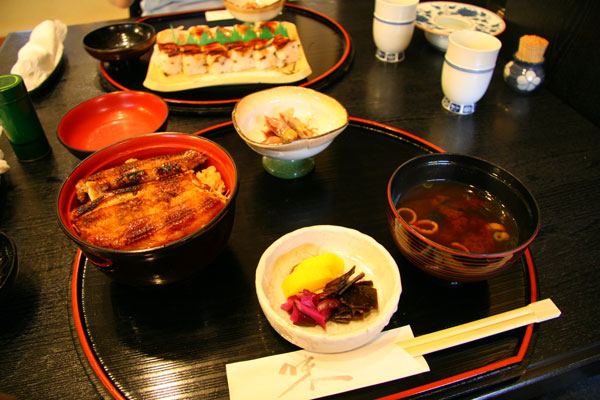
My Anago-don Teishoku arrived with an Aka-dashi soup, a salad with some mysterious little calamari, pickled vegetables, and a Yuzu (Japanese citrus) sorbet not shown in this photo. I remember the soup quite well -- it was a savory seafood-based (Anago bones perhaps?) broth with a strong red miso paste and garnished with strips of Anago. The pickles and sorbet weren't spectacular enough to stand out in my memory. But the true star of the meal arrived, accidentally, when I poped one of those little calamari into my mouth.

And it was an audible "pop" as the squid's tender body bursted under my bite and released a sweet, heavy paste. It's a velvety cream texture, but with a wonderful sweetness of shellfish and a hint of seawater. The squid body itself was roughly 5cm long, with little short tentacles, and very delicately steamed. So what is this dish called?

"Hotaru Ika no Sumiso-ae," or Firefly Squid with Vinegar-Miso Dressing, explained the Obasan who served us. Really? I had heard of Firefly Squids before, but mostly in a sightseeing context where people would take a night cruise in late spring and watch the sea turn into florescent blue. The Obasan continued to explain that the sweet paste was actually the roe, and that it was currently the best season (mid-May) as the mating squids were being fished out of the local waters. It was an unforgettable appetizer, and it would not be our last encounter with the Firefly Squid on this trip.

On to the main course ... what a disappointment it was, or at least MY main course was. I was hoping for a tender, moist fillet with a smoky tasting baste, but the result was just the exact opposite. I'm not saying it was a bad Anago-don -- I just happened to make the wrong choice for my own preference.


My wife's choice turned out much better -- six pieces of pressed Anago sushi, and four pieces of steamed Anago sushi. Her lunch set also came with the excellent Firefly Squids and the Aka-dashi soup, as well as the sorbet.


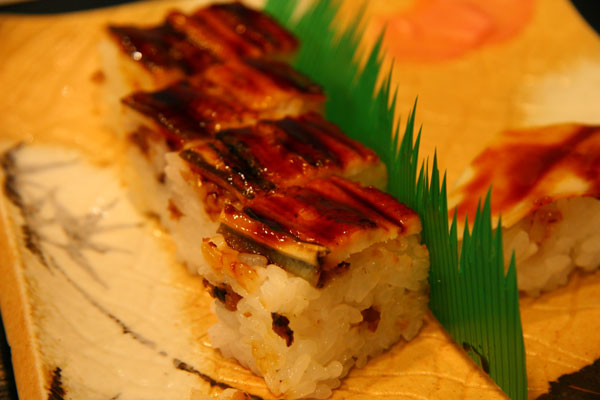
The lightly broiled Anago in the pressed sushi was better than my rubbery dry fillet, but to me the combination of broiling and the rich sauce entirely undermined the delicate flavor of the Anago. Again, it wasn't bad -- it was just not what I was looking for.


Wonder why there's only one piece left? Because this was by far the best of the three Anago preparations, and we almost finished it off before remembering to take a close-up photo. Initially plain-steamed without sauce, this Anago piece was unexpectedly firm and mild-tasting, with the light application of sauce complimenting rather than overpowering the subtle oiliness of the flesh. This was exactly the Anago I was looking for, but ... hey where did the rest go?

Bill for Two Persons
Anago-don Teishoku1575 yen
Anago-zushi Teishoku1575 yen
TOTAL3150 yen (CAD$31)


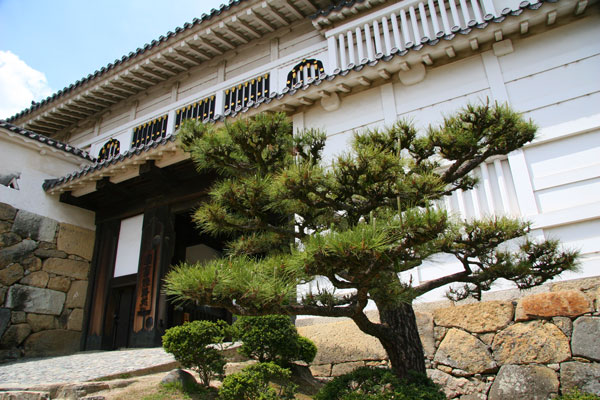
Time to begin the ascend. The magnificent Castle looked deceptively close, but like many medieval strongholds the approach was a winding maze of steps slowly climbing up the compound. In fact it took an hour and forty minutes to go from this picture to the top of the main tower, according to the timestamps.


The seemingly rambling path was adorned with 400-year-old architecture and beautiful landscaping, belying its original purpose of misdirecting attackers.


Imagine you're a foot soldier in the Warring States period and you're climbing these long flights of steps in your 20kg armour suit, with arrows and musket fire raining down from above. Then you'll start to understand the value of the unusual defensive structures you come across on the way up. Heck ... I had a good workout myself even with a 2kg camera bag.


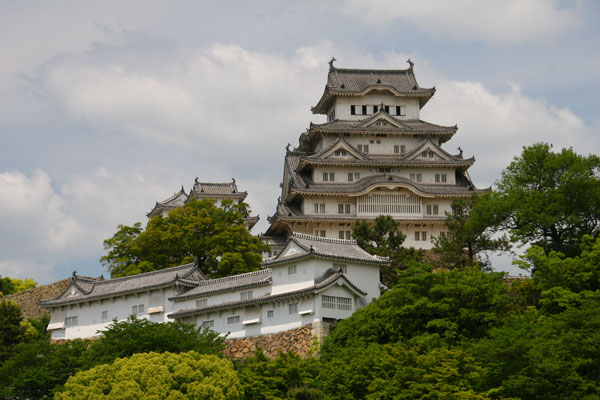
Finally a clear shot of the Tenshukaku (main tower). There's a REALLY interesting little semi-hidden courtyard nearby called the Harakiri-Maru, constructed with the sole purpose of providing the Master a secluded area for an undisturbed ritual suicide in a worst case scenario.


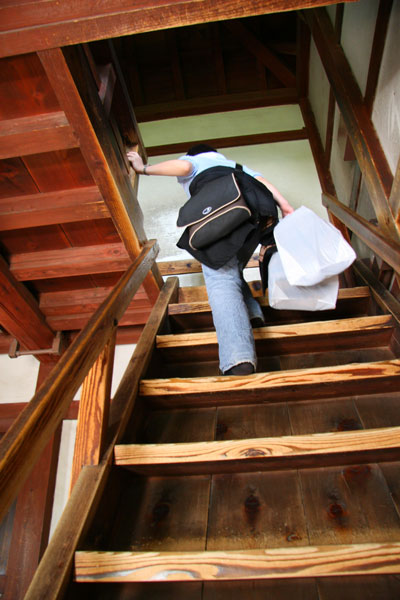
The interior is equipped with very steep stairs as you can see. Inside the white plastic bags are our own shoes, which must be removed prior to entering the interior of the Castle.


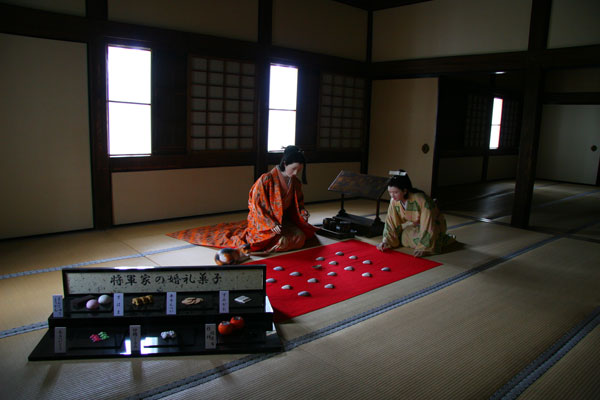
A life-size model of Sen-hime, a princess of the Shogun and a beloved historical figure, and the Wedding Desserts delivered to her husband Lord Honda Tadatoki by the Shogunate. Sen-hime was originally married to the Shogun's arch-enemy, and was remarried to Lord Honda after the Shogun defeated her first husband in battle and forced him to commit suicide. So you can imagine how this puppet princess was treated as a means of diplomacy in 17th century Japan.


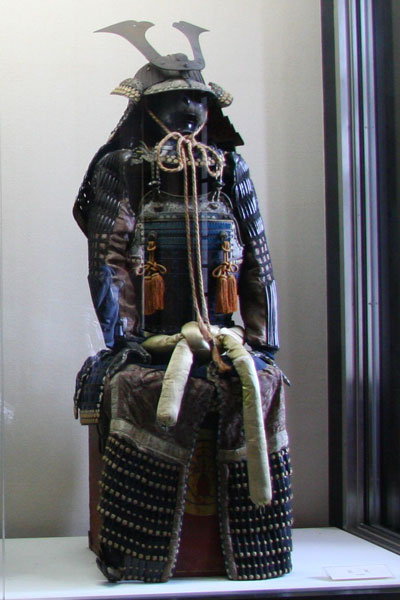
This is just a random shot of the hundreds of exhibits throughout the Castle. The exotic Samurai armour is actually not too dissimilar in principle to their European counterparts from the same period in history, except the use of muskets was only beginning in Japan and so the armours were still comparatively thinner and lighter.


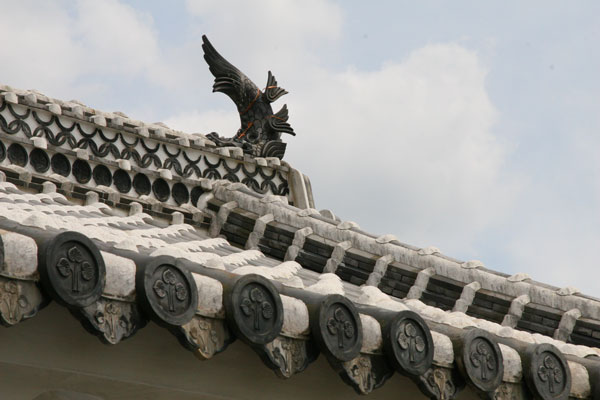
The killer whale talismans at the roof seems to be a typical feature of Edo period castles. Also note the Master's clan crest on the rounded "crest tiles" (Mongawara) -- the ownership of the Castle changed hands many times throughout history, and you can always associate a clan crest with its represented period of origin.


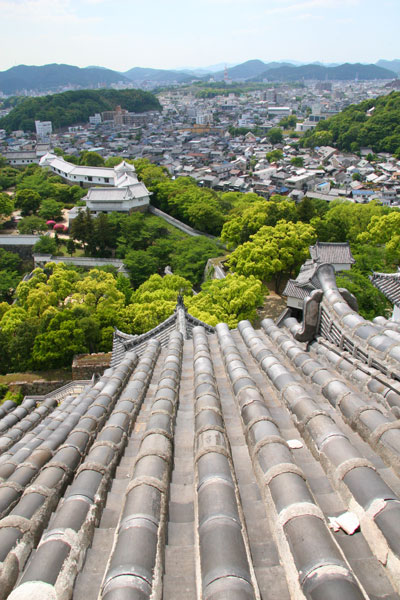
This is my favorite view from the top of the main tower, a westward view towards the rest of the castle compound and the town beyond. Not even a tall buildings in sight, so it wouldn't have been very different from the view Lord Honda woke up to nearly 400 years ago.


This is the southward view towards the Otemae-dori, with the JR station at the end of the boulevard.


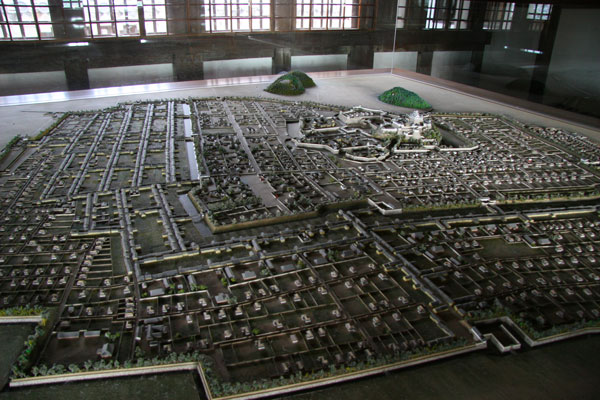
A model of the city of Himeji in the Edo period. Note the series of walls and moats that the potential attacker must breach even before reaching the Castle. The left edge of the picture is roughly where today's JR train station stands, so the entire walled area must have been two or three kilometres in diameter.


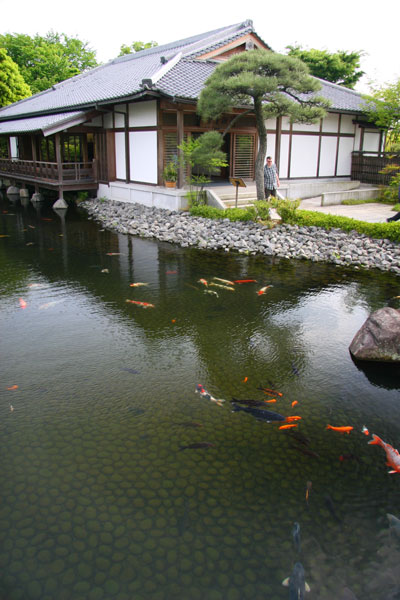
Adjoining the Castle on the southwest side is a relatively new (1992) Japanese garden called Koko-en, or Garden for Love of Antiquity ... well my translation anyway. If you've been to one of the more historic (and more lavish) Japanese gardens such as the Three Famous Gardens (located in Kanazawa, Okayama, and Mito), or if you have little interest in Japanese gardens, then I would recommend skipping this. Otherwise it's not a bad place to watch the colourful Koi fish and relax after a long hike up the Castle. The "combination ticket" for both the Garden and the Castle is just 100 yen more than a ticket to the Castle alone.


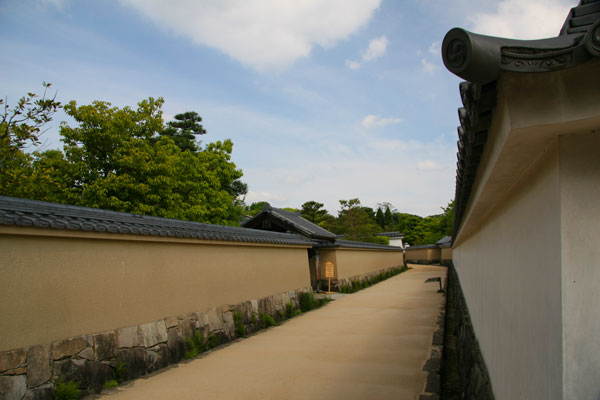
Built on top of an excavated site of former Samurai residences, the Garden fittingly reconstructed a series of beautiful earthen walled alleys, eerily similar to the Nagamachi samurai quarters of Kanazawa. The only clear giveaway hint of modernity is the perfect straight lines of the stone foundations.


A 100 yen (CAD$1) ride back to the JR station is a no-brainer at the end of a long day. The Loop Bus departs from the front of the Koko-en Garden once every 30 minutes.

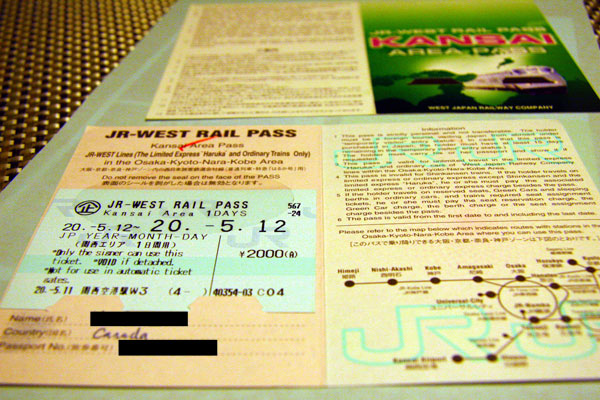
Lastly, if you're planning to visit Himeji on a day trip from Osaka or Kyoto, I'd strongly recommend that you go to the nearest major JR station (eg.Kansai Airport, Osaka, Shin-Osaka, Kyoto) and get a JR-West Kansai Area Pass for 1 Day. It looks like this:


For 2000 yen (CAD$20), you get unlimited travel on any local and Kaisoku (fast) JR trains in the Kansai region from Nara to Kyoto to Osaka to Kobe to Himeji. Since a return trip from Osaka to Himeji costs about 2900 yen, you're getting a serious discount even if Himeji is your only destination of the day. Or if your hotel is in Kyoto, you're effectively getting 50% off regular fare. And if you're making a brief stop in Kobe for a steak dinner ... you get the idea.

Official site of the JR-West Kansai Area Pass is here.

Wednesday, June 18, 2008

The Old Master of Osaka Style Broiled Unagi

KUROMON KAWAHIRO IS PERMANENTLY CLOSED

According to first-person reports from several readers, Kuromon Kawahiro, an Osaka-style Unagiya and one of my favorite memories of Japan, has permanently closed its doors.

This page will be left in its current state, as a tribute to Chef Kawano Iwao and the pinnacle of Osaka-style Unagi that he crafted out of his very hands.

For readers planning a trip to Osaka, the following restaurants all serve Osaka-style broiled Unagi:

Honke Shibato - a 300-years-old Osaka institution
Uoi Honten - another venerable restaurant, a little younger at 140-years-old.
Una Shige - another Osaka-style Unagiya


Food Review: KUROMON KAWAHIRO (Osaka)
Address: Osaka-shi Chuo-Ku Nihonbashi 1-22-9
Hours: Mon-Thu from 11:00-14:00 (According to Yahoo Japan)
Website/Map: http://gourmet.yahoo.co.jp/0002146335/P006397/
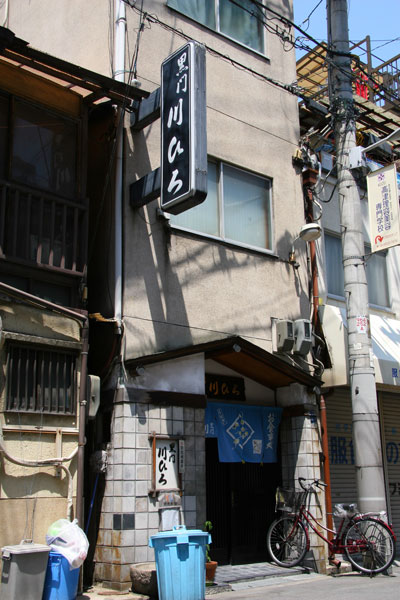
Directions: First go for a walk at Kuromon Market (Nihonbashi subway station, Exit 10, walk Southeast for a couple of blocks). It will help work up your appetite. Then from the South end of the market (opposite from the Nihonbashi side), walk East for one little block, then turn left and comb your way North, towards the Nihonbashi direction. A couple blocks later you'll see its black (Japanese only) sign on the left, as shown in the picture at the bottom of this article.


You must be wondering:

1) What is Osaka Style Unagi anyway?
2) How is it different from the Unagi at my local Japanese restaurant?

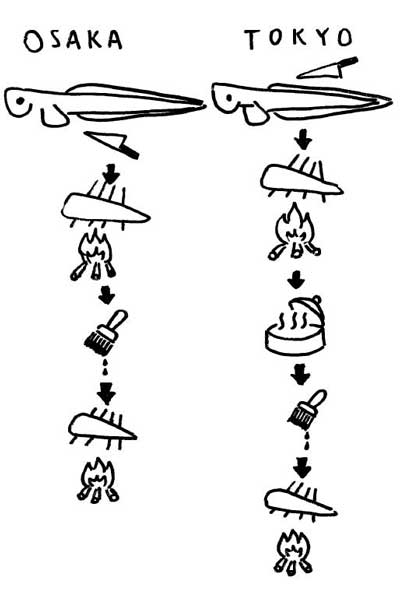
If you're a Japanese food enthusiast, you should know that there are at least two major styles of preparing Unagi -- Kanto-Ryu (Tokyo Style) and Kansai-Ryu (Osaka Style). The easy way to tell is to flip over your Unagi, skin side up. If the white skin is in the middle of the fillet, it's Tokyo Style; if the white skin is at the edges, it's closer to Osaka Style. Easy enough?

The real reason behind this is that Tokyo Style slices open the Unagi at the *BACK*, while Osaka Style guts the Unagi at the *BELLY* side. One theory is that Tokyo was the centre of the Samurai society during the Edo period (ie. the Shogun lived there), and so slicing open the abdomen is a taboo linked to the Samurai class's unique ritual suicide (or execution) of Seppuku. But another plausible theory is that fillet is thinnest at the belly, and by slicing open from the back the chef would be able to keep the thin regions of the fillet from over-charring. In Osaka though, Unagi is gutted just like any other fish. I guess Kansai people are more concerned with efficiency and customer turnover.


The other major difference between the two styles is the steaming process that exists only in Tokyo Style. In essence the Unagi is flame broiled, steamed, then brushed with sauce and flamed broiled again. The steaming not only removed excess fat, but also creates the softness and delicate taste that is widely considered to be more "feminine." But in Osaka Style, the Unagi is flame broiled, brushed with sauce, flamed broiled, brushed with sauce ... until the degree of charring and crispiness is to the Chef's liking. Thus the fillet is supposed to be crispier, stronger flavored, and "masculine," as we're about to find out.


This is the place. I've spent hours reading Unagi reviews on Japanese websites and blogs, and this was my choice. It's not the cleanest location (next to Osaka's largest market), and it's not cheap either ... Yahoo Japan's old review reported 3200 yen ($32) for an order of Mamushi (Kansai-style Unagi on rice) for lunchtime(!), which is more expensive than even the 200-plus year old Unagi specialist Shibato. So why did we pick this place out of many reputable candidates?

Because I trust Majin-san's Unagi Review Blog. Now THIS is a serious Unagi lover, and if you can read Japanese you can see his 160-plus reviews of Unagi restaurants. Most of the restaurants are in Tokyo where he lives, but there are occasional reviews from other parts of Japan. This is where I first read about Kuromon Kawahiro, the only Kansai Style Unagi restaurant near the top of his list. So I decided that I MUST give this place a try, if I ever travel to Osaka in my lifetime.

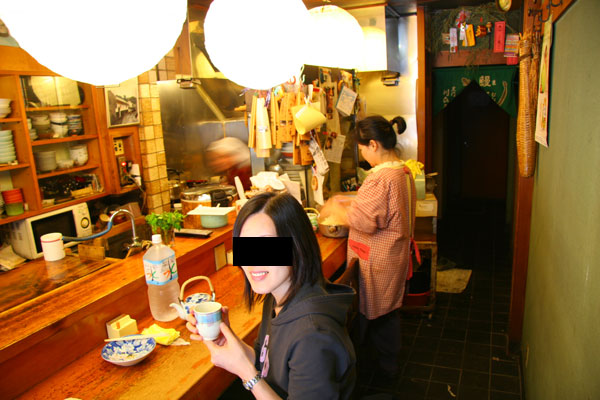
So the picture above is what the restaurant looked like -- garbage cans on the side (must have been a garbage collection day), someone's bicycle in front, and only a couple of old signage reading "Kuromon Kawahiro" in Japanese. We actually passed by this place at 11:20 and saw its door half open, so we thought they weren't yet ready and went back to the Kuromon Market for another round of shopping. But when we came back at 12:00 it was the same half open door. That's when I decided to stick my head closer to the door for a peek, and an old lady waved me in.


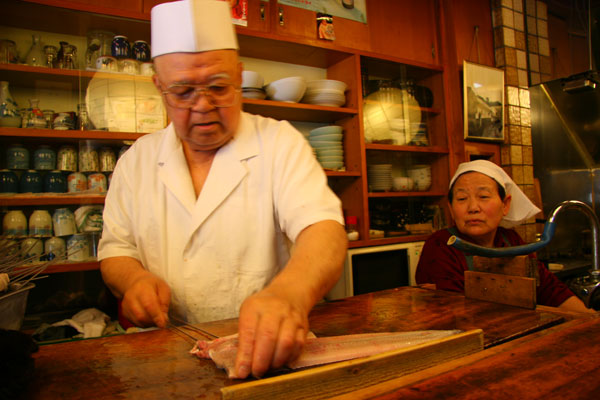
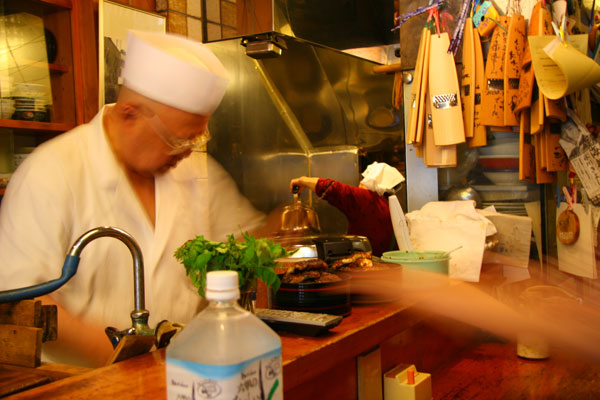
"Gomen kudasai," I said, excuse me. It was a narrow little shop with only three staffs -- the old Chef working on the Unagi behind the counter, the old lady who was the Chef's wife, and a middle aged daughter. There were no tables, only a counter with about 10 seats, where the three of them "Dozo"-ed us to sit down.

"Mamushi de Yoroshii ne?" (Mamushi okay for you?), the old lady asked. Mamushi is "Unagi on Rice" in the Kansai dialect.

"Ah, hai. Futari" (Yes. Two people.) I hadn't had a real chance to practice my Japanese since a trip to Tokyo several years ago.

Up to this point I still hadn't seen anything resembling a menu, outside or inside the shop. I looked around at the walls, and the counter, and then I realized, THERE IS NO WRITTEN MENU!! And no Price List whatsoever. So I just ordered two bowls of Unagi on Rice, at a price known only to the shop. I knew the rough price from browsing Yahoo Japan, but this is getting weird even for the Japanese.


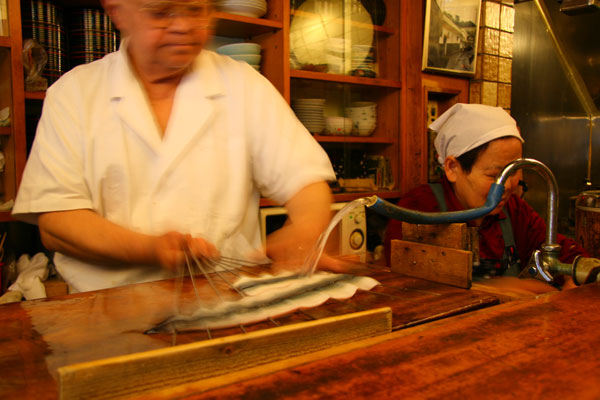
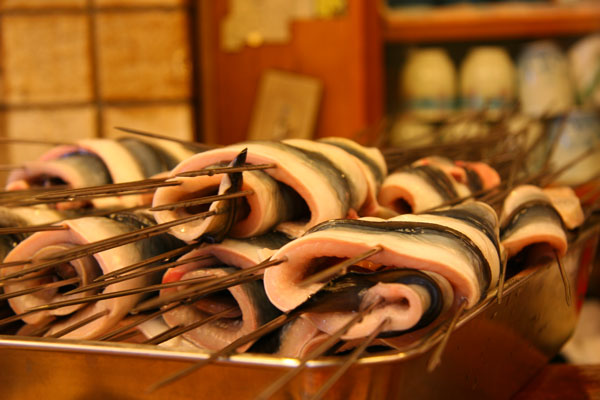
At this time the Chef was still busy skewering the Unagi ... several big stainless steel containers of them. He must had spent the entire morning filleting and cleaning the eels, and now he's skewering the last few and finishing up. With every eel, the old master meticulously inserted 10 or so steel skewers perpendicularly through the fillet, as close to the skin as possible, but without piercing the skin. Then as a final step he hosed water over the skin the to wash any remaining mucous off the Unagi.


"Shashin wo totte mo ii desu ka?" (May I take pictures?) I asked, and the Chef replied with a delighted "Hai, dozo dozo." That's when we started an odd conversation, me in broken Japanese plus single words of Japanized-English, and the chef, Kawano-san, fully in Japanese. Chef Kawano was like ...

"It takes three years, just to learn to skewer the Unagi."

"Chikara. It takes strength to do all this." (Pointing to the several containers of eels)

"This is a single portion. No, THAT is a double portion of Unagi."

... and so on. I gained a lot of random knowledge about Unagi.


I've seen Unagi being prepared before, but never at this close range, in front of a master chef, and who is willing to demonstrate all his techniques. The Unagi is undoubtedly Osaka Style, with the white belly skin at the fillet's edges. And looking at the thickness of the supposedly thinnest part of the fillet, I began to wonder if this was really a single portion, and how we were supposed to finish the meal. When Chef Kawano finished all the skewering, he took a double portion of fillets with the skewers sticking between the fingers of his fisted hand, and walked towards the kitchen.

At this point I did something I normally would never do. I took my camera, followed to the opposite side of the open kitchen, and asked "May I take pictures?" again ...


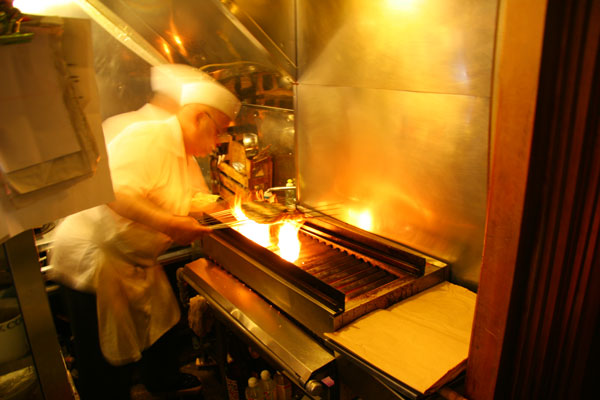
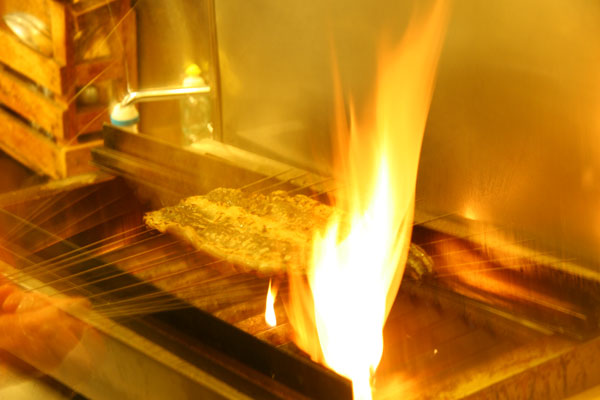
"Ii desu yo," Chef Kawano said as he turned on his stove, AND his intensity. For the next 10 minutes, the Chef would constantly use his skewer-wielding right hand to adjust the fillet's distance from the fire while using his left hand to adjust the flame. He started with the strongest flame, holding the Unagi at 30cm above the grill, and rotating between the meat and skin sides constantly. All housewives know this scorches the outside and locks in the juices, but how much scorching is enough? That, is the experience that makes it worth several thousand yen.


After several minutes of grilling, Chef Kawano started to slaver the Unagi sauce onto the meat side of the fillet with a small brush. The grilling continued, and if I remember right the sauce was applied more than once.


The flame was turned much lower by then, and the fillet was placed close to the flame to infuse the sauce and reduce the excess fat. This is the clearest picture of the fillet I've got, as Chef Kawano kept flipping the fillet constantly, hundreds of times in fact, during the entire process.


It's a family business, and during this whole time Kawano-san's wife had been busy making the Unagi liver soup and preparing the side dish, while the daughter served us tea and hot napkins. Eventually the Chef re-emerges with the skewers still in his right fist, but in a shiny glazed golden brown colour, and an unbelievable smoky aroma of Unagi oil, char, soy sauce and sweet mirin.


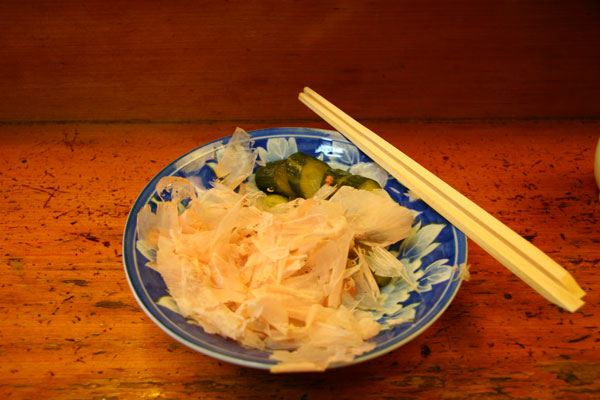
While Chef Kawano was getting the Unagi into our rice bowl his wife served a side dish, which was basically one whole pickled Japanese cucumber under a *mountain* of Katsuo-bushi (skipjack tuna shavings), seasoned with a Dashi soy sauce. The picture shows the serving for one person. I don't know if this is a typical side dish for Kansai Style Unagi, but I've never had this much Katsuo-bushi shavings served to me in any side dish or even main course. An interesting way to start a meal for sure, but as it turned out the Katsuo-bushi worked great as a appetizer, bringing an Umami taste to the mouth while not taking up much room.


Finally the moment I had been waiting for -- the famed Mamushi of Osaka. The three huge pieces of Unagi fillet in the picture is actually only half an eel, as the rice bowl is layered with Unagi at the top, then rice, then Unagi again, then rice at the bottom. Sorry about the slightly blurred pictures, but my emotions was telling me to just dump the camera aside at this point.


The first bite was unbelievable. It was a taste of intense smokiness, sweetness, saltiness, and a mouthful of savory oil all at once. As the crispy charred skin crackled under my bite, my tongue was coated with the Unagi's juices, which had maintained a wonderful strong oily flavor but without a "fishy" taste. My father once taught me how to get the fishy taste out of eel dishes, and I knew, after one bite, that Chef Kawano's technique was as good as it gets.

After that my appetite was like an avalanche, unstoppable until the last piece of Unagi fillet and the last grain of rice. I think we tried to take it slow and savour each bite of a special meal, but according to the timestamps on my pictures we probably finished it in 10 minutes. I don't know how even my wife managed to finish the entire bowl, but it was really that good.

After the meal Chef Kawano showed us his collection of newspaper articles and interviews, one of which was an interview with a Hong Kong food critic, who gave high praises, and also described the difficulties of working as an Unagi chef -- years of Unagi grilling has taken its toll on Kawano-san eyes and knees, and there is no successor to inherit his technique ...


I remembered Kawano-san saying earlier that he was born in Taiwan and didn't move to Japan until the age of 10, and that was 60 years ago. I couldn't help calculating his age, and it made me very sad. This is how I will always remember this visit: the proud, dignified eyes of the master chef standing with his creation in hand, like Michelangelo before his David.


The mystery price turned out to be 3500 yen (CAD$35) per person, but now I understood why it's worth every single yen. It was a complex feeling of sadness as we walked out of Kawano-san's little shop; perhaps it's out of my own selfishness, but I really wish him good health -- I hope to have the pleasure of watching him at the grill again, the next time I visit Osaka.

Bill for Two Persons
Mamushi x 27000 yen
TOTAL7000 yen (CAD$70)