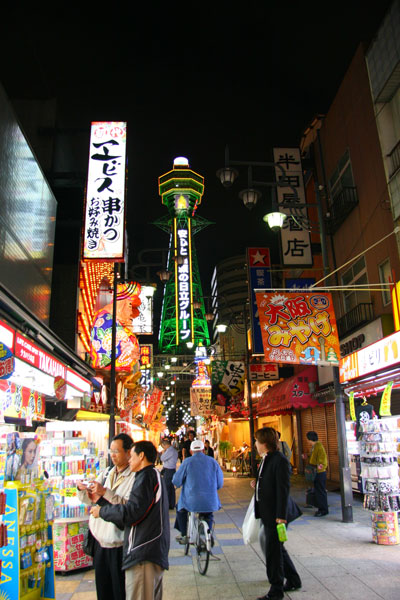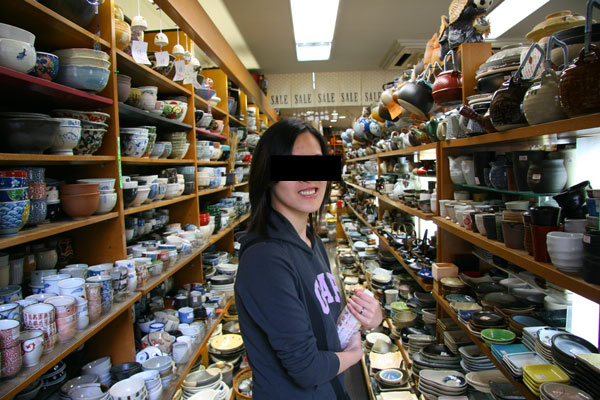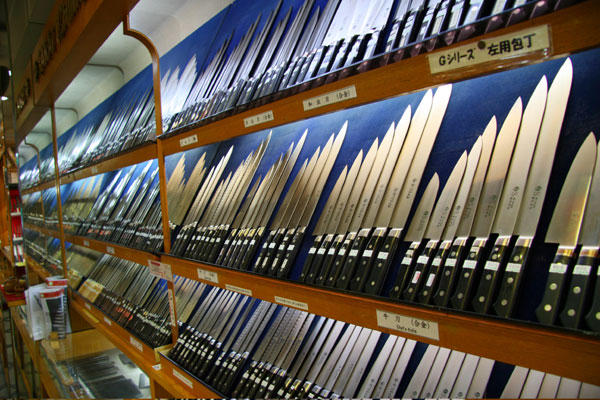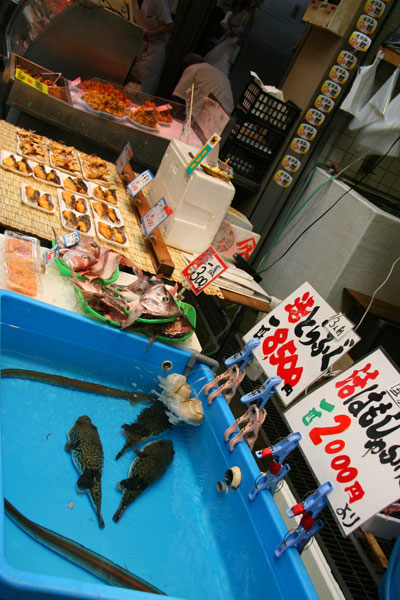
Osaka is a food lover's paradise by anyone's standard -- whether you come from New York, Paris or even Tokyo. In Japanese it is affectionately known as "Tenka no Daidokoro", or Japan's Kitchen, with legitimate reasons. I've never seen another Japanese city (or any city in the world, for that matter) with a higher concentration of eateries.
Note that I'm talking about "eateries", not bonafide "restaurants," as much of Osaka's favorite culinary creations began as peasant food at streetside stands. Today you can still find Takoyaki (octopus balls) stands on Osaka streets just about everywhere, but the Okonomiyaki (grilled pancakes), Doteyaki (beef brisket on skewers), Kushikatsu (deep fried skewers) and Ramen noodles have mostly moved indoors into specialized eateries.

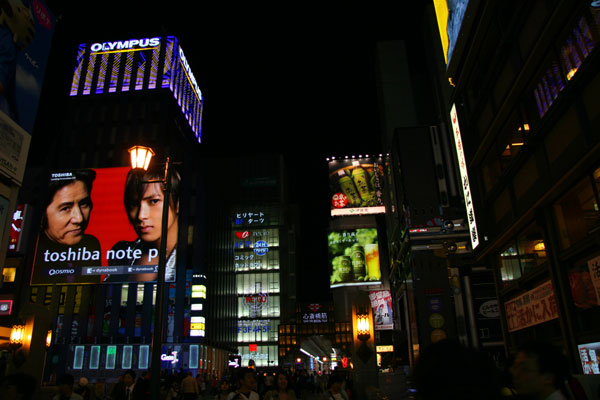
For foodies coming to try out the vibrant local food scene, south Osaka's Dotonbori is definitely the place to be. In Osaka, anyplace with the suffix "-hori" or "-bori" is typically a river or canal, and Dotonbori is a short stretch of canal slicing horizontally between two of Osaka's busiest entertainment districts, Shinsaibashi to the north and Namba to the south. The canal is lined with Osaka's most familiar sights such the Donkihote (Japanese pronunciation for Don Quixote) bargain store, with its elliptical ferris wheel. Note that it's not a 100-yen store, but a chaotic, multi-storeys supermarket / department store / 2nd-hand shop selling everything from shampoo to used Prada handbags.
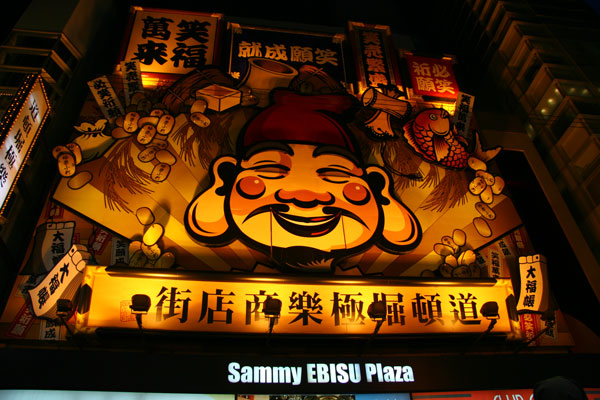
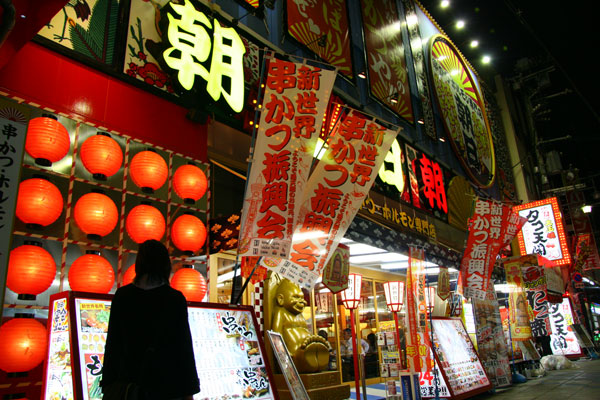
Dotonbori's main drag just south of the canal features the most colourful store fronts. This evil looking character belongs to the Dotonbori Gokuraku Shoten-gai (http://www.doutonbori-gokuraku.com/foreign/english.html), advertised as a food-related theme park decorated in the style of pre-war Osaka. Perhaps it's a fun place, but we chose not to pay 300 yen (CAD$3) just to access its list of restaurants since all we wanted at this time was an order of Takoyaki.

Hardly any tourist would leave Osaka without a picture of one of these giant claw-waving mechanized crabs, the mascot of the Kani Doraku restaurant. I specifically went to this restaurant's website (http://www.douraku.co.jp) to check out its seasonal menu before the trip, but I reasoned that later on this trip we will be going to the crab-producing region of Kanazawa where we can have our crab for cheap. So we managed to subdued the crab-lovers in ourselves and moved on.

Then there's the depressing story of Kuidaore-Taro, the mechanized drum-playing figure which had been a symbol of Osaka for half a century until 2008, when the restaurant announced closing its doors. The restaurant was still in the final months of operation during our visit, but most people just came to swarm around the figure for a souvenir photo. At present (June 2008) it's still undecided where Kuidaore-Taro will go next, but the hometown of Cuidaore restaurant's original founder in Hyogo prefecture is making a bid for it.
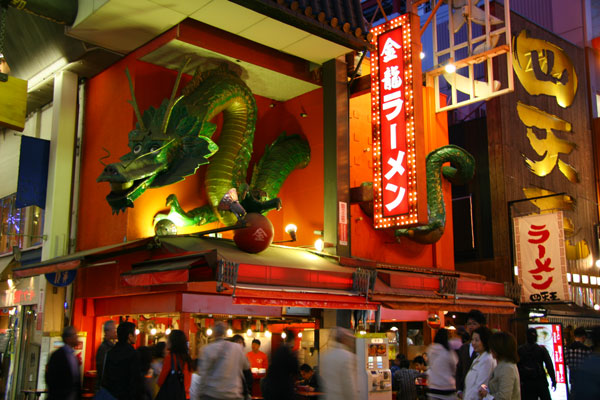
Hmm ... decisions decisions. This evening we decided to go for a good bowl of Ramen noodles, and at this particular stretch of the Dotonbori the choices are plenty. The most famous one is probably Kinryu Ramen (http://www.kinryuu.com), with its namesake "golden dragon" snatching the attention of the potential clients passing by. The soup-base is the typical Tonkotsu (pork bone) from the southern island of Kyushu, so it's not an Osaka invention. We did our research beforehand and picked another Tonkotsu Ramen specialist with a better street rep ...
FOOD REVIEW: ICHIRAN RAMEN (Dotonbori Branch)
Address: Osaka-shi Chuo-Ku Dotonbori 1-5-10
Hours: Daily 10:00-23:00 (according to Yahoo Japan)
Website/Map: http://www.ichiran.co.jp/pc/hp/tenpo/tenpo/doutonbori.html
Directions: Take subway to Namba station, take Exit 14 and walk to Dotonbori's canal side. Head straight to the big elliptical ferris wheel, and when you face the ferris wheel Ichiran Ramen is a few shops to the right, just before the bridge.
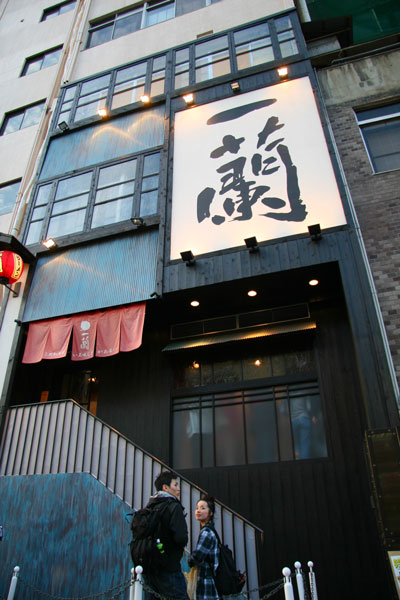
We decided to try this highly popular Tonkotsu (pork bone) Ramen chain originating from Fukuoka. Not an Osaka speciality, just very popular with Osakans. It was just past 6PM on a Sunday, and a line-up was starting to form.
The servers made us wait at the street level, and after about 10 minutes we were invited in ... only to buy our tickets at the automated vending machine and wait a bit more. I didn't see any English on the vending machine, so if you can't read any Japanese you'll probably have to ask for the servers' help. We ordered only two bowls of regular size noodles (650 yen) with half-boiled eggs (100 yen).
Five minutes later we finally got to the ... uh ... counter. You can see a photo from the official English website here, and frankly speaking the little divided booths makes me feel like visiting someone at a prison ... I prefer normal undivided counters or tables.
Next comes the order sheet, in Japanese. They probably have an English one according to their English website, though I haven't seen it at my booth. If you're planning on going and don't understand Japanese, I would recommend printing out the English order sheet here.
In case you're interested, we picked Strong Flavor, Rich Soup, Regular Amount of Garlic, Strong Green Onion (ie.the white stem), Roast Pork Fillet, Regular Amount of Secret Sauce, and Medium Tenderness for the noodles.

One of the BEST bowls of noodles (of any nationality) I've had. The roast pork was average, the egg was good, but the soup base was simply excellent. Incredibly rich and thick, dominated by the flavor or pork, and complimented by a zest of red chili. Better than any Kyushu style Tonkotsu soup I've ever had before. Just thinking about the soup brings slaver to my mouth.
The toppings though wasn't spectacular -- no bamboo shoots, no seaweed, and the pork comes from the shoulder cut, which is a little too lean for my taste. The presentation of the soft-boiled egg was surprising -- not as two halves of soy sauce flavored egg placed on the noodles, but as a shell-on boiled egg on a small dish on the side. What you see in the picture is after I peeled off the eggshell and took a bite. Sorry, I guess that's not the best presentation ... my bad.
Bill for Two Persons
| Ramen x 2 | 1300 yen |
| Soft-Boiled Egg x 2 | 200 yen |
| TOTAL | 1500 yen |
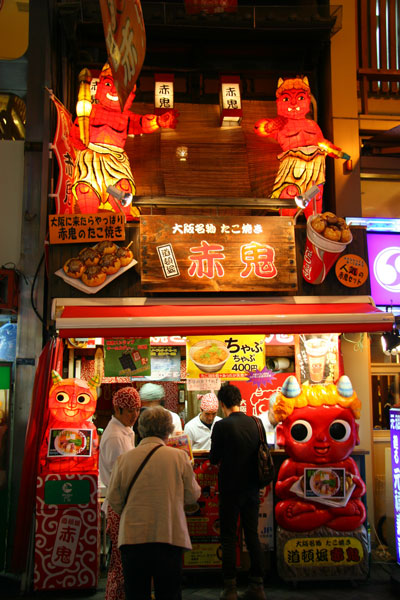
The ramen wasn't quite filling enough, so we headed back to the main street and passed by this Aka-oni ("Red Devil") Takoyaki stand, famous for its signature Takoyaki container that stacks on top of a soft drink cup, as illustrated in the little picture on the right of the store sign. 6 pieces of Takoyaki with a drink goes for 525 yen (CAD$5). But we didn't have our Takoyaki here, because our usual strategy of blending in with the locals is ...
... to find the place with the longest lineup!
FOOD REVIEW: HONKE OOTAKO
Address: Osaka-shi Chuo-Ku Dotonbori 1-5-10
Hours: Daily 10:00-23:00 (according to Yahoo Japan)
Website/Map: http://gourmet.yahoo.co.jp/0006712529/M0027002664/
Directions: Take subway to Namba station, take Exit 14 and walk to Dotonbori's main drag. Keep walking east until you see Kinryu Ramen's big green dragon on your right. Honke Ootako is diagonally across from Kinryu.
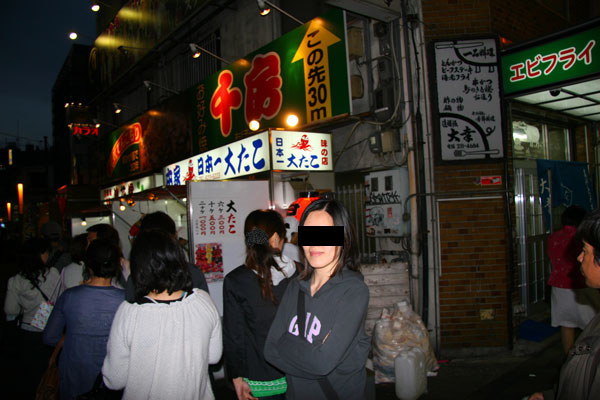
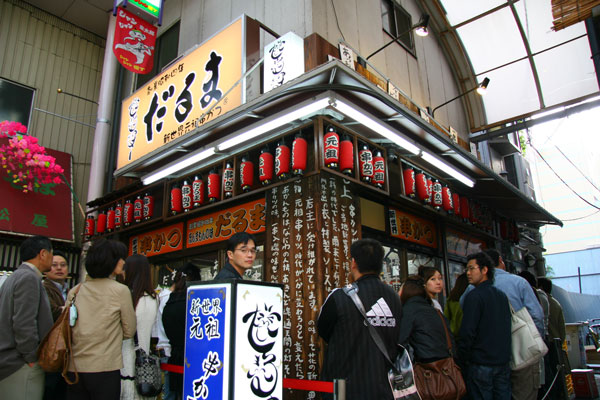
Well, it's about as Osaka as it gets, a take-out only Takoyaki stand in the heart of the Dotonbori. There were 20 people ahead of us when we arrived, but they have a staff member taking the pre-order from the queue, so the actual wait was only 5 minutes. Which is a good thing, since all the tall buildings somehow work in conjunction to channel the wind down to the canal level and it was freezing cold standing there even in May.
There's only one item on the menu, and only one flavor available. The only decision to make was 6 for 300 yen, 10 for 500 yen, or 20 for 1000 yen. Being already quite full from the Ramen, we ordered 6 to share.

So this is how it's made. The first guy works with the containers full of boiled octopus chunks, individually placed each chunk into one of the semi-spherical holes of the Takoyaki grill. Second guy uses a couple of little bamboo skewers to push the gradually drying batter towards the centres of the holes. And the third guy's job is the trickiest -- stabbing at each semi-cooked ball with his skewers to flip and ensure even grilling on all sides. No secret to it, just lots of practice.
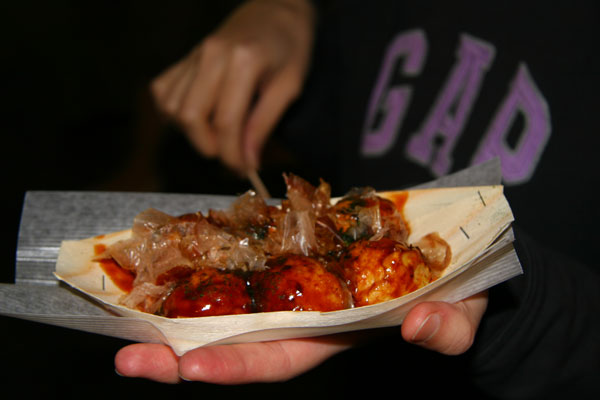
And here's the finished product -- actually pretty ordinary on first glance. Average amount of sauce, average amount of Katsuo-bushi shavings, a little powdered Nori, just what you'd expect at any anonymous takoyaki stand anywhere in Japan. Upon the first bite the skin was rather soft and chewy, which was opposite of what I expected (I personally prefer crisper skin). The filling was excellent though, with a creamy half-cooked sauce surrounding a huge piece of octopus about half the size of a thumb. That alone makes it a fairly good deal at 50 yen a piece, which is probably what the line up was all about.
Bill for Two Persons
| Takoyaki 6 pieces | 300 yen |
| TOTAL | 300 yen |
Food Review: SHODAI EBISU
Address: Osaka-shi Naniwa-ku Ebisu-Higashi 2-5-2
Hours: Daily from 10:00-24:00 (according to official website)
Website/Map: http://www.yebisu.cc/map/index.html
Directions: If you've fully read the story below and STILL want directions to this place, you're a brave guy and I'll give you good detailed directions. Take the subway to Dobutsuen-Mae station. Take Exit 1 and walk north, through the underpass, and then through the covered arcade. Once you come out of the arcade, walk straight until you see the big pufferfish lantern towards your left. Walk towards the lantern and turn right underneath the lantern. Shodai Ebisu is right next to the pufferfish restaurant (Zuboraya).

This is the place where the Yakuza (gangsters) came in to collect protection money, while we were munching on our Kushikatsu. Were we surprised? Very. Did we appreciate the experience? Definitely not. But we stayed in Osaka for three days and came across this by pure chance, so I suppose you can say we're "lucky", depending on how you look at it.
Now you must be thinking: we must have picked the crappiest little eatery in the roughest of all neighbourhoods -- after all Japan is supposed to be one of the world's safest countries. Well, I can assure you that we were in one of the most popular (to domestic tourists) sightseeing areas, on a busy pedestrian street, and sitting in a huge 200-seat restaurant. It just happened to be a bad time since it was raining outside, a little early (17:45) for dinner, and thus we were the only table out of 50 or so tables. I guess that made it a convenient time for the Yakuza to come in ... for a withdrawal.
Long story short: the four Yakuza-san were invited into the party room, a staff went out and came back with the money, and the visitors left visibly holding a small stack of cash. And the two of us, well, just minded our own business, trying our best to relax and enjoy ourselves during the 20-minute visit. A staff did come to our table to bow and apologize though, so I guess they're managing the situation the best they could.
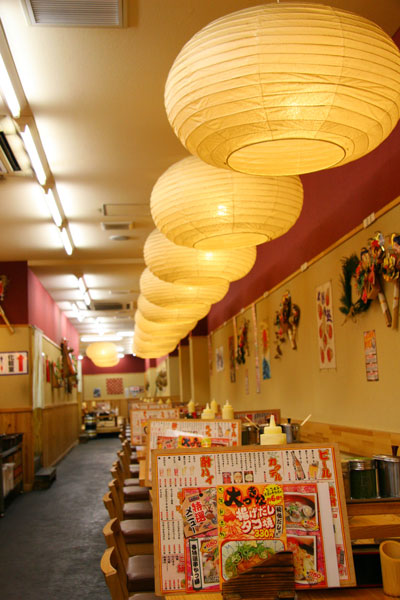
This is a memorable picture. Just right after pressing the shutter, the Yakuza-san came out of the party room and I had to scramble to put back the camera before they think I was photographing them. It was an anxious moment to wait for the four to walk past my back and out the front door.
Enough about the unexpected entertainment -- this is supposed to be a *food* review. The reason that we chose this particular restaurant for Kushikatsu (deep fried skewers), out of 15 or so others in the same area, was the we wanted to have Okonomiyaki (grilled pancakes) as well as Kushikatsu. Okonomiyaki is one of Osaka's signature dishes, and Kushikatsu is the signature dish of Osaka's Shinsekai district in particular.
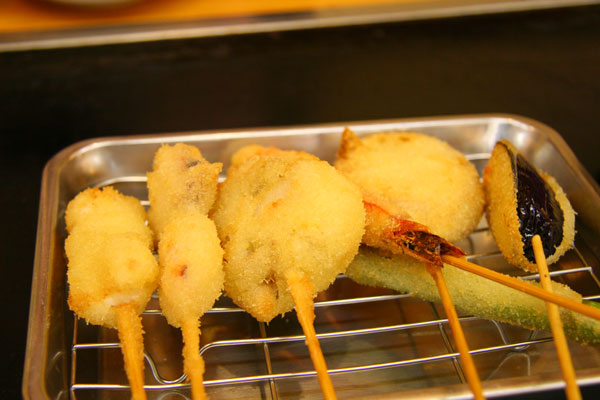
So here it comes, our first try at Kushikatsu at the birthplace of Kushikatsu. From the left: Octopus, baby squid, sea scallop, shrimp, yam, eggplant, and with an unskewered asparagus lying underneath. As you can see the crumb coating was very light, and the only flavoring was in the big steel container of Worcester-based dipping sauce available at every table. The sauce is likely shared by all guests, of past, present and future, hence there was a big sign that said "No Second Dipping" right above every table. Not an appetizing thought, but I guess we're eating like the locals now.
And the taste was actually quite good, better than what I expected of a random restaurant. In fact the sea scallop was excellent -- large, plump, and full of juices. The crunchy yam and asparagus were very good also.

Even though we had our eyes on other items on the menu, the Kushikatsu was so good that we ordered a second round -- two sea scallops and a chicken gizzard. Scallops were excellent again, and the chicken gizzard nice and crunchy. It was surprisingly good food at 100 to 200 yen (CAD$1-$2) per skewer.
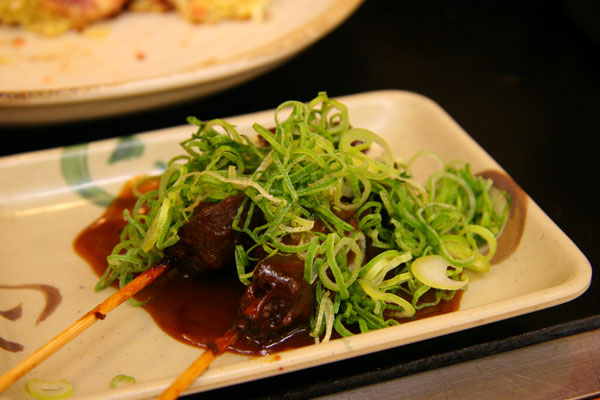
We then ordered another south Osaka specialty known as Doteyaki, which is beef sinew/brisket or whatever normally tough and cheap areas, slow cooked for hours and smothered in a thick, sweet miso sauce. The meat was still a little tough, and the sauce was rather strong, so I guess it serves its purpose as a beer snack. But on this dinner table there are a lot of better food.
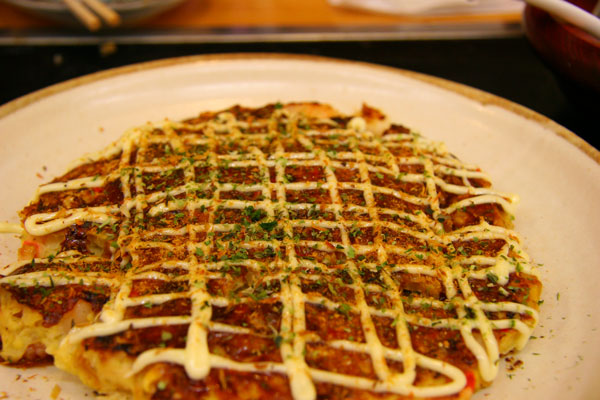
Finally the Seafood Okonomiyaki that we've been waiting for ... sort of ... I expected them to bring the ingredients to our table's hot-plate and let ourselves grill it. Perhaps they figured foreigners would appreciate this service. Oh well.
I should have at least taken a picture of it being cut open, as it was just packed with squids, scallops, shrimps and other goodies. I don't know if it's always like this, or if they're just making up for that Yakuza scare. But for 580 yen (CAD$5.8) that's an impressive amount of seafood. And the seasoning was just right -- not too salty, not too much vinegar, and not so much sauce that would overpower the delicate taste of the seafood.

We also ordered a bowl of Asari Sakamushi (steamed clams in wine broth). Again, surprisingly good for a large Izakaya-style place. I guess this is the advantage of being the only table.

We finished with an order of Nankotsu Karaage (deep fried cartilage), which is really the knee joints of chicken. Nothing spectacular about this dish.
Overall there were some excellent items and some average ones. Apart from the Yakuza thing, this was definitely an enjoyable meal with a good variety of Osaka's most representative dishes, and at a reasonable price of just over 2000 yen (CAD$20) per person.
So would I go there again? Well ... I think it would largely depend on how empty it is at the time ...
Bill for Two Persons
| Beer (medium bottle) | 550 yen |
| Squid | 130 yen |
| Octopus | 160 yen |
| Scallop x 3 | 630 yen |
| Shrimp | 250 yen |
| Yam | 120 yen |
| Eggplant | 100 yen |
| Asparagus | 210 yen |
| Chicken Gizzard | 120 yen |
| Doteyaki | 280 yen |
| Nankotsu Karaage | 450 yen |
| Seafood Okonomiyaki | 680 yen |
| Asri no Sakamushi | 504 yen |
| TOTAL | 4184 yen |
Hotel Review: HOTEL CHUO (Osaka)
Address: Osaka-shi Naniwa-ku Ebisu-Higashi 2-5-2
Price: 6500 yen for a Japanese-style double room with private bathroom
Website/Map: http://www.hotel-chuo.com
How To Book: Through official website
Directions: If you're arriving from the Kansai International Airport, take the Nankai railway and get off at Shin-Imamiya station. The hotel is two blocks to the east. Or if you're arriving from other parts of Osaka, take the subway to Dobutsuen-Mae station. Take Exit 1, and the hotel is to your left, within the same block.
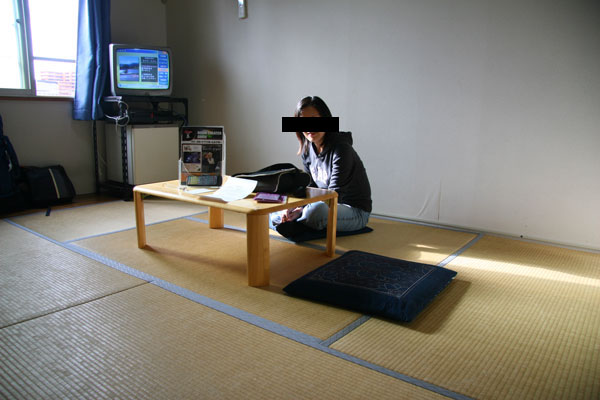
As far as Osaka goes, this is the cheapest it gets unless you're settling for share-bathroom facilities (in which case you can get by for about 2000 yen (CAD$20) per person per night). But this is one step-up, a Japanese-style tatami-floor room with a private, western style bathroom and toilet, complete with bath towels and bathing gel and conditioning shampoo that you would expect from a western-style hotel chain. There's a TV with about 10 channels (Japanese channels, so don't even ask about CNN), and you can borrow a hair dryer from the front desk for free. There's even a simple continental breakfast with bread and some pastries. What more can you want for 6500 yen (CAD$65)?

If you've never stayed in a Japanese-style room before, this is how it looks after you setup your beddings. Place the Futon mattress first (or stack 2 Futons, if you like it fluffier like my wife does), which will have a clean bed sheet attached to it already, then your pillow and blanket/duvet. That's it. Most people would put it away in the morning and bring the low table back to the middle of the room, but you don't have to if you're comfortable with watching TV on your Futon instead of sitting cross-legged around the low table. This room is 6-tatami mats in size, plus a small entrance area, the bathroom, and large closet area for hanging clothes and storing the Futons.

Another great thing is having a small fridge, which is not a common amenity in Japanese style rooms. So this evening we brought back my favorite brand of Japanese ice cream, Mayonaka no Zeitaku, and my wife's favorite non-carbonated drink Premium Calpis. And the Yebisu beer? Well, I still haven't found a Japanese beer to fall in love with.
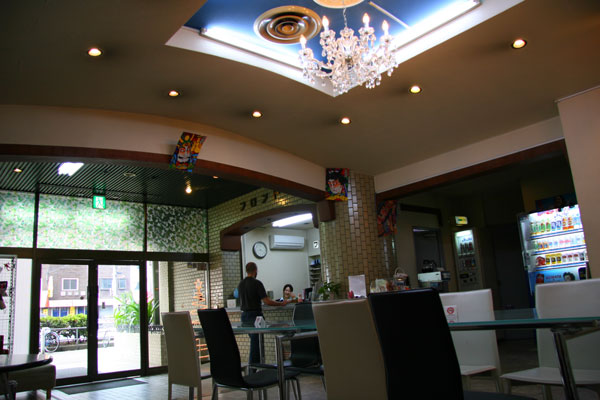
This is what the lobby looks like, with soft drink and beer vending machines, guidebooks and free tourist maps, and best of all, free Internet. There's also an adjoining laundry room with washers and dryers. Chatting with the receptionist here is a white guy, one of many foreigners I've seen over a few days. So it seems it's been well discovered by Gaijin.
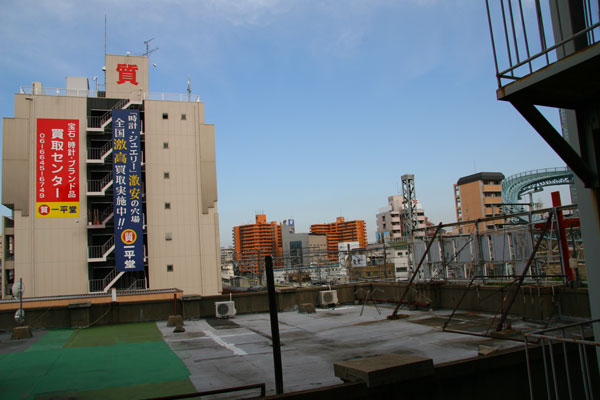
This is looking outside our window at the neighbourhood, which is probably the only aspect one can complain about. This is not the most affluent neighbourhood, and you'll see a few homeless people wandering outside the church next door. However we stayed for a few days and it's pretty safe even at night -- I'd rather be in Osaka than any North American or European city of this size.
However few hotels can beat its convenience of the subway station (Dobutsuen-mae) next door, JR train station (JR Shin-Imamiya) across the street, and direct access to Kansai International Airport from Nankai Railway's Shin-Imamiya station a couple blocks away. For me, the luxury of a hotel next to the subway station at the end of a long day is the ultimate appeal.