Pages

Monday, June 9, 2008

Osaka's Flamboyant Alleys


To me, Osaka is the Anti-Tokyo, in the same way that I consider Los Angeles to be the Anti-New York. No less metropolitan -- just entirely different. Osakans are less dressy than Tokyoites, stand on the opposite side of the escalator (standing on the right and walking on the left, like most of the world), and revere the aroma of caramelized Okonomiyaki sauce emanating from every street corner.
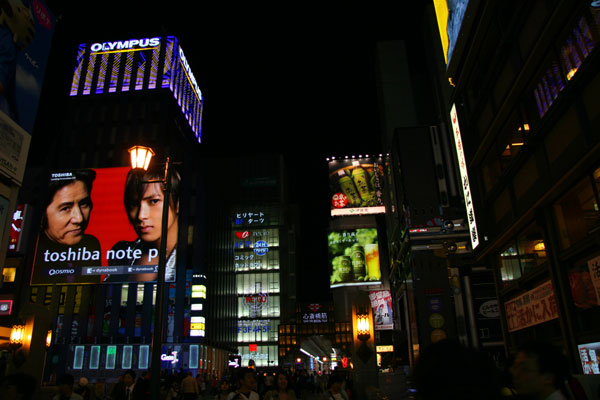


My favorite part of Osaka is the colourful, raucous alleys and semi-covered marketplaces known as Yokocho (side street). On any given day, droves of junior high students in blue and white school uniforms would brush past the washed-out facade of the neighbourhood Mahjong parlour while the oily smoke of Takoyaki (octobus balls) and Kushikatsu (deep-fried skewers) vendors compete for their business.
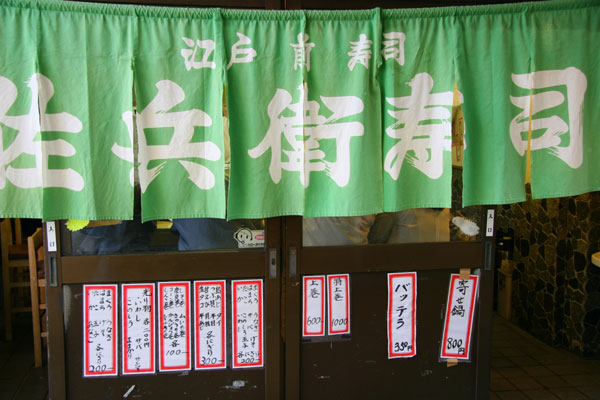

On any given day, you can find the old man occupying his favorite seat at the little sushi stall ...
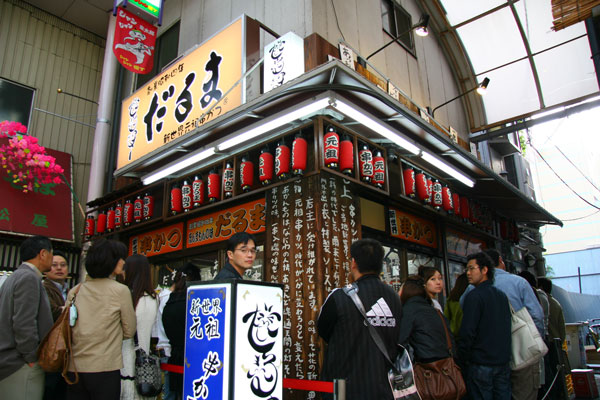

... the younger crowd lining up outside the Kushikatsu stand ...


... and the teenagers who don't even bother with the inconvenience of sitting down to eat.

It's the most wonderful place to people-watch, and it just doesn't get much more authentically Osaka than this.


The Old New World of Shinsekai


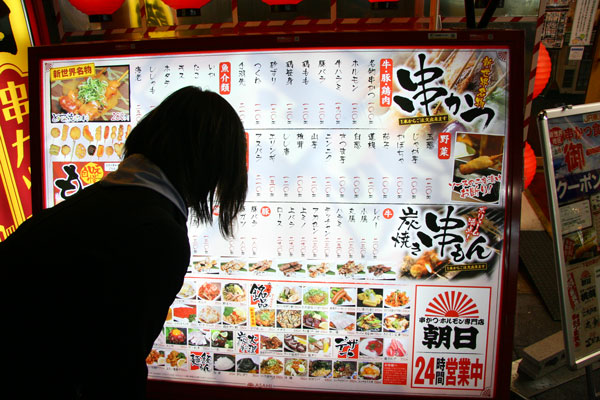
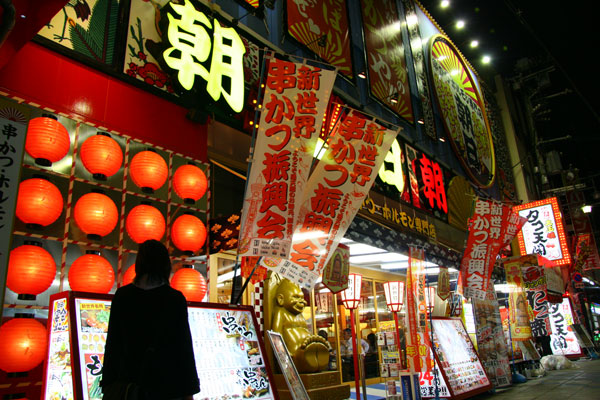
Our hotel happened to be situated right beside one such Yokocho (no, this wasn't in our plan), part of a much larger neighbourhood known as Shinsekai. Shinsekai literally means "New World", a rather ironic name for an old, somewhat nostalgic and cheezy entertainment district. The Pedestrian streets are semi-obstructed by the huge bright menus of Kushikatsu restaurants, and the rows of souvenir stands selling Hello Kitty/Doraemon/Ultraman heads in Kushikatsu skewers targeting domestic tourists and local students.
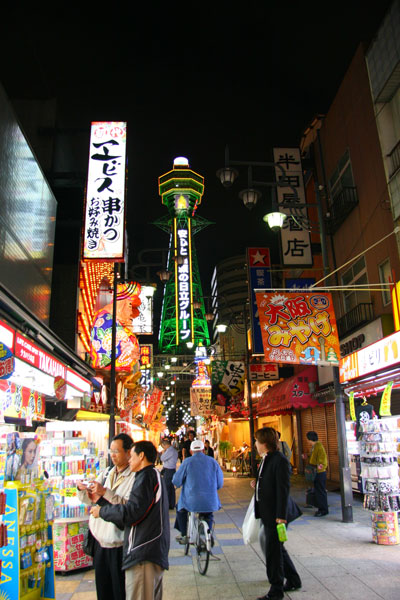

The south end of the area has spawned a large number of Pachinko parlours and cut-price business hotels (around 6000 yen (CAD$60) for a double room, and we stayed at one of them), while the north end stands THE symbol of old Osaka -- the Tsutenkaku (literally "Sky-reaching Manor"), which towers above its four-storey-tall neighbours in south Osaka yet no longer comparable to the cluster of skyscrapers at Umeda, Osaka's de-facto city centre just 5 kilometres to the north.


The Sankei Kurabu -- an old fashioned chess parlour -- would be a rare sight even for the Japanese. The sign at the top says "Shogi" (Japanese chess) and Igo (known in the Western world simply as "Go"). Note how jam packed it is even on a Monday afternoon. I wonder how it works ... how much money the players play for, and how the parlour operates (As a membership club? Or does it accept casual drop-ins?). All I could see were the player rankings on the walls and the signs for snacks like Kushikatsu and Doteyaki.


The original Zuboraya Honten, one of the most famous restaurants in Osaka specializing in ... well you don't need to be able to read Japanese to see what the speciality is. The huge Fugu (poisonous puffer fish) mascot is so well loved by the locals that you'll find all kinds of toys and souvenir items bearing its likeness. In case you're wondering, no we didn't have Fugu this time since May was not the best season -- the traditional season for Fugu starts in November or so, when the sea water temperature starts to drop. But the series of big white signs at the bottom of the picture advertising Tessa (Fugu sashimi) for 1200 yen (CAD$12) and Fugu Karaage (deep fried in batter) for 980 yen did make it a difficult decision for me. Fugu is an Osakan favorite after all, and I usually can't resist tasting the local food wherever I go.

You can read my review of a 6-course Fugu meal here, from my previous trip to Tokyo, if you're interested in having Fugu on your next trip.


At the end I couldn't resist the tempting pictures on the large outdoor menus of the Kushikatsu restaurants, so we walked around and proceeded to pick out restaurants that served BOTH Kushikatsu and Okonomiyaki (a kind of Japanese pancake with various toppings), two of the most representative local cuisines. We ended up picking this brightly lit restaurant with a huge menu list, and it turned out to be a VERY interesting experience. Surprisingly good food, spacious seats (actually the place was empty except for us), good service (which was expected since we were the only table). Everything went great until ...

The Yakuza (gangsters) walked in and demanded protection money! I am NOT joking ... the waiter had to come to our table to apologize to us afterwards. Four large-built males in early thirties came in and talked loudly at the waiters, who became very submissive. The manager wasn't in at the time, and the staff had to invite the visitors into the party room at the back. One of the waiters briefly went out (to get money? to fetch the manager?) and then rushed back. And at the end the visitors left, one of them visibly holding a small stack of cash.

Certainly not the kind of experience we anticipated, or welcome. But that is precisely one of the pleasures of travel. If you're STILL interested in my review of this restaurant's FOOD, it will be in the next article, entirely devoted to Osaka's local cuisines.

DIRECTIONS:

To get to Shinsekai, take the subway to the Dobutsuen-mae station, then just walk south. You absolutely can't miss the towering Tsutenkaku before you. The most interesting area, with the giant Fugu lantern and the high concentration of eateries and shops, lies to the immediate south of the Tsutenkaku.


Doguyasuji - More Than Just Kitchen Stuff


Whenever we go to Japan, my wife would demand that our itinerary includes a visit to one of these specialty "Dogu" streets for souvenir shopping. Tokyo has its 3-blocks-long Kappabashi Dogugai, and Osaka's equivalence is the Doguyasuji. Dogu simply means tools, so you can imagine that this is not a typical tourist street, but a place for food industry professionals and restauranteurs to order kitchen stoves, display cases, neon signs and the like. So what's so attractive about it?


Well, it's not just for the professionals -- you'll come across lots of really neat souvenirs you won't find anywhere else. There are a couple of these little shops selling handmade plastic food imitations. The price of 693 to 1029 yen for a piece of sushi is a little more expensive than what I remember of the same kind of stores in Tokyo. We didn't buy any this time -- we already spent enough last time (3000 yen) for a bowl of imitation ramen noodles.


Instead, this time we focused on Noren, or cloth dividers, which make beautiful decorations for the home. The sign here says 30% off regular price, but we're not really interested in these cartoon-looking ones.


We ended up buying this one for 3500 yen (CAD$35), shown here hanging in front of our kitchen.


If you've got a more colourful taste, you can take home a lantern made for Izakaya, Ramen, or Takoyaki vendors, fabric curtains for Sake vendors or lemonade stands, or a big Maneki Neko (fortune-beckoning cat) statue for good luck. Remember that the professionals shop here, so you're getting a good price on whatever you buy.
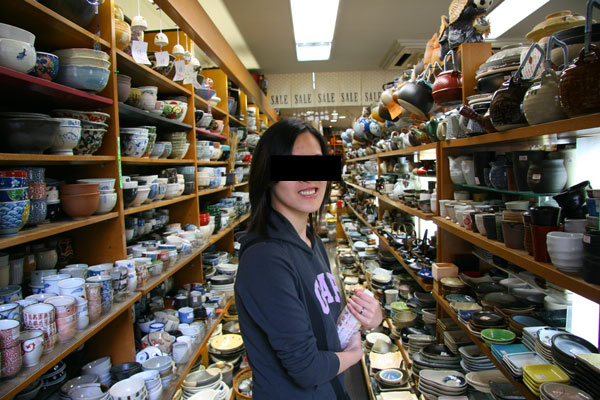

Bowls, cups, plates, teapots ... if you've got room in your luggage for some heavier items, the earthenware shops have handmade items from all over Japan. It was the beginning of our trip and we didn't want to carry heavy (and fragile!) items for the entire two weeks, so we relunctantly settled for chopsticks and chopstick setters. If it were the last day, crap ...
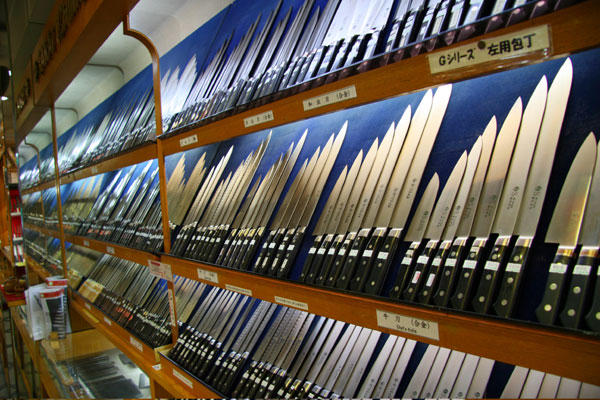

Japanese chefs are as serious about their knives as anyone, and if you've ever sat at the counter in front of a sushi chef, you'll appreciate how the metal's hardness affects the form of the food on your plate. So this is the place to be if you're interested in obtaining a better knife for your kitchen, even if you only use it for slicing breakfast sausages.


Well, there are serious knives, and then there are SERIOUS knives. And swords. And katanas. You can actually buy these real samurai swords, though you may have trouble getting through customs on your airplane back.

Whew. I must confess, I enjoy going to this place as much as my wife does.

DIRECTIONS:

Osaka's Doguyasuji is located conveniently just one block east of the Takashimaya department store in the popular shopping district of Namba. Take the subway to Namba, make your way southeast towards Takashimaya (write it down and ask anyone on the street...everyone knows Takashimaya). The Doguyasuji is at the next block to the east.

If you're going to Tokyo, Kappabashi Dogugai is located near the Tawaramachi subway station between the popular tourist districts of Asakusa and Ueno. Yes we've been there, and I remember it to be at least twice as long as Osaka's Doguyasuji, so happy shopping to you.


Kuromon Market - The Kitchen of Japan's Kitchen


One of Osaka's favorite nicknames is "Tenka no Daidokoro," or Japan's Kitchen, due to its position as the nation's major logistic hub and market centre for the past several centuries. By this rule, Osaka's largest market would be "Tenka no Daidokoro no Daidokoro." Without a doubt, the holder of this distinction would be the Kuromon Ichiba, the largest and favorite market of Osakans. Kuromon means "black gate," so you'll see black signs like these near the many entrances to the market.


The market itself is actually several blocks of covered walkway selling all kinds of fresh and cooked foodstuff, giving you a true understanding of what the Japanese REALLY eat, outside of restaurants. And you'll see that the market is appropriately dominated by vendors of vegetables, fish, and the wide varieties of Osaka's favorite snacks.


The local Miso (soybean paste) shop with its various kinds of Miso and Miso-derivatives. From the right: Amazake (sweet wine), "Spicy" and "Sweet" Kinzanji Miso and Moromi Miso (both are rather chunky types of Miso), and finally chunky white Miso used for marinating fish.
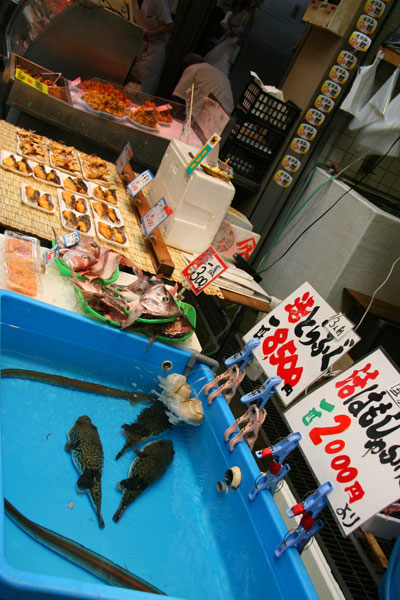

The chubby-looking fish is the famed Torafugu, one of the most expensive species of poisonous puffer fish. The small print says this size feeds three people, and sells for a whopping 8500 yen (CAD$85) each. For a less exquisite meal, Hamo (pike conger) sells for 2000 yen each. But for the typical house wife, you can't beat the price of 300 yen for a plate of random fish heads in those green containers in the middle.


For the lazier house wife, the tempura stand is an attractive option. Squid, squid tentacles, and sweet potatoes are 100 yen (CAD$1) each, a potato croquette costs 80 yen, and a large prawn costs 200 yen. Put a few of these in a toaster over and it's a cheap, fast meal.
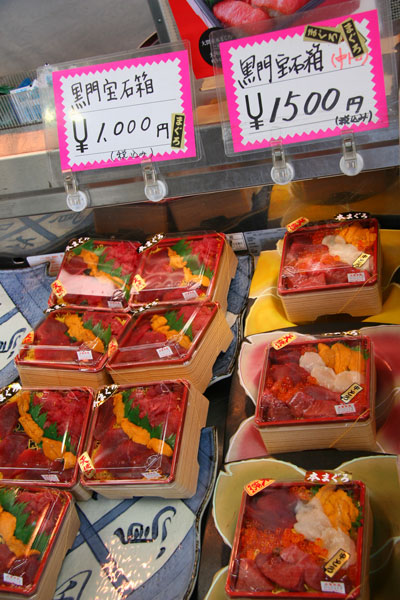

And for the really lazy ones, there's always ready-to-eat seafood rice boxes. 1000 yen (CAD$10) for the regular box with lean tuna, and for 500 yen more you get an upgrade with Chu-Toro (medium fatty tuna). Though, judging by the colour it doesn't look very fatty.


On a side street just outside the market, an old lady starts working on another cut at her grilled fish stand. Featuring prominently on her menu is "Yaki-dai", or grilled snapper. Note that if the two characters are swapped, "Tai-yaki" becomes baked snapper-shaped cake (which you can also find inside the market).


And of course, any Yokocho in Osaka won't be complete without a Takoyaki stand. The price of 300 yen (CAD$3) for 8 of these octopus balls is relatively cheap, as the going rate at the more famous chains is about 300-400 yen for 6. The 200 yen sign is for "tasty juice" (doesn't say what varieties of juice though), in case you're wondering.


Too bad we already had lunch, so we settled for some traditional Japanese confections. My wife's favorite is the simple Daifuku on the right, with its sweet azuki bean filling inside a mochi-rice dough. The one wrapped in an oak leaf is Kashiwa-mochi (literally "oak cake"). I don't remember much of the taste, so it couldn't have been that good.


DIRECTIONS:


The Kuromon Market is immediately southeast of the Nihombashi subway station. Even if you miss the English signs, you'll find it just by following the legions of house wives. Or if you're going to the Doguyasuji as well, it's just three large blocks to the east of the Doguyasuji.

Tuesday, June 3, 2008

We're Back from Japan


I'm still a little groggy from the 15-hours time difference, but yes we're back. Not everything turned out as planned, and the second week was rather tiring since we had to move to a different town every morning, but it was still a great half-month trip. In fact, I think we covered probably half of the places I really want to see over the entire Japan.


One of the highlights was renting our own traditional Kyoto style "townhouse" (Machiya) for three nights in Kyoto. The house was old, creaky, but it was a 90-something-year-old house built in the traditional style, with its sliding screen doors and raised floors and plaster walls and shades flowing in the wind. We cooked breakfast in a Taisho-period (~1912) kitchen, bought from the neighbourhood 100-yen shop, washed our own clothes by hand and dried them over a clothesline in our little courtyard. For three days we became typical Kyoto residents, and THAT was very special.


Another highlight was the two nights we spent under the thatch roofs of the giant farmhouses in Gokayama and Shirakawago. This is a World Heritage site surrounded by the mountains of Central Japan, often snowed-in and separated from the outside world during the winter. In the cold mornings of late spring, we sat around the square fireplace (Irori) with the host family, who served us rice grown from their own field in front of the house. It was an interesting, rustic experience for city people like us. And towards the end of our trip, we followed the footsteps of feudal era travellers and hiked part of the ancient highway between Tsumago-juku and Magome-juku, staying in the centuries-old traditional inns at both ends.


At the end we brought back more than 3000 photos, so we have lots to share. Among the stories I will be sharing are:

- Osaka's vibrant food culture
- Kanazawa's unbelievably fresh seafood
- the famous Kobe Beef, and how it compares to the Matsuzaka Beef we've had before
- Hida Beef, which is also very famous
- Deep Fried Grasshopper (I didn't go look for it .... it just happened to be on my plate)
- Horse Meat in Matsumoto
- a visit to Uji, the Green Tea (and Green Tea Dessert) capital of Japan
- Kyoto style sushi ... and how it's entirely different from what we get outside Japan
- Comparison between Osaka, Nagoya, and Tokyo style broiled Unagi (freshwater eel)
- a traditional Tofu meal ... how do they turn a simple ingredient into 12 courses?
- a real Open-Air Hotspring bath in the wild
- the National Park at Kamikochi
- Two of Japan's most beautiful castles: Himeji and Matsumoto
- Kyoto's visually stunning Aoi Matsuri festival
- lots of nice pics from Kyoto, Nara, Takayama, Kanazawa etc
- and of course, a Trip Preparation guide to help anyone planning a similar trip


As you can see, that's a lot of topics to cover, and will probably take several months. But I will try to stay disciplined and resume regular postings starting next week, once I have sorted out these several thousand photos. Give me some time, but I'm going to do it!

Saturday, May 3, 2008

Last Update Before the Big Trip!


We're leaving for Japan in less than a week, woohoo! So this is the last update before we go.

We still haven't received confirmation of all our accommodation places yet! I'm still waiting for my first choice accommodation in Kyoto for a reply. But the rest are all booked. It wasn't easy, as I had to brush up my Japanese to write emails to the Japanese Ryokans and the local tourist associations in order to book some of the more traditional places. I even had to ***FAX*** a booking request to one of the villages as they still don't have email.

So it took some extra effort, but I think it will be worth it. Our final itinerary is:

Day 1: Kansai Int'l Airport - Osaka
Day 2: Osaka
Day 3: Osaka - Himeji - Kobe - Osaka
Day 4: Osaka - Nara - Uji
Day 5: Uji - Kyoto (Aoi Matsuri festival)
Day 6: Kyoto (Northern Hills + Arashiyama)
Day 7: Kyoto (Higashiyama)
Day 8: Kyoto - Kanazawa
Day 9: Kanazawa - Gokayama
Day 10: Gokayama - Shirakawago
Day 11: Shirakawago - Hida Takayama
Day 12: Hida Takayama - Kamikochi - Okuhida Onsengo
Day 13: Okuhida Onsengo - Matsumoto - Tsumago
Day 14: Tsumago - Magome
Day 15: Magome - Nagoya - Centrair Airport

So that is the big plan, a 15-Day trip concentrating on a small geographical area roughly 300 KM in diameter. About the distance from New York to Washington, or Paris to Brussels. But in my opinion these regions of Kansai (Kyoto-Osaka-Kobe) and Chubu (Central Japan) are the most culturally and culinarily interesting regions of Japan.

As usual I'll come back with photos and commentary. And of course the food pics!

Saturday, March 29, 2008

Japan - 15-Day Slow Trip Thru West-Central Japan

This is the INDEX PAGE of our 2nd Japan Trip, with links to approximately 30 posts covering a wide region.

Presented here is a self-guided trip through Kyoto, Osaka, Nara, Kobe, Uji, Himeji, Nagoya, Kanazawa, Hida Takayama, Shirakawago, Matsumoto, Kamikochi, Tsumago, Magome and more, with in-depth focus on regional food and local culture.


Broiled Unagi with a Twist - Nagoya's Hitsumabushi
Click HERE to Enter


Traveling the Ancient Nakasendo Highway - Part 4: Magome-juku
Click HERE to Enter


Traveling the Ancient Nakasendo Highway - Part 3: the Hike towards Magome
Click HERE to Enter


Traveling the Ancient Nakasendo Highway - Part 2: Tsumago-juku
Click HERE to Enter


Traveling the Ancient Nakasendo Highway - Part 1: Narai-juku
Click HERE to Enter


Curious About Horse Meat in Matsumoto
Click HERE to Enter


Hotspring Hopping in Oku-Hida Onsengo
Click HERE to Enter


A Day-Trip to the National Park at Kamikochi
Click HERE to Enter


Hida Takayama - Restaurant and Hotel Reviews
Click HERE to Enter


Wish We Had More Time in Hida Takayama!
Click HERE to Enter


Shirakawago - Guesthouse and Restaurant Reviews
Click HERE to Enter


The Photographer's Paradise of Shirakawago
Click HERE to Enter


Gokayama - Japan's Shangri-La in the Mountains
Click HERE to Enter


Kanazawa - Restaurants, Budget Hotel and Transportation
Click HERE to Enter


Kanazawa - the Beauty of Japan's Other Side
Click HERE to Enter


The Ultimate Kyoto Experience - Renting the Eco-House Machiya
Click HERE to Enter


Northwest Kyoto's Hidden Gems
Click HERE to Enter


Kyoto - Restaurant Reviews
Click HERE to Enter


Kyoto - Practical Trip-Planning Mini-Guide
Click HERE to Enter


Festive Kyoto - the Aoi Matsuri
Click HERE to Enter


Savouring the Tea Capital of Japan - Uji
Click HERE to Enter


Nara: Part 2 - The Insider's Nara
Click HERE to Enter


Nara: Part 1 - The Tourist's Nara
Click HERE to Enter


Kobe Beef in Kobe -- A Step-By-Step Photo Sequence
CLICK HERE to Enter


Taking the Long Way up Himeji Castle
CLICK HERE to Enter


The Old Master of Osaka Style Broiled Unagi
CLICK HERE to Enter


A Random Review of Osaka's Local Cuisine
CLICK HERE to Enter


Osaka's Flamboyant Alleys
CLICK HERE to Enter


We're Back from Japan
CLICK HERE to Enter

PRE-TRIP POSTS

Last Update Before the Big Trip!

Tentative Itinerary

Kansai Wins the Poll -- We Will Go To Kansai!

Sunday, February 3, 2008

Tentative Itinerary

We've come up with a tentative itinerary for our upcoming trip to Japan. For this half-month trip, we're going to spend a week in the Kansai region, then a week in Central Japan. Our travel agent has booked us Cathay Pacific flights that will take us in from Osaka, then out from Nagoya.

We'll try to book Tatami (straw mat flooring) rooms for all 14 nights. This is not going to be a cheap backpacking trip, but we'll try to keep accommodations below 10,000 yen (CAD$100) per night. Is this realistic? Come back later and check our cost run-down!

As for the FOOD, you know we're not gonna cheap out. In our usual tradition we'll try to bring back photos of the local fare wherever we go. I've even made a list of them...

DESTINATIONEATDO
OsakaKansai speciality snacks (takoyaki, okonomiyaki etc)Can't find anything we're really interested in seeing ... walk around Shinsaibashi and Umeda maybe
HimejiAnago (sea eel) is the local specialtyHimeji-jo, a 17th century castle and World Heritage Site
KobeKobe beef! Can't wait to compare Matsuzaka beef to Kobe!Kobe Harbour maybe ... not really interested in seeing the old foreigner district
NaraTofu? Kansai-style sushi? Mmm...All the sights around Nara Park; Historical streets of Nara Machi
UjiThis is the Tea Capital of Japan. Tea, Tea Noodles, Tea Ice-Cream ...Byodoin (the temple on the back of 10-yen coin), 500-year-old tea merchant stores
KyotoElegant Kyoto-style sushi, then peasant fares like Tonkatsu and Oyakodon etcAoi Matsuri (May 15th, one of the three major festivals of Kyoto), one day in Higashiyama, one day in Saga Arashiyama
KanazawaSashimi! Sushi! And everything from the Sea of Japan coast!Kenroku-en (one of Japan's "Three Famous Gardens"), traditional streets in Higashi Chaya-gai, Gold-leaf merchants
Shirakawago and GokayamaWhatever local cuisines the inn keepers serveTwo nights living under the giant thatched roofs of the 18th century farm houses
Hida TakayamaHida Beef, not as famous as Kobe or Matsuzaka but rumoured to be as good, especially raw or cooked in Miso ... Feudal townscape from 18th century, and the famous parade floats
Okuhida OnsengoOkuhida means "inner Hida", so probably more Hida BeefOpen-air hotspring pools ... ahhh!
Kamikochi (if weather permits)Doesn't matter ... it's a half-day trip in a National Park anywaySupposed to be a beautifully pristine place ... we'll see
MatsumotoHorse meat specialties, especially Basashi (horse sashimi)Matsumoto-jo, the complete opposite of Himeji Castle and another one of the "Four National Treasure Castles"
Tsumago and MagomeWhatever our inn serves ... but river fishes are supposed to be the focusFollow the footsteps of feudal-period travelers and walk the ancient mountain highway from Tsumago to Magome, spending two nights in the centuries-old wooden inns
NagoyaEither Chubu-style eel on rice (hitsumabushi) or roasted chicken wings ... whatever we come across firstNothing really interests us ... Atsuta Jingu maybe


Well this is the current plan anyway. We're not sure if this is a realistic plan since that's a lot of places for half a month. Still three months to go so perhaps our plan will change. We'll keep you posted if we change our minds!

Budget? We're thinking roughly CAD$1800 per person, excluding airfare. That should include all food, accommodation, transportation and entrance fees to museums and temples. Though it's a little tight given our forever expanding food budget ...

Wednesday, January 30, 2008

Kansai Wins the Poll -- We Will Go To Kansai!

We have a winner!


(Picture by Daniel Bachler, copied under the Creative Commons license)

A couple months ago I asked our readers to cast their votes for which region of JAPAN we should take our Food Trip to this year. The final results are as follows, as of 12:00AM PST, Feb 1, 2008:

Region# of Votes
Kyushu (Pork Bone Ramen!)3
Kansai (Tea, Tofu, Kobe Beef)18
Central Japan (Seafood, Miso, Hida Beef)5
Northeast (Beef Tongue, Noodles)1
Hokkaido (Seafood)14


So you have spoken, and we will keep our promise. We will go to Kansai this year! And we will bring back our restaurant reviews and other useful info.

Hokkaido placed a close second, but it seems Kobe Beef and the ancient capital of Kyoto was more popular among readers. Along with Kansai, I am also considering extending our tour to one neighboring region. I'm considering either Western Honshu (Hiroshima's Atomic Dome and Itsukushima Shrine, Izumo's Grand Shrine etc), or Central Japan (Thatched-Roof Village of Shirakawago, Hida Takayama, Hiking the Ancient Mountain Highway in Kisoji etc). I will make a decision within the next couple of days, and I'll post the decision here ASAP.

Thursday, October 25, 2007

Where should we go? YOU DECIDE!

PLEASE VOTE ... where in JAPAN should we go next?

More than 5000 visitors so far have shared our memories of the great fun we had on our Tokyo Food Trip. So fun that we're deciding to do it again!

Please vote before Jan 31, 2008. We'll take votes into consideration to decide where to take our next JAPAN FOOD TRIP!

ARCHIVE OF PAST TRIPS:

Tokyo Food Trip: 8-Day Self-Guided Gourmet Tour

Click HERE to Enter


Central Europe: 12-Day Self-Guided World Heritage Tour

Click HERE to Enter


Firenze-Milano: 8-Day Food Pics

Click HERE to Enter